


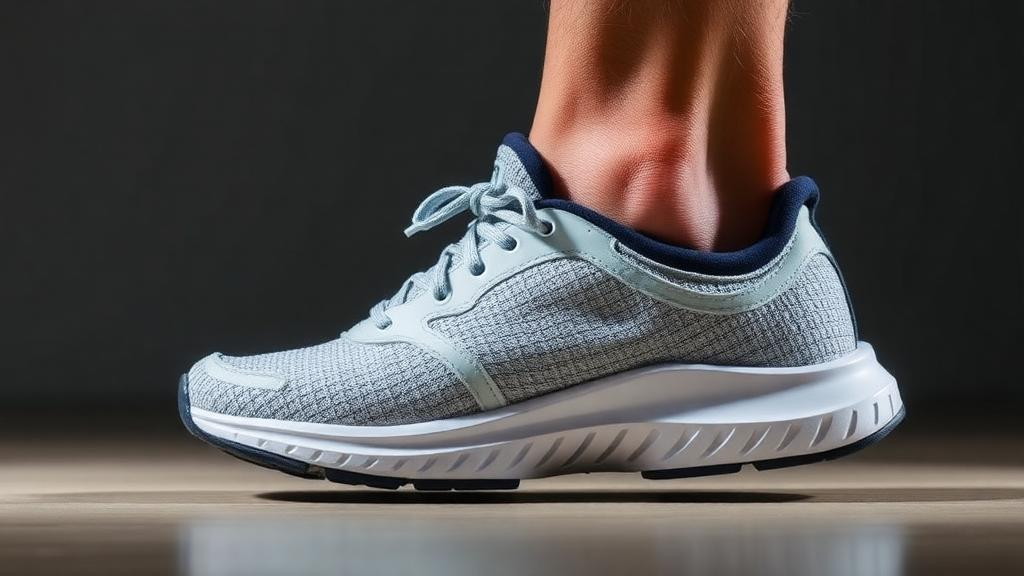
Every runner knows the feeling of a shoe that seems to change character from stride to stride, cushioned on one landing and firm on the next. A new study suggests that some of that variability may not be in the runner at all, but in the shoe itself. Researchers at Massey University in New Zealand, working with the New Balance Sports Research Lab, have shown that the mechanical cushioning of a running shoe midsole depends strongly on the angle at which the shoe is loaded, a finding that challenges the way footwear cushioning is measured in laboratories around the world.
The study, published in the journal Sports Engineering, set out to answer a deceptively simple question: does a running shoe behave the same way when it is compressed straight down as it does when it is compressed at the angles produced by real foot strikes? Standard test methods, including the widely used ASTM F1614 protocol, prescribe uniaxial loading in which the shoe is squeezed perpendicular to its sole. Yet runners rarely land that way. Rearfoot strikers contact the ground heel-first with the sole inclined roughly 16 to 20 degrees above horizontal, while forefoot strikers land on the ball of the foot with the sole tilted about 15 to 19 degrees in the opposite direction. Those angular differences change which part of the midsole absorbs the load and how much foam is engaged.
To capture this, the team tested six women’s US size 8.5 running shoe constructions that differed in midsole material, hardness and stack height. Two commercial New Balance models, the 880 with a 34.5 millimetre stack and the 1080 with a 40.5 millimetre stack, provided the basis for constructions built on production tooling, meaning the midsoles were representative of retail footwear. The materials spanned the two foams that dominate the modern market: ethylene-vinyl acetate, or EVA, the long-standing workhorse valued for cushioning, durability and low cost, and polyether block amide, or PEBA, the high-resilience superfoam behind today’s performance racing shoes. PEBA was tested at two hardness levels, 37 and 50 Asker C, while EVA was available only at the harder 50 Asker C grade.
Each shoe was fitted over a rigid mechanical last shaped to a size 8.5 foot and mounted on an Instron ElectroPuls E3000 testing machine. The last could be rotated about its transverse axis, allowing the researchers to load the shoe at three orientations: 15 degrees of dorsiflexion to mimic a rearfoot strike, a neutral 0 degrees for a midfoot strike, and 15 degrees of plantarflexion for a forefoot strike. Every cycle ran from a 50 newton preload to a peak force of 1500 newtons, roughly 2.5 times the body weight of a 60 kilogram runner, applied as a sinusoidal waveform at 1.5 hertz under closed-loop force control. Because the waveform shape and peak force were held constant, orientation was the only loading variable that changed. Each shoe received 30 preconditioning cycles before testing, and 25 cycles were recorded at each orientation, with the first five discarded to let the foam settle after repositioning.
From the force-displacement data the researchers extracted three outcomes. Vertical stiffness was calculated as the gradient of the loading curve between 70 and 90 percent of peak force, a range that avoids the nonlinear toe region at low loads and the densification zone near maximum compression. Peak displacement was the compression recorded at peak force. Energy return percentage was the energy recovered during unloading, obtained by trapezoidal integration, expressed as a fraction of the energy absorbed during loading. After removing 17 outlying cycles, or 4.7 percent of the dataset, by an interquartile range rule confirmed by curve inspection, 343 observations remained for statistical modelling.
The results were striking in their consistency. In every single shoe construction, stiffness was lowest under dorsiflexion, the rearfoot-strike orientation, and peak displacement was highest under the same condition. Compared with neutral loading, dorsiflexion reduced stiffness by 72 newtons per millimetre in the material-comparison model and increased peak displacement by 8.6 millimetres. Plantarflexion produced the same pattern of softer, deeper compression but with smaller magnitudes, a 37 newton per millimetre stiffness reduction and 2.4 millimetres of extra displacement. In the second model, comparing soft and hard PEBA, the orientation effects were smaller for stiffness but nearly identical for displacement, at 8.3 and 2.3 millimetres. All of these effects were statistically significant.
The physical explanation lies in contact geometry. When the shoe is tilted relative to the applied load, the region and volume of foam engaged during compression change, reducing the amount of material available to support the force. With less foam doing the work, the midsole compresses further under the same load. Dorsiflexion produced the larger effect, which the authors attribute to the reduced contact area associated with angled loading on the curved rearfoot geometry. The findings extend earlier work by Mohammadi and Nourani, who reported that compression angle affected strain energy in EVA soles, and they align with the observation that rearfoot and forefoot strikers load different regions of the midsole during running. In other words, the orientation effects observed in the laboratory are mechanically relevant to what actually happens on the road.
Energy return told a different story. Of the three outcomes, it was the least sensitive to loading orientation, and most of its variance was explained by differences between shoe constructions rather than by the angle of loading or the number of cycles. In the material comparison, the contrast between EVA and PEBA accounted for a large share of the variance, with PEBA showing a non-significant trend toward higher energy return and significantly greater peak displacement. In the PEBA hardness comparison, hardness itself explained very little, suggesting that the differences between soft and hard PEBA shoes reflect features other than durometer, possibly including geometry or microstructure that the study did not characterise. This supports the researchers’ hypothesis that energy return, being rooted in material-level properties, would remain relatively stable across orientations.
The study also documented a subtle but important drift across the 20 analysed cycles. Peak displacement and energy return changed slightly and linearly with successive loading cycles, meaning that the value measured depends on how many cycles precede the measurement. A standard single-orientation, fixed-cycle test captures neither this cyclic drift nor the orientation sensitivity, so it may not represent the stiffness and displacement a runner actually experiences. The authors are careful to note that the standard test remains a useful benchmark, but they argue that a fuller characterisation of running-relevant loading requires more than one orientation and a stated cycle count. Because rearfoot cushioning properties are known to influence vertical ground reaction forces during heel-toe running, the orientation-dependent differences could carry biomechanical consequences in actual use.
The researchers acknowledge several limitations. Only one shoe was tested per material-hardness-stack-height combination, so manufacturing variability could not be assessed, and with just two constructions per group the between-group comparisons are exploratory. The constant 1500 newton peak force does not capture the variation in ground reaction forces across running speeds and body masses, the three tested orientations approximate but do not span the continuous spectrum of real foot strike angles, and each material was represented by a single density, so material and density effects could not be separated. Foam cell structure was not characterised, and stack height was compared between two shoe models whose other differences cannot be fully disentangled. Future work, the authors suggest, should test whether the orientation effects translate into measurable biomechanical changes during running, examine loading frequencies given the viscoelastic nature of midsole foams, extend cyclic testing to see whether orientation effects persist as foam ages, and replicate across multiple shoes of the same construction. For now, the message for the footwear industry is clear: a shoe tested only straight down may not behave the way it does when a runner lands on the heel or the forefoot, and multi-orientation testing offers a more honest picture of how midsoles actually cushion the millions of angled impacts that running delivers.
Subject of Research: Effects of loading orientation on the mechanical cushioning properties of running shoe midsoles
Article Title: Mechanical cushioning properties of running shoe constructions across loading orientations
Article References: Scherrer, D., Legg, K. A., Rogers, C. W., Gottschall, J. S., & Cochrane, D. J. (2026). Mechanical cushioning properties of running shoe constructions across loading orientations. Sports Engineering, 29(2), Article 33. https://doi.org/10.1007/s12283-026-00567-2
Image Credits: AI Generated
DOI: 10.1007/s12283-026-00567-2
Keywords: running shoes, midsole, cushioning, EVA, PEBA, foot strike, stiffness, energy return, biomechanics, mechanical testing, stack height, sports engineering
Cite Scienmag News
Denise Maddox. (October 6, 2026). Your Running Shoes Soften When Your Foot Tilts, Lab Tests Reveal. Scienmag. https://scienmag.com/your-running-shoes-soften-when-your-foot-tilts-lab-tests-reveal/
Denise Maddox. "Your Running Shoes Soften When Your Foot Tilts, Lab Tests Reveal." Scienmag, 6 October 2026, https://scienmag.com/your-running-shoes-soften-when-your-foot-tilts-lab-tests-reveal/. Accessed 6 October 2026.
Denise Maddox. "Your Running Shoes Soften When Your Foot Tilts, Lab Tests Reveal." Scienmag. October 6, 2026. https://scienmag.com/your-running-shoes-soften-when-your-foot-tilts-lab-tests-reveal/


