


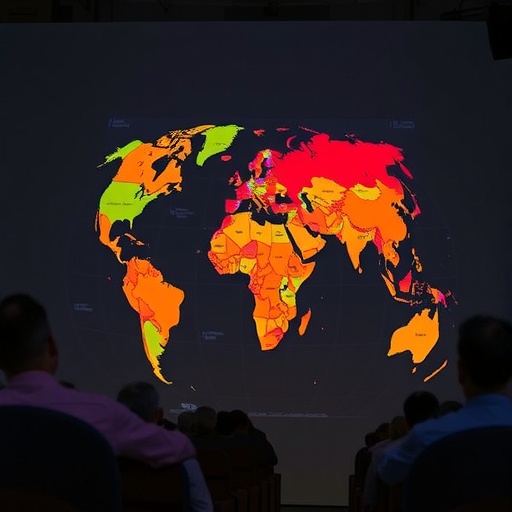
A recently published investigation in the esteemed journal Nature Communications reveals compelling insights into how education shapes cultural alignment on a global scale. This international study conducted by psychology experts from York University, London School of Economics, and New York University, elucidates the profound influence of higher education in orienting individuals’ cultural values towards those prevalent in Western, industrialized societies such as Canada, the United States, the United Kingdom, and Western Europe. Utilizing an unprecedented dataset of nearly 270,000 participants spanning 95 diverse nations, it underscores the implications for social sciences and cross-cultural research methodologies.
The cornerstone of this research lies in the extensive analysis of responses drawn from the World Values Survey, one of the most comprehensive global datasets addressing human values and beliefs. Key findings illustrate a strong correlation between higher education and the adoption of cultural traits characteristic of “WEIRD” societies—a term acronymically denoting Western, Educated, Industrialized, Rich, and Democratic populations. This connection persistently emerges regardless of the geographical origin of the study subjects, revealing an overarching Western influence embedded within educational systems worldwide.
Such findings have critical ramifications for researchers relying on university student populations as proxies for their national cultures. Lead author Assistant Professor Cindel White, affiliated with York University’s Department of Psychology, explicitly cautions that comparisons drawn exclusively from highly educated cohorts risk overlooking the substantial cultural heterogeneity unobservable within these ostensibly homogeneous groups. The education-induced convergence toward Western norms may obscure genuine cultural distinctions, thereby skewing research conclusions about cultural variability.
Interestingly, the study contests classical modernization theories which loosely tie socioeconomic factors such as income and social status to cultural transformation. Contrary to these assumptions, the data did not reveal a similarly robust relationship between income levels or social stratification and cultural similarity to WEIRD nations, highlighting education as a unique and potent vector of cultural transmission and transformation apart from economic variables.
Professor Michael Muthukrishna, co-author and cognitive anthropologist, emphasizes the pivotal role schooling plays not merely in knowledge dissemination but also in shaping cognitive frameworks and value orientations. He observes that global education systems retain discernible vestiges of their Western origins, perpetuating cultural norms such as individualism, analytical reasoning, and generalized interpersonal trust. These traits contrast with higher conformity to social norms commonly found in less educated populations across various countries.
Remarkably, the evidence suggests that even within countries culturally distinct from Western settings, higher education acts as a catalyst for aligning personal values and worldviews more closely with Western ideals. For instance, Russians without university degrees exhibit considerable cultural divergence from American values; however, this gap dramatically narrows among Russians holding university qualifications. Such a pattern recurs in 70 percent of examined nations, demonstrating the widespread influence of education transcending national cultural boundaries.
It is imperative to clarify that the study does not imply total cultural homogenization nor erasure of diversity among educated individuals globally. Rather, it indicates a directional shift toward Western cultural paradigms while preserving nuanced variability within highly educated groups. This subtle but significant transformation complicates simplistic notions that equate geographic origin alone with certain cultural outlooks, urging scholars to integrate education level as a critical variable in cultural psychology and comparative sociology.
The implications extend beyond academic discourse into practical research design considerations. Cross-cultural studies that recruit participants predominantly from universities in places like Nairobi, São Paulo, or Mumbai risk underestimating fundamental cultural distinctions if they overlook the homogenizing effect of education. Recognizing this gradation enables more accurate interpretation of comparative findings and can prevent overgeneralizations that misrepresent the lived cultural realities of non-Western populations.
Moreover, this new understanding enriches theories of cultural evolution by highlighting education as one of humanity’s most sophisticated mechanisms for cultural propagation. Unlike basic socialization or economic modernization alone, formal schooling explicitly encodes and diffuses complex worldviews and cognitive habits, facilitating global cultural diffusion and convergence in unprecedented ways. The persistence of Western characteristics embedded in curricula worldwide calls for critical reflection on educational content and its role in shaping future generations’ identities.
In conclusion, this landmark study spearheaded by Professor White and Professor Muthukrishna challenges researchers and educators alike to reassess assumptions about culture and education. As globalization accelerates, the entanglement of education and culture deepens, producing an intricate mosaic of shared values and persistent diversity. Understanding this dynamic is crucial not only for academic inquiry but also for fostering cross-cultural empathy and cooperation in an increasingly interconnected world.
Cite Scienmag News
Courtney Benton. (March 27, 2026). York University Study Finds Higher Education Globally Tied to ‘WEIRD’ Cultural Values. Scienmag. https://scienmag.com/york-university-study-finds-higher-education-globally-tied-to-weird-cultural-values/
Courtney Benton. "York University Study Finds Higher Education Globally Tied to ‘WEIRD’ Cultural Values." Scienmag, 27 March 2026, https://scienmag.com/york-university-study-finds-higher-education-globally-tied-to-weird-cultural-values/. Accessed 3 September 2026.
Courtney Benton. "York University Study Finds Higher Education Globally Tied to ‘WEIRD’ Cultural Values." Scienmag. March 27, 2026. https://scienmag.com/york-university-study-finds-higher-education-globally-tied-to-weird-cultural-values/


