


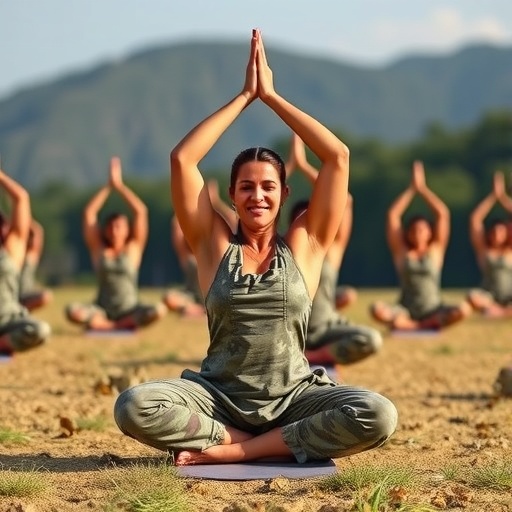
In a groundbreaking study published in BMC Psychology, researchers have unveiled compelling evidence supporting the efficacy of yoga-based intervention programs in enhancing psychological immunity and life satisfaction among armed forces personnel in India. This randomized controlled trial offers a pioneering exploration into how ancient mind-body practices can bolster mental resilience, a finding with profound implications for military mental health strategies worldwide.
The armed forces environment exposes personnel to intense psychological and physical stressors. Persistent exposure to such stress can erode mental defenses, triggering a spectrum of issues including anxiety, depression, and diminished overall life satisfaction. Traditional mental health interventions often face limitations in accessibility and stigma, necessitating innovative and holistic approaches. Yoga, an ancient practice emphasizing breath control, physical postures, and meditation, has gained modern scientific interest for its potential psychophysiological benefits.
The study meticulously designed a structured yoga-based intervention tailored to the unique needs of Indian military personnel. Over a defined period, participants engaged in daily sessions integrating asanas (postures), pranayama (breath regulation), and dhyana (meditation), guided by skilled instructors trained to address the physical and psychological demands inherent to military service. This holistic regimen aimed to enhance not only physical wellness but fortify the psychological immune system, a conceptual framework describing the mind’s defense mechanisms against stress and mental illness.
Psychological immunity, a construct developed in positive psychology, refers to adaptive capacities enabling individuals to cope with adversities effectively, maintain emotional balance, and exhibit resilience. Measuring changes in psychological immunity required sophisticated psychometric tools administered at baseline and post-intervention phases. Additionally, life satisfaction was quantified using validated scales capturing cognitive evaluations of one’s overall well-being and contentment with life circumstances.
Results from this randomized controlled trial indicated statistically significant improvements in both psychological immunity and life satisfaction scores among those who completed the yoga intervention, compared to control participants who did not receive the program. The enhancements observed suggest that integrating yoga into routine military training regimes may serve as a potent adjunct to traditional mental health initiatives, potentially mitigating the adverse psychological impact of combat and operational stressors.
A critical aspect underpinning the study’s robustness was the rigorous methodological approach. Randomized allocation minimized selection bias, while blinding of assessors reduced measurement bias. The sample size was carefully calculated to ensure sufficient statistical power to detect meaningful differences. Furthermore, compliance and adherence rates were meticulously monitored, affirming the feasibility of implementing yoga-based programs within disciplined military structures.
Physiologically, yoga is known to modulate autonomic nervous system activity, shifting the balance from sympathetic dominance—commonly associated with fight-or-flight responses—to parasympathetic activation, which fosters relaxation and recovery. Neuroendocrine findings from ancillary studies indicate reductions in cortisol levels and inflammatory markers following consistent yoga practice, underpinning observed psychological benefits with tangible biological correlates.
The study’s findings resonate with emerging evidence in psychoneuroimmunology, demonstrating bidirectional communication between the mind, nervous system, and immune function. Enhancing psychological immunity through yoga may promote resilience not only against mental illnesses like PTSD and depression but also attenuate inflammatory responses linked to chronic diseases frequently observed in stressed populations such as military personnel.
Importantly, the intervention’s accessibility and cost-effectiveness position it as a scalable solution for resource-constrained military settings. Unlike pharmacological treatments, yoga avoids adverse side effects and stigma, potentially increasing acceptability and sustained engagement among personnel. Its integrative approach also encourages self-regulation skills and mindfulness, fostering enduring behavioral changes conducive to long-term mental health.
This research invites dialogue on the broader implications of mind-body therapies in occupational health paradigms. Military institutions globally confront rising mental health challenges; incorporating evidence-based alternative interventions like yoga may revolutionize standard preventive and therapeutic frameworks. Moreover, the principles extrapolated here could extend to other high-stress professions, amplifying the societal impact.
Future research directions outlined by the authors encourage exploration into neurobiological mechanisms mediating yoga-induced psychological immunity enhancements, longitudinal efficacy assessments, and cross-cultural adaptations of programs. Integrating biometric monitoring, neuroimaging techniques, and qualitative analyses could enrich understanding of personalized responses to yoga interventions.
In sum, this pioneering randomized controlled trial unequivocally demonstrates that a yoga-based intervention can substantially improve psychological immunity and life satisfaction in Indian armed forces personnel. The study not only endorses yoga as a scientifically validated adjunct to conventional mental health practices but also champions a shift towards holistic care models that honor the inseparable interconnection of mind and body.
As mental health continues to ascend on public health agendas, especially within high-stakes environments like the military, evidence-informed integrative interventions like yoga hold tremendous promise. This study lays foundational groundwork for an innovative paradigm where resilience is cultivated through deliberate mind-body synergy, setting a precedent that could transform mental health landscapes globally.
Cite Scienmag News
Glenn Wilkins. (October 27, 2025). Yoga Boosts Psychological Immunity, Life Satisfaction in Soldiers. Scienmag. https://scienmag.com/yoga-boosts-psychological-immunity-life-satisfaction-in-soldiers/
Glenn Wilkins. "Yoga Boosts Psychological Immunity, Life Satisfaction in Soldiers." Scienmag, 27 October 2025, https://scienmag.com/yoga-boosts-psychological-immunity-life-satisfaction-in-soldiers/. Accessed 4 September 2026.
Glenn Wilkins. "Yoga Boosts Psychological Immunity, Life Satisfaction in Soldiers." Scienmag. October 27, 2025. https://scienmag.com/yoga-boosts-psychological-immunity-life-satisfaction-in-soldiers/


