


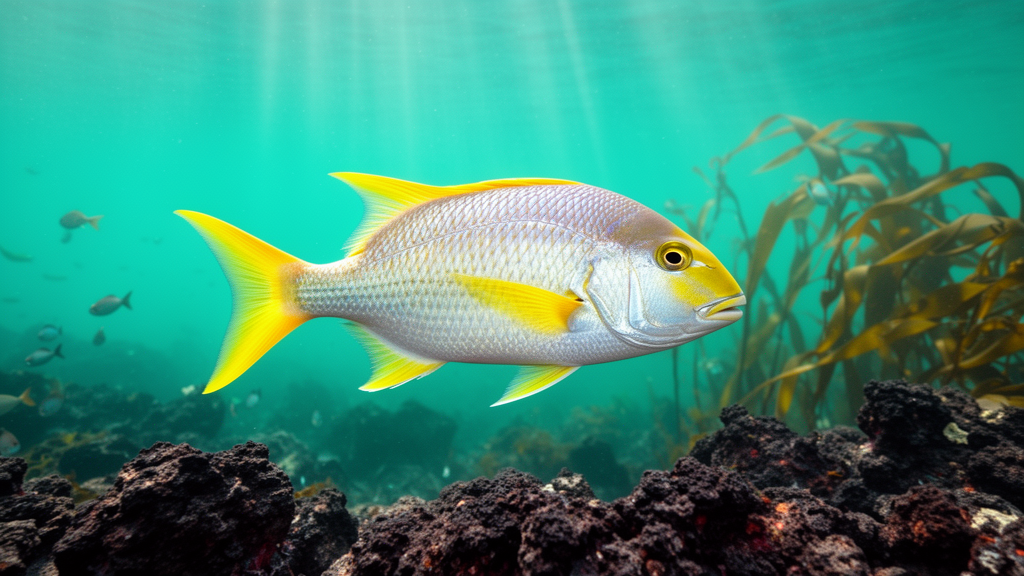
A small snapper with shimmering golden stripes, pulled from the clear waters of Hahyo Port on Jeju-do Island in October 2024, has turned out to be a species never before documented in Korea. The fish, measuring just 78.9 millimeters in standard length, was identified as the yellowfin snapper, Lutjanus xanthopinnis, a species that scientists only formally described in 2015 after untangling it from a long history of confusion with a close relative. The discovery, published in the journal Acta Ichthyologica et Piscatoria, raises the number of snapper species known from Korean waters to eleven and adds a third member to the country’s roster of the so-called yellow-lined snapper complex.
The specimen was captured by rod and hook within Hahyo Port in Sinhyo-dong, Seogwipo-si, on the southern coast of Jeju-do Island, at coordinates 33°14′58.5″N, 126°37′12.9″E. The catch occurred at high tide, when the water depth reached approximately four to six meters. After capture, the fish was euthanized with MS-222, fixed in ten percent formalin, and preserved in seventy percent ethanol for detailed study. It now resides in the Ichthyology Laboratory at Kunsan National University under voucher number AREIS-0008, where researchers counted its fin rays, measured its proportions, and compared every trait against the diagnostic features laid out when the species was first named.
Snappers of the family Lutjanidae comprise seventeen genera and roughly 110 species worldwide, and the genus Lutjanus alone contains about seventy of them. Within this sprawling group, seven species share a distinctive suite of yellow to brownish stripes along the sides of the body, earning them the collective label of the yellow-lined snapper complex. Until now, Korean waters were known to host ten Lutjanus species, of which only two, Lutjanus ophuysenii and Lutjanus vitta, belonged to this striped complex. The new arrival from Jeju-do makes it three.
The identification rests on a careful tally of anatomical details. The Jeju specimen carries ten spines and thirteen soft rays in its dorsal fin, three spines and eight soft rays in its anal fin, sixteen pectoral fin rays, and forty-nine pored scales along the lateral line. Five scale rows cover its cheek, and scales are present on the preopercular flange, the bony flap at the rear edge of the gill cover. Its posterior nostril is oviform rather than rounded, and the predorsal scales extend forward to roughly the midpoint of the interorbital area, the strip of skull between the eyes. Each of these features matches the original description of Lutjanus xanthopinnis published by Iwatsuki, Tanaka, and Allen in 2015.
What makes this identification scientifically satisfying is how cleanly the species separates from its lookalike. For decades, Lutjanus xanthopinnis was misidentified as Lutjanus madras, a species described from the Indian Ocean, because the two fish are strikingly similar in shape and coloration. Iwatsuki and colleagues finally split them apart by pinpointing a set of consistent differences. The yellowfin snapper has eight anal fin soft rays instead of nine, four to five cheek scale rows instead of seven to eight, scales on the preopercular flange instead of bare skin, an elliptical posterior nostril instead of a round one, and predorsal scales that reach the middle of the interorbital region rather than stopping at the rear edge of the eye.
Coloration provides a further clue, though with a caveat for young fish. When fresh, the Jeju specimen showed a silverish body darkening toward the base of the dorsal fin, with dark maroon to brown oblique lines above the lateral line and golden-yellow horizontal stripes below it. The topmost yellow stripe runs along the center of a single scale row and is about half a scale in width, while the stripes beneath it are thinner and relatively uniform. In Lutjanus madras, by contrast, the midlateral yellow stripe is far more pronounced, spanning one and a half to three scale rows. The authors note that this color-based distinction may not hold for juveniles, which makes the meristic counts and scale patterns all the more important for reliable identification.
Within the yellow-lined snapper complex itself, the yellowfin snapper is also separable from its other relatives. It has thirteen soft dorsal fin rays compared with fourteen in Lutjanus adetii and twelve in Lutjanus lutjanus, five cheek scale rows compared with six in Lutjanus mizenkoi, scales on the preopercular flange where Lutjanus ophuysenii has none, and thin yellow body stripes lacking the broad black stripe that runs from the eye to the upper base of the caudal fin in Lutjanus vitta. Taken together, these characters leave little doubt about the specimen’s identity.
The fresh color pattern of the fish also inspired its new Korean name. Researchers propose No-rang-tung-dom, a name based on the several thin yellow horizontal stripes visible below the lateral line on the body. In preservation, most of the vivid coloration fades to pale gray, with yellow persisting only at the base of the soft dorsal fin, the anal fin, and the caudal fin base, which is why photographs taken before fixation carry so much taxonomic weight.
Geographically, the record is notable for how far the species has traveled from its recognized range. Lutjanus xanthopinnis is widely distributed across the western Pacific and into the eastern Indian Ocean, from southern Japan through the East Indies, including Sri Lanka, the Andaman Sea off western Thailand, Malaysia, Brunei, western Indonesia from the Malay Peninsula to Bali, the Philippines, Taiwan, China, and Japan. The type locality lies in Uchinoura Bay, Kagoshima, Japan. Earlier records from the region had been filed under the name Lutjanus madras, meaning the true distribution of the yellowfin snapper was only clarified after the 2015 split. The Jeju-do record now extends the confirmed range into southern Korea.
Whether the species is a rare visitor or an established resident of Jeju’s nearshore waters remains an open question, and a single specimen cannot settle it. But the finding underscores how much biodiversity still hides in familiar waters, and how modern taxonomic scrutiny, down to the shape of a nostril and the reach of a row of scales, can reveal species that were swimming past scientists all along. For Korea’s marine fauna, the yellow-striped newcomer brings the national snapper count to eleven, and the yellow-lined snapper complex to three, with the promise that further surveys around Jeju-do may reveal whether No-rang-tung-dom is here to stay.
Subject of Research: First record of the yellowfin snapper Lutjanus xanthopinnis from Jeju-do Island, Korea
Article Title: First record of yellowfin snapper, Lutjanus xanthopinnis ( Actinopterygii , Perciformes , Lutjanidae ), from Jeju-do Island, Korea
Article References: Kim, M.-S., Kim, K.-J., Jang, M.-H., & Kim, J.-G. (2025). First record of yellowfin snapper, Lutjanus xanthopinnis (Actinopterygii, Perciformes, Lutjanidae), from Jeju-do Island, Korea. Acta Ichthyologica et Piscatoria, 55, 89-92. https://doi.org/10.3897/aiep.55.143930
Image Credits: AI Generated
Keywords: yellowfin snapper, Lutjanus xanthopinnis, Jeju Island, Korea, first record, snapper, Lutjanidae, marine biodiversity, taxonomy, yellow-lined snapper complex, First, record
Cite Scienmag News
Addison Whitmore. (October 19, 2026). Yellowfin snapper makes first appearance in Korean waters at Jeju Island. Scienmag. https://scienmag.com/yellowfin-snapper-makes-first-appearance-in-korean-waters-at-jeju-island/
Addison Whitmore. "Yellowfin snapper makes first appearance in Korean waters at Jeju Island." Scienmag, 19 October 2026, https://scienmag.com/yellowfin-snapper-makes-first-appearance-in-korean-waters-at-jeju-island/. Accessed 19 October 2026.
Addison Whitmore. "Yellowfin snapper makes first appearance in Korean waters at Jeju Island." Scienmag. October 19, 2026. https://scienmag.com/yellowfin-snapper-makes-first-appearance-in-korean-waters-at-jeju-island/


