


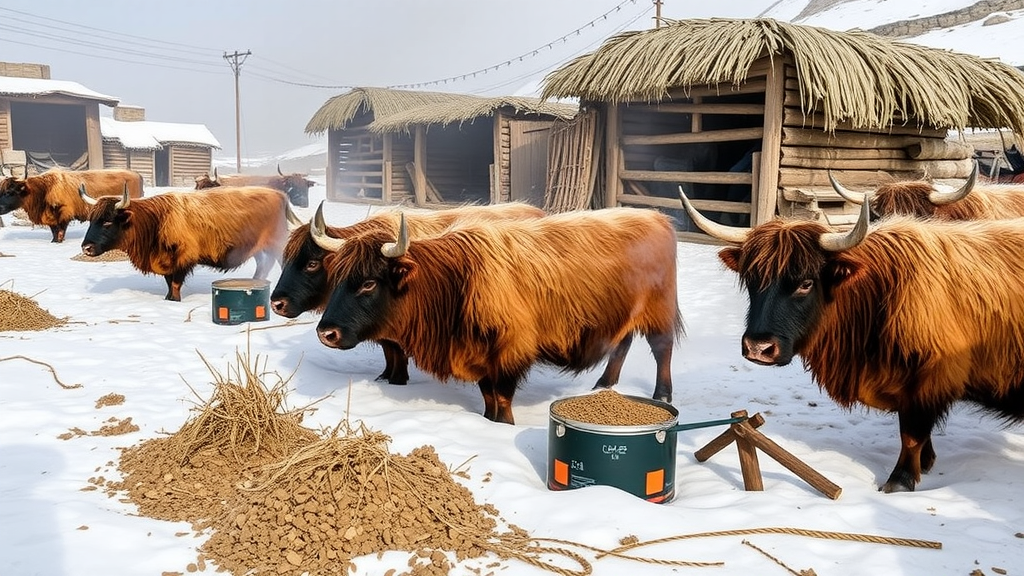
High on the Qinghai-Tibet Plateau, where the thin air and brutal winters have shaped human life for millennia, the humble yak is more than livestock. Its dried dung is the primary household fuel, burned in traditional stoves for cooking and heating across thousands of villages. A new year-long field study has now quantified, with unusual precision, what that dependence means for the air villagers breathe outdoors: fine particulate matter concentrations that peak in December, surge during morning and evening stove-firing hours, and are strongly modulated by the plateau’s harsh meteorology. The research, published in the journal Air Quality, Atmosphere & Health, combines long-term on-the-ground measurement with machine learning to disentangle how weather and fuel use jointly govern pollution in one of the world’s most understudied inhabited environments.
The study, led by Yumiao Li and colleagues at Southwest Jiaotong University in Chengdu, together with researchers at the Tianfu Yongxing Laboratory, deployed continuous monitoring of particulate matter and a suite of meteorological parameters in a plateau village for a full annual cycle. The team recorded annual mean concentrations of 24.3 micrograms per cubic meter for PM10, the coarse particle fraction, and 18.5 micrograms per cubic meter for PM2.5, the finer fraction that penetrates deepest into human lungs. While those annual averages may appear moderate by the standards of heavily polluted megacities, the seasonal and diurnal structure behind them tells a far more troubling story about when and how villagers are actually exposed.
The monthly pattern was unambiguous. December registered the highest monthly mean concentrations of both PM10 and PM2.5, while July recorded the lowest. That winter maximum aligns squarely with the heating season, when yak dung stoves burn for extended hours to keep homes warm in conditions where temperatures plunge far below freezing and conventional fuels such as coal or natural gas are scarce or unavailable. During the non-heating months, by contrast, stove use drops and atmospheric conditions improve, allowing particulate levels to fall to their annual minimum. The contrast between heating and non-heating season concentration peaks was pronounced, underscoring that the seasonal rhythm of pollution on the plateau is dictated less by industry or traffic than by the domestic hearth.
The diurnal cycles revealed an equally distinctive fingerprint. Concentrations of particulate matter rose sharply during two windows: 8:00 to 10:00 in the morning and 18:00 to 22:00 in the evening. These are precisely the periods when villagers light up their stoves, first to prepare breakfast and later to cook the evening meal and heat the house against the falling nighttime temperatures. The pattern is a classic signature of residential solid-fuel combustion, and it mirrors findings from other rural regions of China where household coal and biomass burning dominate ambient pollution. On the plateau, however, the fuel is yak dung, and its incomplete combustion in traditional stoves releases a substantial load of particulate matter that escapes indoors and accumulates in the village air.
One of the study’s most striking technical findings concerns the composition of the particle load. In every month, the ratio of PM2.5 to PM10 exceeded 69 percent, ranging from 68.6 to 76.2 percent. In other words, fine particles made up the dominant share of the total particulate burden year-round. This matters enormously for health, because PM2.5 particles are small enough to bypass the body’s upper respiratory defenses, lodge deep in the alveoli of the lungs, and even enter the bloodstream. A long body of epidemiological research, including the foundational work of C. Arden Pope and Douglas Dockery, has linked fine particulate exposure to cardiovascular disease, respiratory illness, and premature mortality. A pollution profile dominated by the fine fraction therefore carries disproportionate health implications, even at concentrations that might seem tolerable if judged on coarse particle numbers alone.
To understand why concentrations rise and fall as they do, the researchers turned to the meteorology of the plateau itself. Using Spearman correlation analysis alongside machine learning models, they found that PM2.5 concentrations were negatively correlated with solar radiation, temperature, and wind speed, and positively correlated with relative humidity. The physical logic is intuitive. Stronger winds disperse and dilute locally emitted particles; higher temperatures and stronger solar radiation enhance vertical mixing of the boundary layer, lifting pollutants away from the surface; and calm, cold, humid conditions trap particles near the ground where people live and breathe. On the Qinghai-Tibet Plateau, where winter brings both intense stove use and stagnant, cold air, these factors conspire to produce the December maximum the monitoring recorded.
The machine learning component of the study was designed as a rigorous head-to-head comparison. The team evaluated three widely used ensemble algorithms: Random Forest, Extreme Gradient Boosting, known as XGBoost, and Light Gradient Boosting Machine, known as LightGBM. All three are tree-based methods capable of capturing nonlinear relationships between meteorological drivers and pollutant concentrations, but they differ in how they build and combine their constituent trees. Random Forest grows many decision trees on bootstrapped samples of the data and averages their predictions, while XGBoost and LightGBM build trees sequentially, with each new tree correcting the errors of its predecessors. Across three evaluation metrics, Random Forest outperformed the two boosting approaches, proving the more reliable tool both for identifying the meteorological factors that influence PM2.5 and for predicting concentrations.
The predictive power of the trained model allowed the researchers to extend their analysis beyond the single monitored village. Applying the framework to villages in four cities across the Qinghai-Tibet Plateau, they predicted outdoor PM2.5 concentrations during periods of yak dung stove operation. The predictions exhibited similar variation trends across all four locations, suggesting that the pollution dynamics documented in the monitored village are not a local anomaly but a regional pattern rooted in shared fuel practices and a shared climate. That generalizability is what elevates the study from a single-site case report to a template for understanding air quality across the entire plateau, home to millions of people whose exposure has historically been invisible to national monitoring networks concentrated in eastern cities.
The findings arrive at a moment of growing recognition that household solid-fuel burning is a major and underappreciated source of ambient air pollution, not merely an indoor air problem. Previous research, including work published in the Proceedings of the National Academy of Sciences, has argued that Chinese household emissions constitute a substantial share of the country’s particulate burden, and field campaigns measuring traditional biomass cookstoves in Tibet and South Asia have documented their high emission factors. The new study adds a crucial temporal dimension to that literature, showing exactly when in the day and the year plateau villages are most affected, and demonstrating how machine learning can translate sparse field measurements into actionable exposure estimates for communities that lack permanent monitoring infrastructure.
The authors argue that their results can inform future strategies for improving outdoor air quality on the plateau and support assessments of the environmental and health benefits those strategies would deliver. Cleaner-burning stove designs, improved combustion efficiency, fuel alternatives, and ventilation interventions could all, in principle, blunt the morning and evening peaks and shrink the winter maximum. Because the study establishes a quantitative baseline and a validated predictive model, any such intervention could be evaluated against measured and modeled expectations rather than guesswork. For a region where the energy transition must balance cultural tradition, fuel scarcity, and the imperative of public health, that kind of evidence is the essential first step. The image that emerges from the data is vivid: twice a day, as stoves are lit across plateau villages, a fine-particle plume rises into cold, still air, and only when the sun climbs and the wind picks up does the atmosphere begin to clear.
Subject of Research: Temporal variation of outdoor particulate matter pollution from yak dung combustion in Qinghai-Tibet Plateau villages and its correlation with meteorological factors
Article Title: Temporal variation of outdoor particulate matter concentration in a village of the Qinghai-Tibet Plateau and its correlation with meteorological factors: based on long-term field measurement and machine learning approach
Article References: Li, Y., Chen, J., Wu, D., Ma, R., Yi, Y., Yu, T., & Deng, M. (2026). Temporal variation of outdoor particulate matter concentration in a village of the Qinghai-Tibet Plateau and its correlation with meteorological factors: based on long-term field measurement and machine learning approach. Air Quality, Atmosphere & Health, 19(10), Article 211. https://doi.org/10.1007/s11869-026-02094-2
Image Credits: AI Generated
DOI: 10.1007/s11869-026-02094-2
Keywords: Qinghai-Tibet Plateau, yak dung stove, particulate matter, PM2.5, air quality, machine learning, Random Forest, meteorology, heating season, household air pollution, village air monitoring, XGBoost
Cite Scienmag News
Russell Cooper. (September 23, 2026). Yak Dung Stoves Drive Winter Air Pollution Spikes on the Qinghai-Tibet Plateau, Year-Long Study Finds. Scienmag. https://scienmag.com/yak-dung-stoves-drive-winter-air-pollution-spikes-on-the-qinghai-tibet-plateau-year-long-study-finds/
Russell Cooper. "Yak Dung Stoves Drive Winter Air Pollution Spikes on the Qinghai-Tibet Plateau, Year-Long Study Finds." Scienmag, 23 September 2026, https://scienmag.com/yak-dung-stoves-drive-winter-air-pollution-spikes-on-the-qinghai-tibet-plateau-year-long-study-finds/. Accessed 4 October 2026.
Russell Cooper. "Yak Dung Stoves Drive Winter Air Pollution Spikes on the Qinghai-Tibet Plateau, Year-Long Study Finds." Scienmag. September 23, 2026. https://scienmag.com/yak-dung-stoves-drive-winter-air-pollution-spikes-on-the-qinghai-tibet-plateau-year-long-study-finds/


