

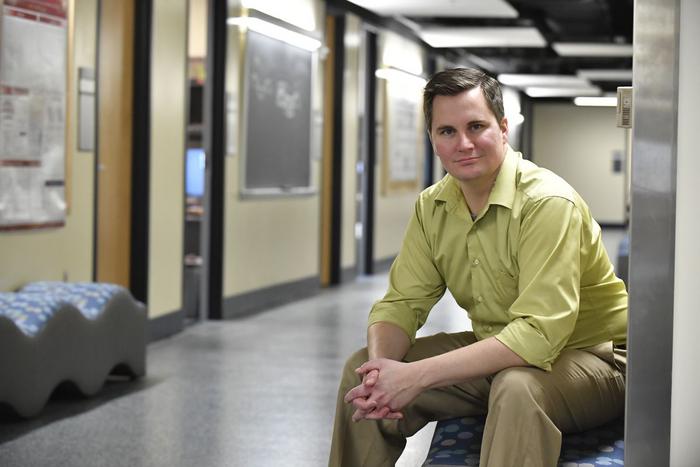
A theoretical astrophysicist at West Virginia University will play a key role in the development of a first-of-its-kind planned space probe to detect and accurately measure gravitational waves — ripples in the fabric of space and time.

Credit: WVU Photo
A theoretical astrophysicist at West Virginia University will play a key role in the development of a first-of-its-kind planned space probe to detect and accurately measure gravitational waves — ripples in the fabric of space and time.
Sean McWilliams, associate professor of physics and astronomy in the WVU Eberly College of Arts and Sciences, was part of a team in 2015 that first detected those invisible ripples, which confirmed Albert Einstein’s general theory of relativity. Now, with $750,000 in support from NASA’s Established Program to Stimulate Competitive Research, McWilliams will lead efforts to develop models to help facilitate observations from the planned space probe.
Called the Laser Interferometer Space Antenna, or LISA, the probe will be the first dedicated space-based gravitational wave observatory that will measure binaries over a wide range of masses.
Gravitational waves, first predicted by Einstein in 1916, can be caused by cataclysmic events such as colliding black holes and neutron stars, massive stars exploding at the end of their lifetimes and even remnants of radiation created by the Big Bang.
McWilliams’s team will study the inspirals of stellar-mass binaries that will eventually merge as well as massive binaries at the centers of merging galaxies. LISA will further scientists’ perception of the universe and better equip them to study phenomena invisible in normal light.
“LISA signals will be much louder relative to the detector noise than LIGO’s were, so the models have to be much more accurate to make sure the models don’t limit the science we can do,” said McWilliams, who also leads the WVU Center for Gravitational Waves and Cosmology. “This project will attempt to make the necessary dramatic improvements in modeling accuracy that will be required.”
LIGO, which stands for Laser Interferometer Gravitational-Wave Observatory, is a large-scale observatory, based in Washington and Louisiana, designed to detect gravitational waves. It was used by the team that included McWilliams in the 2015 discovery.
“For supermassive black-hole binaries, their spin and eccentricity distributions are sensitive to their environments just prior to entering the LISA band,” McWilliams said. “In addition, LISA can observe stellar-mass binaries earlier than ground-based detectors, and the measurement of their spins and eccentricities can provide insights into their formation and evolutionary history that cannot be obtained otherwise.”
LISA is slated to launch in 2035.
Researchers will also build upon a model developed by McWilliams called the “backward one-body method.” McWilliams calculated an exact mathematical formula for the signal produced by two merging black holes, making it easier for scientists to analyze gravitational waves.
Before the backward one-body method, researchers relied on a mathematical transformation to calculate the exact waveform from a black hole merger. That could become an arduous task, leading to multiple numerical simulations.
McWilliams used general relativity to calculate how a tiny test mass spirals into and perturbs the final black hole, allowing for more accurate reporting.
“We will first improve the efficiency of the best models for inspirals that are currently available, and we will replace the merger signals with BOB (backward one-body),” McWilliams said. “From there, we will be able to rapidly assess new ideas for improving accuracy throughout the waveform. Ultimately, we plan to have a model that builds on all known physics throughout the signal and then add tunability to the model.”
McWilliams’ team includes Zach Etienne, adjunct associate professor.
“It’s very gratifying to receive this support for the work my group has been doing for quite a few years now,” McWilliams said. “It’s also humbling, since it means we are now responsible for helping LISA fulfill its science mission. The challenge is honestly a bit daunting, since the current models are not nearly at the level of accuracy that will be needed and the next decade will pass quickly. The instrument is really being built and, barring catastrophe, will launch in decade from now.”

