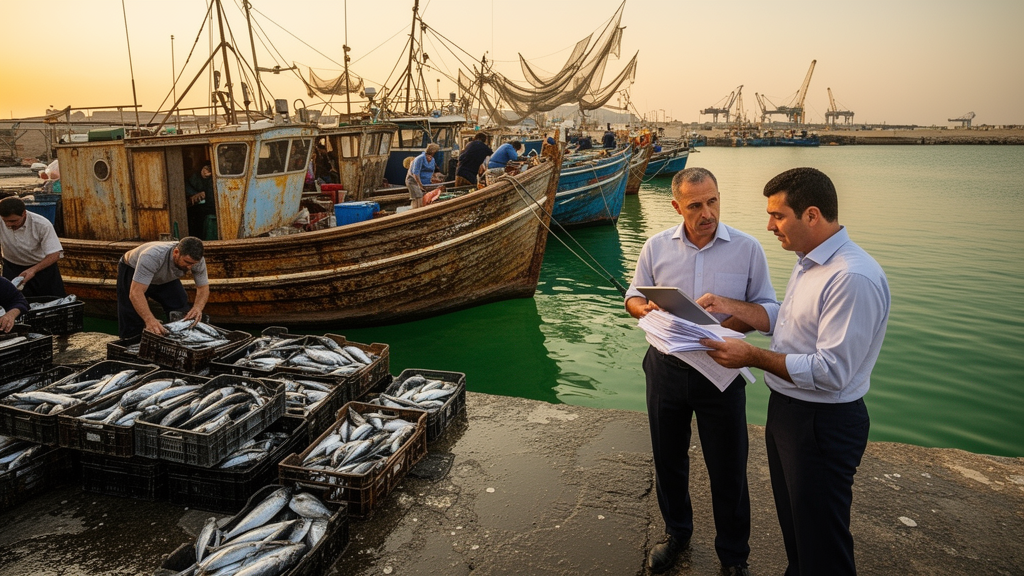
When the World Trade Organization’s Agreement on Fisheries Subsidies entered into force on September 15, 2025, it marked the first time that multilateral trade rules had been written specifically to prohibit the public money that fuels illegal, unreported and unregulated fishing, overfished stocks and excess fleet capacity. But a new study published in Frontiers in Marine Science argues that the treaty’s central promise to developing countries rests on an institution whose operational design is not yet ready to carry the weight. The research, led by Jiayu Bai of Nankai University with Muyun Guo of Renmin University of China and Min Zhao of the University of Macau, examines the Fisheries Funding Mechanism established under Article 7 of the Agreement, the voluntary fund better known as the WTO Fish Fund, and identifies five areas where its rules fall short of what effective implementation will require.
The Agreement on Fisheries Subsidies was adopted on June 17, 2022, after two decades of negotiation that began during the Doha Round in 2001. It commits WTO Members to eliminating subsidies tied to vessels or operators engaged in illegal fishing, subsidies for fishing activities affecting overfished stocks, subsidies that contribute to overcapacity or overfishing, and subsidies for fishing outside national jurisdictions or the competence of regional fisheries management organizations. Members must also notify the WTO about the type of subsidized fishing activity, the status of the fish stocks involved, the conservation measures in place and the capacity of their fleets. For many developing and least developed country Members, particularly small island states whose economies and food security depend heavily on fisheries, meeting these transparency and management obligations is a formidable technical and financial undertaking.
It was to ease this burden that negotiators wrote Article 7, which requires targeted technical assistance and capacity building for developing and least developed country Members and establishes a voluntary funding mechanism in cooperation with international organizations including the Food and Agriculture Organization, the International Fund for Agricultural Development and the World Bank. Contributions must be exclusively voluntary and may not draw on the WTO’s regular budget. The fund became ready to accept donations on November 8, 2022, and has since received more than USD 20 million from Members including the European Union, Japan, Canada, Australia, Norway, New Zealand, Iceland and others. Its first Call for Proposals opened on June 6, 2025, and the Steering Committee approved 26 project grants totalling USD 2.9 million; a second call that closed on May 8, 2026, approved further grants of nearly USD 2.2 million.
The fund’s assistance takes two forms. Technical assistance draws heavily on the FAO, which can help Members collect, compile, analyze and report fisheries data, run its Global Capacity Development Programme against illegal fishing, support the development of management plans for rebuilding overfished stocks, and strengthen institutional coordination. The WTO itself contributes through publications, seminars and capacity building activities supporting legislative reform and inter-ministerial coordination. Financial support is project-based and divided into two categories: Category 1 project preparation grants of up to USD 50,000 for needs assessments, feasibility studies and proposal development, and Category 2 programmatic project grants of up to USD 300,000 for larger implementation-oriented work, which must be grounded in prior national needs assessments. Category 2 projects span five types, from analysis and sector studies to capacity building, legislative updates, data collection and improvements to fisheries management systems.
Yet the study finds that the fund’s architecture leaves it exposed on five fronts. The most fundamental is funding predictability and scale. Because contributions are discretionary and cannot come from the regular WTO budget, the fund is a purely voluntary trust fund whose long-term resources depend on shifting political and geopolitical priorities. The authors note that the amounts pledged so far are modest relative to the scale of capacity needs across vulnerable coastal states, while the multi-year programs the Agreement demands, including monitoring, control and surveillance systems and scientific stock assessment work, require stable, long-horizon financing that voluntary pledges cannot guarantee.
The second problem concerns access. Many developing and least developed country Members lack the administrative and technical capacity to design eligible projects, implement reforms such as vessel monitoring systems, and satisfy the fund’s own documentation requirements. States with in-house project offices or access to consultants can navigate the application process; the most vulnerable may simply be unable to compete, producing the paradox that the countries most in need of support are the least likely to receive it. The authors argue this imbalance directly threatens the right to development that the fund exists to protect, and may result in slow delivery, fragile sustainability of technical investments and weak returns on donor money.
Third, the study highlights a transparency deficit in how funding decisions are made. Although the Steering Committee reviews and evaluates all submissions and notifies selected applicants, no detailed, weighted scoring system for project prioritization has been published. The paper asks how factors such as vulnerability, fisheries dependence, governance gaps and regional public goods are actually ranked, and warns that this opacity risks perceptions of politicized allocation and a mismatch between funding and the most urgent needs. Fourth, the fund’s monitoring, evaluation and learning system relies partly on self-assessments and end-of-project surveys, which the authors note are inexpensive but susceptible to social-desirability bias, inconsistent interpretation and declining response rates. The system’s Logical Framework explicitly deprioritizes long-term impact monitoring because ecological metrics are costly and attribution is difficult, yet outcomes such as stock recovery and reductions in illegal fishing manifest over years and require independent corroboration from bodies such as the FAO or regional fisheries management organizations.
Fifth, the paper flags coordination and fragmentation risks. The fund was created in cooperation with the FAO, the IFAD and the World Bank precisely because no single agency can deliver the mix of legal, scientific and investment inputs that fisheries governance requires, but there is no detailed guidance on how the different organizations’ systems are to be harmonized. The authors observe that the WTO, unlike the FAO or the World Bank, has no technical cooperation division with sector-specific project management experience, and that without tight coordination multiple agencies may fund similar activities without aligning technical specifications, producing wasted investment, mismatched equipment and sustainability problems.
To close these gaps, the study proposes a package of mutually reinforcing reforms. On financing, it recommends rolling three-to-five-year replenishment cycles with published minimum targets, a blended architecture combining core grants with co-financing from the World Bank or FAO, and a reserved rapid-response window for urgent shortfalls. On access, it suggests regional project development units serving neighboring countries jointly, South-to-South technical secondments between developing country administrations, and open-access template tools such as sample procurement terms and model legal amendments. On transparency, it calls for a published scoring table, with an illustrative weighting of 30 percent for vulnerability, 25 percent for governance gaps, 20 percent for environmental impact, 15 percent for feasibility and co-financing, and 10 percent for regional public welfare, alongside published decisions with short rationales and quota windows earmarking shares of funding for least developed countries, small-scale fisheries, innovation and emergency response. On evaluation, it urges independent third-party reviews, a central monitoring database and annual public reporting. On coordination, it proposes co-funding mechanisms, a joint digital implementation platform for shared calls and pipelines, and adoption of FAO and regional fisheries management organization standards for stock assessment, vessel monitoring and catch documentation.
The authors frame the fund as the institutional bridge between the Agreement’s legal commitments and their practical realization, translating special and differential treatment from exemption into genuine enablement. With approximately a third of the world’s fishery resources currently overexploited and harmful subsidies recognized as a primary driver, the stakes extend well beyond trade procedure. The study notes that three “Fish Weeks” are expected by the end of 2026, when Members will explore how to advance negotiations on additional subsidy provisions, and that a more comprehensive agreement remains the goal. Whether the Fish Fund can convert its promising start, more than USD 20 million pledged and dozens of grants approved, into durable compliance capacity across the developing world, the authors conclude, depends on reforms that make its financing predictable, its doors genuinely open, its decisions transparent, its results independently verified and its partnerships coherent.
Subject of Research: Institutional design and operational challenges of the WTO Fisheries Funding Mechanism under the Agreement on Fisheries Subsidies
Article Title: Promoting sustainable fishing: from the perspective of Fisheries Funding Mechanism under the Agreement on Fisheries Subsidies
Article References: Bai, J., Guo, M., & Zhao, M. (2026). Promoting sustainable fishing: from the perspective of Fisheries Funding Mechanism under the Agreement on Fisheries Subsidies. Frontiers in Marine Science, 12, Article 1699171. https://doi.org/10.3389/fmars.2025.1699171
Image Credits: AI Generated
DOI: 10.3389/fmars.2025.1699171
Keywords: WTO, Agreement on Fisheries Subsidies, Fisheries Funding Mechanism, fisheries subsidies, marine sustainability, special and differential treatment, capacity building, illegal unreported and unregulated fishing, overfishing, right to development, FAO, international trade law
Cite Scienmag News
Violet Maxwell. (October 23, 2026). WTO Fisheries Fund Faces Design Gaps That Could Undermine Ocean Sustainability Goals. Scienmag. https://scienmag.com/wto-fisheries-fund-faces-design-gaps-that-could-undermine-ocean-sustainability-goals/
Violet Maxwell. "WTO Fisheries Fund Faces Design Gaps That Could Undermine Ocean Sustainability Goals." Scienmag, 23 October 2026, https://scienmag.com/wto-fisheries-fund-faces-design-gaps-that-could-undermine-ocean-sustainability-goals/. Accessed 23 October 2026.
Violet Maxwell. "WTO Fisheries Fund Faces Design Gaps That Could Undermine Ocean Sustainability Goals." Scienmag. October 23, 2026. https://scienmag.com/wto-fisheries-fund-faces-design-gaps-that-could-undermine-ocean-sustainability-goals/