


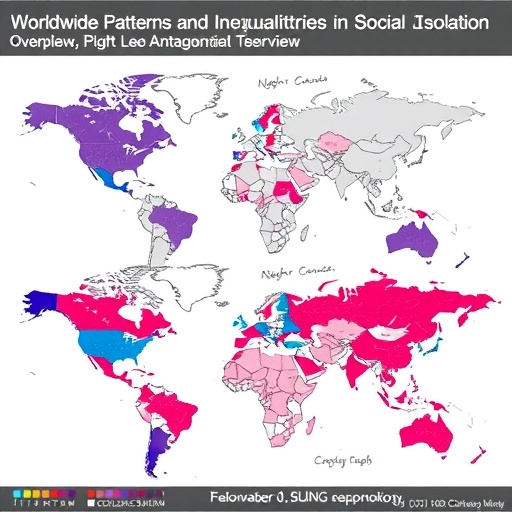
In the wake of the COVID-19 pandemic, a profound transformation in social dynamics has unfolded on a global scale, revealing a marked increase in social isolation that transcends borders and socioeconomic divisions. Recent cross-sectional research highlights this escalating trend, shedding light on the disproportionate vulnerability of lower-income populations during the initial phases and the subsequent diffusion of social isolation effects across broader economic groups. This phenomenon not only underscores a critical public health challenge but also illuminates complex intersections between socioeconomic status, mental well-being, and global policy frameworks.
Social isolation, defined as the objective lack of social contacts and engagements, has long been recognized as a determinant of mental and physical health outcomes. However, the pandemic-induced social restrictions, including lockdowns and physical distancing mandates, have exacerbated isolation levels to unprecedented degrees. The recent study meticulously examines these trajectories, offering a nuanced understanding of how social isolation has evolved since the onset of the pandemic, particularly focusing on temporal and demographic variances.
Initially, the research identifies a sharp rise in social isolation predominantly within lower-income populations. This demographic faced unique vulnerabilities, including limited access to digital connectivity, constrained economic resources, and heightened exposure to stressors such as job loss and housing instability. These factors collectively exacerbated their social disconnection, intensifying mental health burdens such as anxiety and depression. The data suggest that pre-existing income inequality operated as a catalyst, magnifying the detrimental impacts of the pandemic on social cohesion in economically disadvantaged groups.
As the pandemic progressed, a broader diffusion of social isolation was observed across various socioeconomic strata. Middle- and upper-income individuals, initially buffered by resources and networks, also experienced increasing isolation, partly due to prolonged restrictions and shifts toward remote work and virtual interactions. This universal spread indicates the pervasive nature of pandemic-related isolation, implicating large swaths of the global population regardless of baseline social capital or economic stability.
The study’s cross-sectional methodology employed multinational data collection, integrating self-reported measures of social engagement, frequency of interpersonal contacts, and subjective perceptions of loneliness. These metrics were triangulated with socioeconomic indicators to elucidate patterns and disparities. The comprehensive analytical framework underscores the intricate relationship between policy enforcement severity, cultural contexts, and individual socio-economic realities.
Crucially, findings point to the urgent need for targeted interventions aimed at the most vulnerable populations. Strategies that enhance digital access, community-based support systems, and mental health services can mitigate social disconnection’s adverse effects. Moreover, understanding country-level policy responses provides a pathway to tailor public health directives that balance infection control with preserving social connectivity.
The pandemic has thus foregrounded the broader implications of isolation as a social determinant of health. Longitudinal consequences may include increased risk for chronic diseases, cognitive decline, and mortality, amplifying the urgency for integrative public health approaches. The research contributes a pivotal evidence base advocating for cross-disciplinary efforts encompassing social sciences, economics, and epidemiology to formulate resilient systems responsive to such societal disruptions.
Moreover, this global increase in social isolation intersects with broader phenomena such as globalization and demographic shifts. The strain on social development mechanisms, particularly in developmental psychology frameworks, highlights potential disruptions in socialization processes for various age groups, including youth and the elderly. Economic fluctuations and population dynamics further complicate these patterns, suggesting a multifaceted crisis emerging from the pandemic’s social repercussions.
Policy scholars and social scientists emphasize that effective mitigation must incorporate localized understandings of social inequality and economic constraints. Variations in international relations and geopolitical strategies also influence national responses, which in turn affect social isolation rates. This complex interplay necessitates research that transcends disciplinary boundaries to inform equitable and sustainable policy solutions.
Understanding the evolution and breadth of social isolation illuminated by this study invites renewed consideration of community resilience, social capital rebuilding, and integration of technological innovations in health promotion. As the world navigates pandemic recovery phases, addressing these psychosocial dimensions stands as vital to enhancing population well-being and reducing health disparities exacerbated by income inequality.
The research foregrounds social isolation not merely as an individual experience but as a pervasive societal challenge intensified by infectious disease outbreaks like COVID-19. This calls for transformative approaches that prioritize mental health within the broader context of infectious disease preparedness and socioeconomic policy planning. The widespread nature of isolation and its impacts demand comprehensive, coordinated efforts to safeguard both individual and collective health in the unfolding global landscape.
In sum, the study’s insights highlight the critical intersectionality of public health, social sciences, and economics in understanding and addressing pandemic-induced social isolation. It prompts a reimagining of social support infrastructures, advocating for inclusive frameworks that can withstand future crises while promoting social equity. As the pandemic continues to reshape human interaction, informed policy and community engagement efforts become indispensable tools against the tide of social disconnection.
Cite Scienmag News
Glenn Wilkins. (September 15, 2025). Worldwide Patterns and Inequalities in Social Isolation: A Scientific Overview. Scienmag. https://scienmag.com/worldwide-patterns-and-inequalities-in-social-isolation-a-scientific-overview/
Glenn Wilkins. "Worldwide Patterns and Inequalities in Social Isolation: A Scientific Overview." Scienmag, 15 September 2025, https://scienmag.com/worldwide-patterns-and-inequalities-in-social-isolation-a-scientific-overview/. Accessed 5 September 2026.
Glenn Wilkins. "Worldwide Patterns and Inequalities in Social Isolation: A Scientific Overview." Scienmag. September 15, 2025. https://scienmag.com/worldwide-patterns-and-inequalities-in-social-isolation-a-scientific-overview/


