


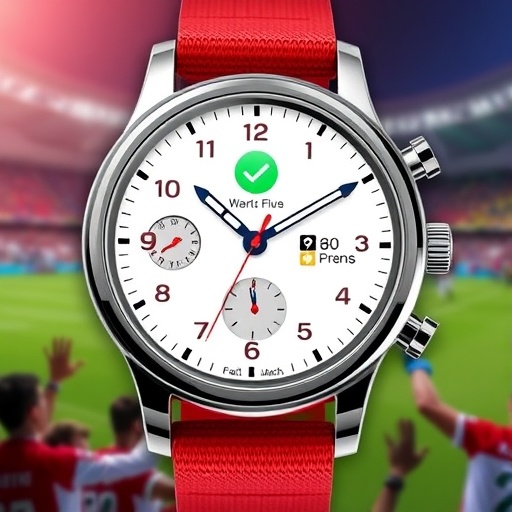
As the anticipation reaches fever pitch for the 2026 FIFA World Cup, researchers at Bielefeld University are embarking on a groundbreaking study that applies cutting-edge wearable technology to understand the physiological impact of football on fans across the globe. The Football Fever Study aims to explore how the emotional rollercoaster of the World Cup, the most widely viewed sporting event on the planet, influences heart rate, stress indicators, movement, and sleep patterns in real time, using data collected unobtrusively from participants’ smartwatches. This novel approach harnesses the ubiquity and sophistication of modern biometric devices to provide unprecedented insight into the embodied experience of sporting fandom.
The origins of this study trace back to previous pilot research conducted by the team during the 2025 DFB Cup Final, where 229 ardent fans of DSC Arminia Bielefeld were monitored using smartwatches and heart rate sensors. In this preliminary work, clear physiological responses were observed, with stadium attendees showing an average heart rate of 94 beats per minute compared to 79 beats per minute among those watching on television. Significantly, heart rates for on-site fans surged by as much as 36% following goals, underscoring the direct impact of peak emotional moments on cardiovascular activity.
Building on these promising early results, the ongoing Football Fever Study takes the concept to a global scale, inviting supporters of all national teams to participate. Importantly, the study does not limit itself to a single brand or type of wearable but embraces a broad ecosystem of devices. Initially restricted to Garmin users at launch on May 28, 2026, the study has since expanded to include data from twelve additional smartwatch brands such as Apple Watch, Google Pixel Watch, Samsung Health, Withings, Fitbit, Oura, Polar, Amazfit, Coros, Whoop, Xiaomi Mi Fitness, and Wahoo. This inclusivity not only increases the potential sample size exponentially but also enhances the ecological validity of the findings by reflecting a more diverse user base.
The team emphasizes that fans can join the study at any point during the tournament, even if only watching select matches. This flexibility acknowledges the dynamic nature of international sporting events and makes participation accessible to casual fans as well as die-hard enthusiasts. Data collected will be anonymously captured, adhering strictly to data privacy and protection regulations, ensuring participant confidentiality is maintained. The biometric readouts—capturing heart rate variability, stress levels inferred from physiological markers, movement, and sleep patterns—offer a rich, multidimensional view of the physiological states provoked by live sporting events.
Crucially, the study pioneers an intersection between sports science, psychology, and data science, underlining its multidisciplinary ethos. It is anchored within Bielefeld University’s Focus Area QUAMU, a research hub dedicated to the Quantification of Uncertainty, which examines how to rigorously interpret complex, probabilistic data. This partnership facilitates advanced analytical techniques, including machine learning and statistical modeling, to draw meaningful patterns from the voluminous and highly variable biometric data streams.
Professor Dr. Christian Deutscher, leading the project from the Faculty of Psychology and Sports Science, highlights the inclusive ambition of the research. He notes the underrepresentation of fans from Eastern and Southern Europe and Turkey, encouraging their participation to enrich the dataset’s diversity and robustness. More comprehensive data means the ability to decode subtle physiological signatures tied to national identities, cultural contexts, and emotional responses, potentially unearthing hitherto unknown variations in how fans experience the high-stakes drama of international football.
Complementing this, Professor Dr. Christiane Fuchs—the head of the Data Science group within the Faculty of Business Administration and Economics—explains the study’s technical infrastructure. The collection framework integrates directly with the APIs of the various smartwatch manufacturers, ensuring continuous, real-time data synchronization. This automation eliminates manual input errors and minimizes participant burden. Moreover, the data pipeline includes rigorous anonymization protocols and encryption to maintain ethical research standards regarding participant privacy.
Emerging data visualizations and initial analyses will be made publicly accessible throughout the tournament via the project website, with particular attention paid to matches involving the German national team. These insights are expected to illuminate how moments of anticipation, elation, and disappointment manifest physiologically across large populations, potentially revealing universal biomarkers of collective emotional experiences as well as individual differences based on fan behavior and engagement intensity.
By exploring how competitive football affects the autonomic nervous system and cardiovascular health, the study could have broader implications beyond sports. Understanding the stress responses associated with football fandom may inform psychological well-being initiatives, cardiovascular risk assessment, and the design of interventions to moderate stress-induced health impacts. Additionally, it may open pathways toward leveraging wearable technology in real-world settings for monitoring emotional health and resilience amid collective social experiences.
The Football Fever Study exemplifies how modern technology can transform traditional observational studies into data-rich, real-time analyses, merging quantitative rigor with the passion and unpredictability of sport. It stands as a testament to the power of interdisciplinary research—fusing behavioral science, computational analytics, and wearable tech—to decode complex human phenomena on an unprecedented scale. As the passion of millions ignites stadiums and screens around the world, this pioneering work promises to translate the fervor of fandom into quantifiable science, revealing the heartbeats behind the beautiful game.
Interested individuals who own a smartwatch compatible with the supported brands can enroll via the project’s dedicated online portal. This open call underscores the democratic nature of the research: the more participants who contribute their anonymized data, the richer and more generalizable the conclusions will become. By launching this initiative within the global spectacle of the FIFA World Cup, Bielefeld University not only advances academic knowledge but also fosters a direct connection between science and popular culture, engaging fans in a novel and participatory way.
In summary, the Football Fever Study harnesses the power of wearable biometric data to capture the physiological essence of football fandom during one of the world’s largest sporting events. Its sophisticated methodology, global inclusivity, and commitment to data privacy set a new standard for observational research that bridges the emotional intensity of sport with quantitative inquiry. As the tournament unfolds, this fusion of technology and passion offers an unprecedented window into how the beautiful game touches hearts in the most literal sense.
News Publication Date: 2026 (Exact date unspecified)
Web References:
https://uni-bi.de/worldcupfever
Cite Scienmag News
Reid Dalton. (June 15, 2026). World Cup Fever Study Now Accessible on All Leading Smartwatches. Scienmag. https://scienmag.com/world-cup-fever-study-now-accessible-on-all-leading-smartwatches/
Reid Dalton. "World Cup Fever Study Now Accessible on All Leading Smartwatches." Scienmag, 15 June 2026, https://scienmag.com/world-cup-fever-study-now-accessible-on-all-leading-smartwatches/. Accessed 4 September 2026.
Reid Dalton. "World Cup Fever Study Now Accessible on All Leading Smartwatches." Scienmag. June 15, 2026. https://scienmag.com/world-cup-fever-study-now-accessible-on-all-leading-smartwatches/


