

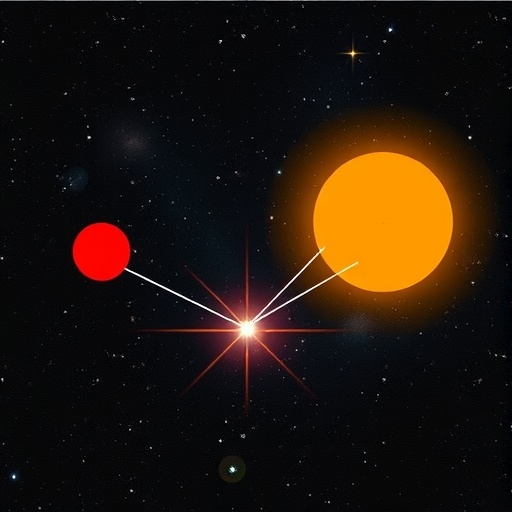
In a breakthrough discovery that challenges longstanding assumptions about the life cycles of massive stars, astronomers have observed a dramatic and unprecedented transformation of the red supergiant star WOH G64. Once heralded as one of the most extreme examples of its kind within the Large Magellanic Cloud, WOH G64 has now shifted into a far hotter and more luminous phase, classifying it as a yellow hypergiant. This rare cosmic event offers unique insights into the late evolutionary phases of massive stars, a period that remains poorly understood despite decades of research.
Red supergiants (RSGs) have typically been regarded as the late-stage evolutionary phase of massive stars before their cataclysmic demise as supernovae. These stars are characterized by cool surface temperatures and immense radii, with WOH G64 standing out for its extraordinary luminosity, size, and the substantial amount of stellar material it sheds through intense mass loss. Since it was recognized in the 1980s, WOH G64 has been a textbook example of these attributes, embodying the extreme end of the RSG population.
However, recent time-series photometric observations have revealed subtle yet profound changes in the star’s brightness and color, signaling an ongoing transformative process. Follow-up spectroscopy, which scrutinizes the star’s light across various wavelengths to decode its chemical composition and atmospheric conditions, confirmed that WOH G64’s spectral characteristics have shifted dramatically. Lines typical of cooler RSG atmospheres have weakened or disappeared entirely, replaced by features indicative of much higher surface temperatures and altered atmospheric dynamics.
This rare transition underscores the notion that the evolution of the most luminous RSGs may not end with a straightforward supernova explosion. Instead, it hints at a more complex path involving a bluewards movement on the Hertzsprung-Russell diagram, where stars evolve from red supergiants to hotter, more compact phases. WOH G64’s current identification as a yellow hypergiant—a class of stars known for their instability, significant mass loss, and extreme brightness—places it in a very short-lived and precarious evolutionary stage.
One of the pivotal revelations from this study is that WOH G64 is not a solitary star, but rather part of a massive symbiotic binary system. In such systems, two stars closely orbit one another, interacting and profoundly influencing each other’s evolution through the exchange of mass and angular momentum. This binary nature offers a compelling explanation for the star’s sudden change, potentially involving a common-envelope phase during which the outer layers of the red supergiant are partially expelled due to gravitational interactions with its companion.
Alternatively, the transition could represent a return to quiescence following an exceptional eruptive episode lasting over three decades, marking one of the longest recorded stellar outbursts of this nature. During such eruptions, the star dramatically increases its brightness and mass-loss rate, altering its extended atmosphere or ‘pseudo-atmosphere’ and leading to the pronounced changes observed in its spectrum and photometric behavior.
The implications of observing this evolutionary leap in real-time extend far beyond WOH G64 itself. It provides a rare laboratory for testing theoretical models of massive star evolution, especially concerning the influence of binary interactions in shaping stellar end-of-life destinies. With many massive stars existing in binary or multiple systems, insights gained here could revisit and refine predictions related to supernova progenitors and the diverse types of supernovae they produce.
Furthermore, the findings highlight the potential for some red supergiants to escape immediate supernova explosions by moving into hotter phases, thereby explaining the sparsely populated region of luminous RSG progenitors in supernova surveys. This shift might also influence the chemical enrichment of galaxies, as these stars’ mass loss contributes to the interstellar medium’s composition prior to their ultimate fate.
Spectroscopic monitoring of WOH G64 throughout its transition has revealed a complex interplay of emission and absorption features, alongside changing molecular bands, indicating evolving atmospheric structures and temperatures. Such detailed observational data enable astrophysicists to constrain stellar parameters with higher precision, such as effective temperature, luminosity, and wind velocities, each essential for reconstructing the physical processes governing massive star evolution.
The study combines multi-decade data sets collected from ground-based observatories and space missions, enabling a robust temporal analysis that captures both gradual and abrupt changes in WOH G64’s physical state. This long-term monitoring approach exemplifies how continuity in astronomical observations is critical to uncovering dynamic phenomena that would otherwise remain hidden in snapshots.
WOH G64’s dramatic metamorphosis propels it into the spotlight as an astrophysical Rosetta Stone, decoding the enigmatic late phases of stellar evolution marked by instability, mass shedding, and interactions in binary systems. It challenges astronomers to rethink the canonical pathways through which massive stars approach their violent endings and to consider the diversity introduced by complex internal and external influences.
Looking ahead, continuous observation campaigns and advanced modeling efforts will be crucial to fully comprehend the mechanisms triggering such dramatic transitions. Understanding the interplay between stellar winds, eruptions, and binary interactions will illuminate not only the fate of WOH G64 but also the fate of many massive stars across the cosmos.
This discovery amplifies the urgency to identify and monitor other luminous red supergiants for similar transitional behavior. Doing so could uncover additional instances of rare phases like the yellow hypergiant stage, enriching our understanding of the fleeting, transformative moments in the life of massive stars.
The implications of this work extend beyond stellar astrophysics. As massive stars are essential drivers of galactic evolution, through their chemical enrichment and feedback mechanisms, unraveling their end-of-life behavior improves models of galaxy formation and evolution across cosmic time.
Ultimately, witnessing WOH G64’s transition offers astronomers a vivid, real-time glimpse into stellar evolution’s intricacies, opening new avenues for research that merge observational astronomy, stellar physics, and computational simulation. The star’s ongoing story promises to keep scientists captivated as its fate unfolds under a more nuanced framework influenced heavily by binary companionship and exceptional eruptive history.
By expanding the frontier of knowledge on how some of the Universe’s most colossal stars navigate their final chapters, this discovery deepens our grasp on the life cycle of matter and energy in the cosmos, reinforcing the intrinsic connection between individual stellar destinies and the broader cosmic ecosystem.
Subject of Research: The late-stage evolution of massive red supergiant stars, the role of binary interactions in stellar evolution, and the identification of transitions from red supergiant to yellow hypergiant phases.
Article Title: The dramatic transition of the extreme red supergiant WOH G64 to a yellow hypergiant.
Article References: Muñoz-Sanchez, G., Kalitsounaki, M., de Wit, S. et al. The dramatic transition of the extreme red supergiant WOH G64 to a yellow hypergiant. Nat Astron (2026). https://doi.org/10.1038/s41550-026-02789-7
Image Credits: AI Generated
DOI: https://doi.org/10.1038/s41550-026-02789-7


