


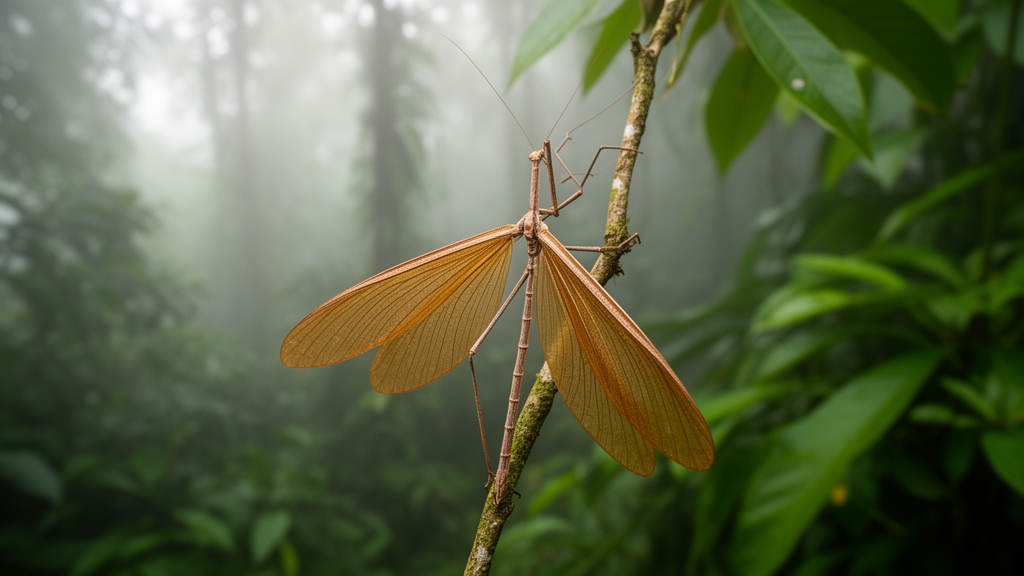
A winged stick insect collected in Veracruz has produced the first recorded Mexican occurrence of Metriophasma iphicles and the northernmost known occurrence of both the species and its genus. The taxonomic study identified 11 specimens from the Estación de Biología Tropical “Los Tuxtlas” near San Andrés Tuxtla. The record raises the number of stick-insect species known from continental North America, defined here as Canada, the United States and Mexico, from 107 to 108.
It also brings the regional total for the family Pseudophasmatidae from six species to seven and the number of genera from 22 to 23. The eight specimens collected in July 2022 comprised seven males and one female. They were taken at night while perched on branches and vines, with no evidence indicating that the insects were feeding on those plants.
Each was preserved separately in 70% ethanol and deposited in the Entomology Laboratory of the Facultad de Ciencias Forestales at the Universidad Autónoma de Nuevo León under the voucher numbers PHASM054–061. One male was dry-mounted to provide a clearer view of the hindwing pattern. The investigators also examined three additional specimens from the same locality, collected in 2017 and 2018, which increased the material under study to 11.
Initial identification exposed differences between the Mexican insects and Agrostia, the only previously recorded winged genus of Pseudophasmatidae in the region. When the specimens were run through an existing regional key, they approached Perliodes, now treated as a synonym of Agrostia. Their hindwings, however, reached the ninth abdominal tergite, while those of Agrostia do not reach the eighth.
Keys published by earlier authors instead led the material to Metriotes, now a synonym of Metriophasma, and subsequent species keys identified the insects as M. iphicles. Among the diagnostic features distinguishing Metriophasma are a sunken, usually triangular apical area on the middle and hind tibiae, five-segmented tarsi, well-developed wings, an abdomen that is not strongly lobed at its distal end, and ventral carinae on the middle and hind femora. These characters help separate the genus from North American families and genera with superficially similar forms.
They distinguish it, for example, from the completely or substantially wingless Haplopus and Hypocyrtus, the strongly lobed terminal abdomen of macropterous Prisopus and the three-segmented tarsi of Timematidae. Several additional traits place the specimens within Metriophasma iphicles and distinguish them from related species. Their elongated bodies and mesonotal carinae separate them from the three stockier species assigned to the subgenus Acanthometriotes.
Tubercles rather than spines on the dorsal mesonotum distinguish them from M. armatum, M. baculus and M. stollii. Their concolorous hindwings differ from those of M. agathocles, M. baculus and M. diocles, while the absence of a median mesonotal carina separates them from M. pericles. The paper’s regional checklist documents seven species of Pseudophasmatidae in Canada, the United States and Mexico.
The family includes three wingless Anisomorpha species, two wingless Autolyca species, the winged Agrostia rugicollis and the newly documented M. iphicles. The Mexican records include A. paromalus from Yucatán, Autolyca elena and A. pallidicornis from Chiapas, A. rugicollis from Colima and M. iphicles from Veracruz. The accompanying identification key is designed for adults of either sex and uses wing development, femoral carinae, body coloration and shape, terminal abdominal structures, body proportions and geographic distribution.
Its compilers caution that some Mexican taxa may remain unreported or undescribed. Metriophasma is a Neotropical genus containing 11 macropterous species. Most are native to South America, with the subgenus Acanthometriotes comprising three stocky South American species and the nominotypical subgenus eight more elongated species, also distributed mainly in South America.
Two species, M. diocles and M. iphicles, had previously been recorded in Central America. M. iphicles was known from Honduras and Panama, so the Veracruz specimens constitute both the first Mexican record and the northernmost reported record of the species and genus. The paper places the occurrence within the tropical and subtropical corridor along the Atlantic side of the continent, where a northward population of M. iphicles has reached Veracruz.
The authors consider the presence of M. iphicles in additional southern Mexican states, including Chiapas and Oaxaca, and in northern Central American countries, including Guatemala and Belize, to be expected. That statement is a prediction rather than a documented extension of the range. The comparison with low-vagility animals such as pit vipers is used as geographic context for the tropical pathway, while the ability of M. iphicles to fly provides a potential means of dispersal.
Geographical separation from the previously reported populations raises the possibility that the Mexican material may conceal additional diversity. The published identification rests on the available morphological evidence, but the authors call for molecular analysis and detailed examination of internal genitalia to determine whether the Veracruz population is genuinely M. iphicles or a closely related undescribed member of the same species complex. The new record also brings the number of winged stick-insect species in continental North America to six: the newly recorded M. iphicles, Agrostia rugicollis, one macropterous Prisopus species, one brachypterous Haplopus species and two brachypterous Hypocyrtus species.
By documenting preserved specimens, clarifying family-level differences and presenting a regional checklist and key, the study expands both the known North American fauna and the set of specimens available for subsequent testing of the Veracruz population’s identity and distribution.
Subject of Research: Taxonomic documentation of the first Mexican record of the winged stick insect Metriophasma iphicles.
Article Title: A new record of a winged stick insect ( Phasmatodea ) from Mexico, with a checklist and key to the species of the family Pseudophasmatidae from continental North America
Article References: de Luna, M., García-Barrios, R., Cuéllar-Rodríguez, G., & López-Mora, U. (2023). A new record of a winged stick insect (Phasmatodea) from Mexico, with a checklist and key to the species of the family Pseudophasmatidae from continental North America. Journal of Orthoptera Research, 32(2), 171-176. https://doi.org/10.3897/jor.32.98203
Image Credits: AI Generated
DOI: 10.3897/jor.32.98203
Keywords: Metriophasma iphicles, stick insects, Phasmatodea, Pseudophasmatidae, Veracruz, Mexico, species record, insect distribution, taxonomic key, cryptic diversity, record, winged
Cite Scienmag News
Gavin Prescott. (October 20, 2026). Winged stick insect recorded in Mexico for first time. Scienmag. https://scienmag.com/winged-stick-insect-recorded-in-mexico-for-first-time/
Gavin Prescott. "Winged stick insect recorded in Mexico for first time." Scienmag, 20 October 2026, https://scienmag.com/winged-stick-insect-recorded-in-mexico-for-first-time/. Accessed 20 October 2026.
Gavin Prescott. "Winged stick insect recorded in Mexico for first time." Scienmag. October 20, 2026. https://scienmag.com/winged-stick-insect-recorded-in-mexico-for-first-time/


