


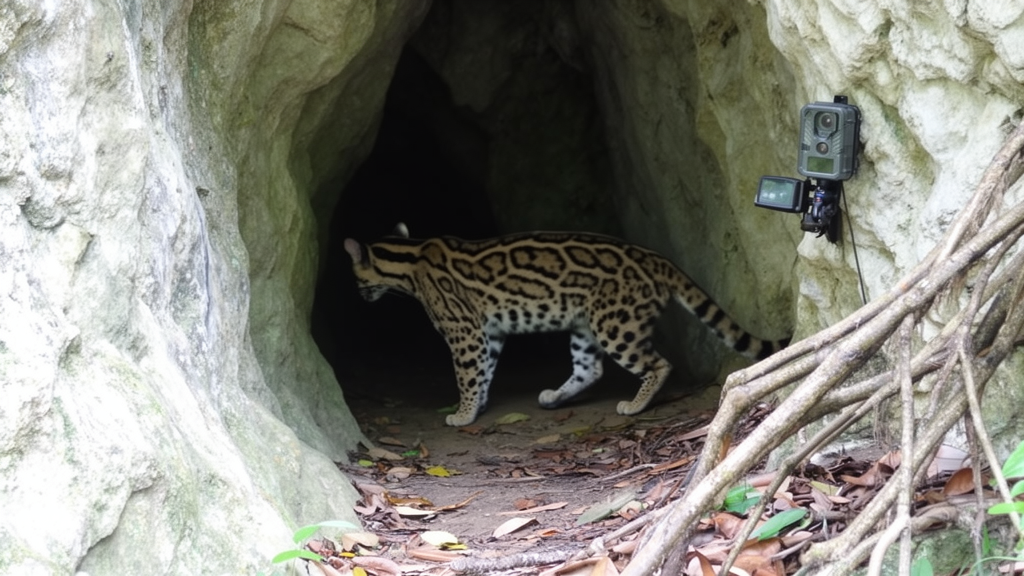
A camera trap in Malaysia’s Lipis Geopark recorded a mainland clouded leopard leaving a limestone cave, providing the first documented evidence of the species using a cave in the country. The observation emerged from a camera-trapping survey of terrestrial vertebrates conducted in the Merapoh karst cave complex and a forested section of the Taman Negara Pahang buffer zone. Researchers deployed 20 passive infrared cameras for 55 days between February and April 2022, accumulating 1,100 camera-trap nights.
The devices produced 7,755 images, including 3,979 wildlife images representing 288 independent capture occasions. These detections covered 30 vertebrate species: 22 mammals, seven birds and one reptile. The clouded leopard image offers a rare glimpse of a globally Vulnerable, elusive cat in a habitat shaped by limestone formations, forest fragmentation, agriculture, tourism and quarrying.
Lipis Geopark covers much of Lipis District in northwestern Pahang and includes permanent forest reserves, portions of Taman Negara Pahang and a section of the Central Forest Spine–Primary Linkage 1 ecological corridor. The Merapoh area contains numerous caves, sinkholes, limestone towers and limestone forests characteristic of Peninsular Malaysia’s karst terrain. The Merapoh cave system is estimated to be approximately 130 million years old, but fewer than half of its caves have been explored.
Because previous research in Malaysian karst systems had concentrated largely on cave-obligate species, the survey was designed to document the use of caves and adjacent forests by medium- and large-bodied terrestrial vertebrates, a group for which local information remained limited. The survey divided its monitoring into two sites. Site A consisted of eight caves in the Merapoh complex, where human influence varied substantially.
Gua Persit and Gua Katak were surrounded by mixed plantations and fruit orchards, while the land around Gua Bekong and Gua Tahi Bintang had been progressively cleared, apparently for agricultural expansion. Gua Kalong, Gua Sisik Naga and Gua Keris ran alongside plantations bordered by patches of secondary vegetation. Gua Gunting stood in a forested landscape connected to Hutan Simpan Persit.
Site B covered approximately 10 km along Federal Route 8 within the Taman Negara buffer zone, adjacent to Hutan Simpan Aur Gading. Cameras there were placed mainly in primary forest, although some sites bordered plantations, secondary vegetation and areas remote from settlements. Ten cameras were installed at each site.
In the cave complex, devices faced cave entrances or exits and were fixed to trees or cave walls. In the forest buffer zone, they were attached to trees and directed toward animal trails and clearings. All cameras were positioned approximately 25–40 cm above ground with a clear view of open ground, an arrangement intended to reduce obstruction from vegetation and improve the chance of recording passing animals.
Species in the resulting images were identified using field guides for the reptiles, birds and mammals of Southeast Asia. The researchers also used rarefaction and extrapolation analyses to assess sampling adequacy, calculated Shannon diversity, Simpson’s dominance and Pielou’s evenness indices, and derived a Photographic Capture Rate Index from independent captures per 100 camera-trap nights. Eurasian wild pig was the most frequently recorded species, appearing in 77 independent occasions for a Photographic Capture Rate Index of 14.000.
Brush-tailed porcupine ranked second with 37 occasions and an index of 6.727, followed by southern pig-tailed macaque with 31 occasions and an index of 5.636. The researchers treated the index as a proxy for relative abundance and activity, cautioning that it can also reflect differences in animal behaviour and detectability rather than directly measuring population size. Site B produced more individual detections than Site A, with 244 compared with 147, but the cave complex yielded greater species richness.
Sample completeness reached approximately 98% at Site A and 99% at Site B, indicating that the difference was unlikely to be an effect of insufficient sampling. Coverage-based rarefaction and extrapolation likewise maintained higher predicted richness for Site A, although confidence intervals overlapped slightly at the highest coverage levels. The Siamese langur and Temminck’s mouse deer were Near Threatened.
Seven detected species were regulated under the Convention on International Trade in Endangered Species of Wild Fauna and Flora. Temminck’s mouse deer, mainland clouded leopard, leopard, Indian muntjac and Malayan sun bear appeared in Appendix I, while the great argus and leopard cat appeared in Appendix II. These classifications describe global conservation status and trade controls; they do not by themselves establish the size or trend of the populations recorded in Lipis.
The clouded leopard was photographed by a camera facing a trail into one of the caves. The sequence showed an individual exiting, directly documenting cave use. The research described this as the first such record in Malaysia.
Mainland clouded leopards occur in Peninsular Malaysia and are reported from mature evergreen rainforest, secondary or selectively logged forest and grassland, although they are associated particularly with dense primary forest. Malaysian camera-trapping research has previously found more detections in forested habitats, at higher elevations and farther from water bodies. The Merapoh observation therefore adds a new element to the species’ documented habitat use, but it does not establish that caves are a regular refuge, how often they are used or why the individual entered this one.
The authors drew comparisons with field observations from Borneo, where mainland clouded leopards have been observed walking along forest trails and may use caves or rocky ledges as resting sites. Those observations, together with the Malaysian image, indicate that the species is not exclusively dependent on canopy-dwelling activity. The Merapoh record is consistent with behavioural flexibility, yet its cause remains unresolved.
The authors proposed that cave use could involve shelter, movement or foraging strategies and could potentially represent an adaptive response to anthropogenic pressure. These remain interpretations rather than tested outcomes of the camera-trap observation. Because the record came from one camera and one exiting animal, it cannot establish a behavioural pattern across Lipis Geopark or the wider population.
Human activity may complicate interpretation of wildlife use around the surveyed caves. Most sites in Site A showed evidence of tourism, agriculture or guano harvesting, and local guano collection was frequently reported at Gua Persit. Unmanaged visitation can introduce noise, light and litter, while guano harvesting has been associated with the loss of bat pups and the abandonment of colonies.
Quarrying and forest conversion have affected limestone hills in the region, and oil-palm and rubber plantations have fragmented much of Pahang’s native forest. The survey also illustrates both the strengths and limitations of camera trapping in karst terrain. Cameras enable continuous, non-invasive monitoring without requiring observers to remain present, which is particularly useful for elusive mammals such as large carnivores and ungulates.
However, irregular cave shapes constrain camera placement and viewing angles, debris can trigger devices and animals moving above the sensor may be missed. The researchers addressed some of these problems by monitoring multiple entrances, exits, forest trails and clearings, but the resulting records still represent detection rates rather than complete population inventories. The authors called for comprehensive biodiversity assessments across the largely unexplored limestone systems of Merapoh and other parts of Lipis Geopark, alongside broader camera surveys of the Taman Negara buffer zone.
They also emphasized integrating these findings into forest-connectivity planning so that protection of individual caves is supported by connected surrounding habitat.
Subject of Research: Camera-trap documentation of vertebrate diversity and mainland clouded leopard cave use in Lipis Geopark, Malaysia
Article Title: Camera trapping survey of vertebrates in Lipis Geopark, Pahang, Malaysia with notes on cave utilisation by mainland clouded leopard ( Neofelis nebulosa )
Article References: Azidi, S. N. Z., Halmi, N. Z., Anak Chuat, J. C., Ahamed Noordeen, S. N., Mohd Yazid, M. H., Hasrizal Fuad, M. A. B., Arifuddin, M., Mukri, I., Har, F., Giordano, A., & Vijaya Kumaran, J. (2026). Camera trapping survey of vertebrates in Lipis Geopark, Pahang, Malaysia with notes on cave utilisation by mainland clouded leopard (Neofelis nebulosa). Biodiversity Data Journal, 14, Article e166468. https://doi.org/10.3897/bdj.14.e166468
Image Credits: AI Generated
Keywords: mainland clouded leopard, Lipis Geopark, Merapoh caves, camera trapping, karst biodiversity, Taman Negara Pahang, wildlife conservation, habitat connectivity, Malaysia, vertebrate diversity, Camera, trapping
Cite Scienmag News
Margaret Porter. (October 20, 2026). Camera survey records Malaysian clouded leopard using limestone cave. Scienmag. https://scienmag.com/camera-survey-records-malaysian-clouded-leopard-using-limestone-cave/
Margaret Porter. "Camera survey records Malaysian clouded leopard using limestone cave." Scienmag, 20 October 2026, https://scienmag.com/camera-survey-records-malaysian-clouded-leopard-using-limestone-cave/. Accessed 20 October 2026.
Margaret Porter. "Camera survey records Malaysian clouded leopard using limestone cave." Scienmag. October 20, 2026. https://scienmag.com/camera-survey-records-malaysian-clouded-leopard-using-limestone-cave/


