


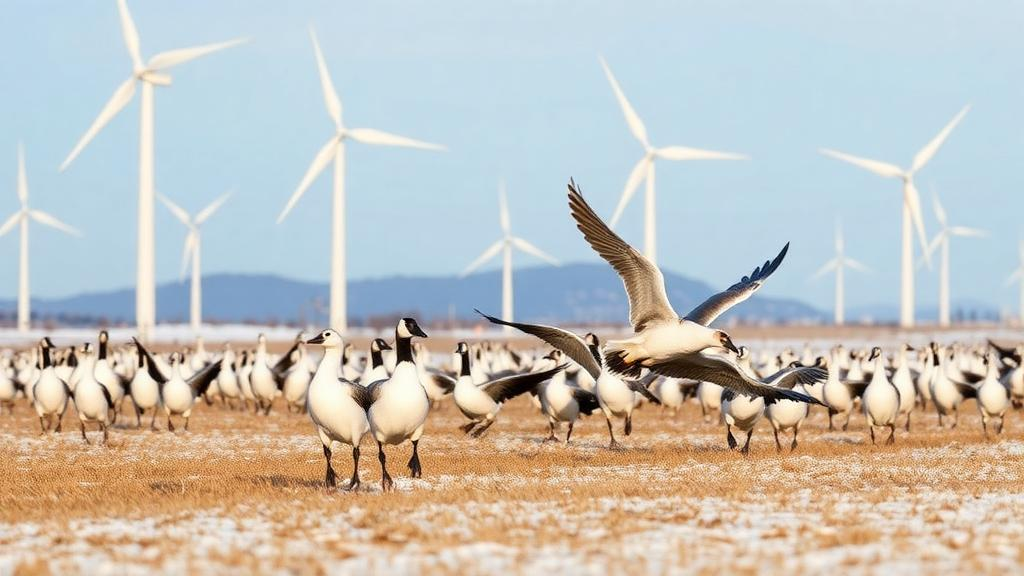
Denmark’s race toward climate neutrality is colliding with one of its most loyal winter visitors. In the fields of Vinge, in central Jutland, thousands of Taiga Bean Geese descend each winter on green cereal fields — and a proposed renewable energy cluster of wind turbines, solar panels and biogas plants threatens to erase exactly those fields. A new study published in Environmental Management by Lisa Vergin of Aarhus University and colleagues has now put a number on what that loss would mean for the birds, and the answer is stark: under prolonged cold conditions, geese deprived of winter cereals lose up to 8 percent more body mass than geese with access to them, an energy debt that grows larger with every additional freezing day.
The stakes are unusually high for this particular population. Taiga Bean Geese wintering in central Jutland belong to a subgroup of only about 1,500 to 2,000 individuals breeding across northeastern Norway, northern Sweden, Finland and northwest Russia, and the species is a conservation concern after past population declines. What makes the Danish fields so important is a behavioral quirk: extreme site fidelity. Nearly all geese in this subgroup shift from their main wintering site at Lille Vildmose to Vinge when cold weather strikes, turning the agricultural landscape into a critical cold-weather refuge. Roughly 70 percent of geese tagged in Denmark returned to central Jutland as their cold-spell refuge across multiple winters, concentrating on the same core areas year after year.
To quantify what losing that refuge would cost, the researchers built an energy budget model adapted from earlier work on Barnacle Geese, recalibrated for Taiga Bean Geese using species-specific measurements wherever available. The approach tracks daily energy intake against daily expenditure and converts any surplus or deficit into body mass change — a positive energy budget adds tissue at a rate of one gram per 29 kilojoules, with a storage efficiency of 0.8, while a deficit burns reserves at the same conversion rate with full efficiency. Eleven adult geese were captured in November 2023 at Lille Vildmose and fitted with solar-powered GPS-GSM neck collars; seven of them used the central Jutland wintering area that season, providing the movement data that anchored the simulations.
The technical machinery behind the model is considerable. Because no basal metabolic rate measurements exist for Taiga Bean Geese, the team scaled values from the closely related Greylag Goose to the birds’ body mass, which started at an average of 3,487 grams. Activity costs came from a machine-learning classifier trained on tri-axial accelerometer data paired with synchronized video recordings of the tagged birds — 6.75 hours of annotated footage covering foraging, preening, sleeping, resting and flying. The resulting extreme gradient boosting model achieved 91 percent overall accuracy and a Cohen’s Kappa of 0.87, allowing the researchers to reconstruct each bird’s daily time budget. Each behavior was assigned a metabolic multiplier: 1.6 times basal rate for foraging, 1.5 for inactivity, 1.9 for preening, and a striking 13.7 times basal rate for flight.
Thermoregulation added another layer. The model estimated heat loss as a function of body mass, ambient temperature, wind speed adjusted to bird height and global radiation, assuming a body temperature of 40 degrees Celsius and plumage insulation values averaged from Barnacle and Brent Geese. Crucially, heat generated during activity was credited toward thermoregulation, so extra thermoregulatory costs were only charged when environmental heat loss exceeded activity-derived heat production. Energy intake, meanwhile, was reconstructed from dropping rates, fecal composition and plant energy content measured separately on freezing days with snow and frost and on milder days above zero, ensuring the foraging data matched the simulated weather.
The team ran four scenarios over a 56-day simulation window from early January to late February. The worst case, pasture-cold, restricted geese to semi-natural pastures during a prolonged cold spell — effectively mimicking the complete loss of winter cereal fields to the energy cluster. Two contrasting cold scenarios maintained cereal access, either exclusively or split evenly with pastures, mirroring the habitat mix geese actually use during cold periods. A final mild-winter scenario kept geese on pastures alone. Weather inputs were drawn from real conditions in winter 2023/2024, with cold scenarios parameterized on days averaging below zero and the mild scenario on days above zero. Each scenario was run 500 times with parameters sampled from their measurement uncertainties to produce confidence intervals.
The results tell a clear story about winter severity. In all cold scenarios, energy intake fell short of the elevated expenditure driven by thermoregulation, and simulated body mass declined — daily energy intake ranged from 1,167 to 1,835 kilojoules while expenditure reached up to 1,728 kilojoules. But the habitat configuration determined how fast the reserves drained. By the end of the simulation, geese confined to pastures were up to 8 percent lighter than those with winter cereal access, and the gap widened almost perfectly linearly over time, at 0.14 percent per day compared with exclusive cereal foraging. That translated into an additional mass loss of nearly 5 grams per day for pasture-only geese versus cereal foragers, and about 2.7 grams per day versus geese using both habitats. Under mild conditions, by contrast, geese maintained stable body mass on pastures alone.
The implications ripple far beyond a single winter. Body stores accumulated on the wintering grounds fuel spring migration, condition at arrival on the breeding grounds, and ultimately reproductive success — female geese arriving in better condition are known to breed more successfully, meaning a bad winter can generate carry-over effects that suppress the population years of effort are meant to protect. The modeled reductions of 9 to 17 percent in the cold scenarios are broadly comparable to declines documented in other goose species, including roughly 20 percent modeled over two months in wintering Brent Geese and 13 percent across a winter in Barnacle Geese. Geese can compensate to some degree — by extending nocturnal foraging, which the GPS data showed peaks around full moon, or by shifting to agricultural grasslands — but each strategy carries costs, from predation risk at night to the energy price of longer flights, estimated at 10.5 joules per meter flown.
There is a real irony in the situation the study exposes. The renewable energy cluster is part of Denmark’s legally mandated push toward climate neutrality by 2050, yet its footprint falls on the precise fields that make cold-spell survival possible for a threatened goose population. The researchers stress that their findings do not argue against the green transition, but they do show that land-use change must be evaluated against both resource quality and environmental context. Pastures suffice in mild winters; cereals become lifelines in cold ones. Since climate change is expected to increase variability even as average temperatures rise — 12 of the past 16 Danish winters included at least one week-long cold spell, and the winter of 2026 delivered 44 subzero days — those lifelines will keep being needed.
The study’s most actionable message concerns how to plan the escape routes. For site-faithful species like Taiga Bean Geese, alternative habitat works best when it is familiar habitat: the researchers suggest converting fields the geese already use, close to low-disturbance natural areas such as the Nørreådalen river valley, where the project has proposed establishing compensatory winter cereal fields. They recommend doing this before infrastructure is built, within an adaptive management framework, so geese can learn and adjust to the new fields while the old ones still exist. Field selection by geese depends not just on food quality but on field size, elevation, distance from roads and roosts, and the weight of tradition and memory — factors that no energy-siting map currently captures. As the world builds out renewable capacity at unprecedented speed, this Danish case offers a template: budget the energy of the animals that live where the turbines will stand, and design the green transition so its gains for the climate do not become losses for the biodiversity it is meant to protect.
Subject of Research: Energetic consequences of renewable energy habitat loss for wintering Taiga Bean Geese in Denmark
Article Title: Habitat Loss Through Renewable Energy Infrastructure: Budgeting the Energetic Consequences for Wintering Geese
Article References: Vergin, L., Madsen, J., Linssen, H., Nolet, B. A., & Clausen, K. K. (2026). Habitat Loss Through Renewable Energy Infrastructure: Budgeting the Energetic Consequences for Wintering Geese. Environmental Management, 76(10), Article 331. https://doi.org/10.1007/s00267-026-02632-9
Image Credits: AI Generated
DOI: 10.1007/s00267-026-02632-9
Keywords: Taiga Bean Goose, renewable energy, habitat loss, wind turbines, solar panels, energy budget, thermoregulation, GPS tracking, site fidelity, winter cereals, Denmark, conservation planning
Cite Scienmag News
Margaret Porter. (September 30, 2026). Wind Turbines vs. Wintering Geese: Energy Transition May Drain Vital Bird Reserves. Scienmag. https://scienmag.com/wind-turbines-vs-wintering-geese-energy-transition-may-drain-vital-bird-reserves/
Margaret Porter. "Wind Turbines vs. Wintering Geese: Energy Transition May Drain Vital Bird Reserves." Scienmag, 30 September 2026, https://scienmag.com/wind-turbines-vs-wintering-geese-energy-transition-may-drain-vital-bird-reserves/. Accessed 4 October 2026.
Margaret Porter. "Wind Turbines vs. Wintering Geese: Energy Transition May Drain Vital Bird Reserves." Scienmag. September 30, 2026. https://scienmag.com/wind-turbines-vs-wintering-geese-energy-transition-may-drain-vital-bird-reserves/


