


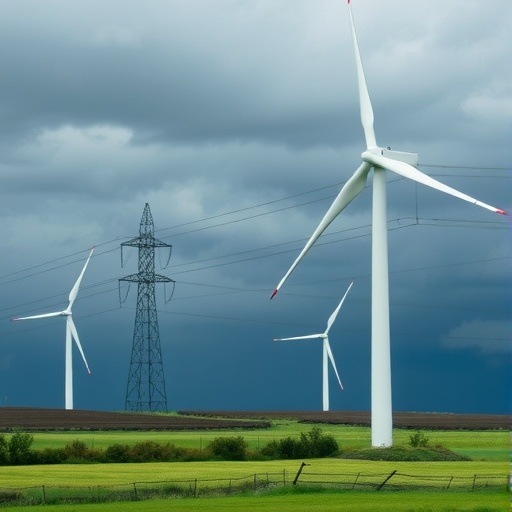
A new review of research on wind-driven power outages finds that despite rapid advances in weather forecasting, machine learning, and grid-hardening technologies, significant gaps remain in the ability to predict and prevent widespread blackouts caused by typhoons, hurricanes, and falling trees. The study, published in the International Journal of Disaster Risk Science, systematically surveys the field of wind-induced electric power interruption and argues that future progress depends on integrating meteorology, structural mechanics, electrical engineering, and artificial intelligence into unified early warning systems.
The review, authored by Jingwei Fu, Donglian Gu, Zhen Xu, and Qingrui Yue, organizes existing knowledge around a “risk source–risk exposure–risk mitigation” (3R) framework, originally proposed for urban safety analysis. Under this scheme, wind disasters and their secondary hazards—most notably falling trees—constitute the risk sources; transmission and distribution infrastructure, from towers and conductors to insulators and substation equipment, constitutes the risk exposure; and resilience-building measures before and during an event constitute the risk mitigation. The authors argue that this framing captures the vital interdependencies among the components of the problem better than earlier reviews, which they say have tended to focus on specific disciplines or isolated technical approaches.
The stakes are substantial. The review cites an analysis of 66 major power outages worldwide between 2011 and 2019, which found that extreme weather was the dominant root cause, with tree falls serving as the most common immediate trigger; wind events and associated tree damage together accounted for more than half of major outages in that period. The consequences can be severe even in well-prepared systems. When Super Typhoon Doksuri made landfall in Fujian, China, in 2023, it felled more than 1,500 transmission towers, induced over 1,300 distribution line outages, and affected at least 14,000 distribution transformer zones. In the Northeastern United States, one study cited in the review estimates that approximately 55.2 percent of power system failures are caused by tree failure alone.
The first pillar of the review addresses the risk source: how well scientists can model the winds that threaten power systems. The authors describe a field in transition. Numerical weather prediction models such as the Weather Research and Forecasting (WRF) model, MM5, COSMO, and RAMS remain the workhorses of operational forecasting, but machine learning–based weather prediction systems have emerged as a major shift. The review highlights systems including FourCastNet, which delivers global forecasts at 0.25-degree resolution; FuXi, which extends to 15-day global forecasts at six-hour temporal resolution; FengWu, which pushes accurate medium-range prediction beyond 10 days; GraphCast, which uses a graph neural network on a global icosahedral grid to produce 10-day forecasts of hundreds of parameters in under a minute; and Pangu-Weather, trained on 39 years of global data, which the review notes outperformed the European Centre for Medium-Range Weather Forecasts’ Integrated Forecasting System in tracking two strong tropical cyclones.
Yet these advances come with important caveats. The review notes that machine learning weather prediction systems suffer from excessive detail smoothing in forecasts and weaker typhoon intensity prediction. More fundamentally for power applications, most mesoscale numerical weather prediction frameworks operate at grid spacings of roughly 1 to 10 kilometers—far coarser than the 100-meter to 1-kilometer scales, and 10-to-100-meter microscales, at which urban airflow actually behaves. Because large-scale training data limit the performance of even AI-enhanced forecasts at the city level, the review concludes that mesoscale outputs must be dynamically downscaled, often through computational fluid dynamics (CFD), to support urban-scale wind field prediction. Promising approaches include nested multiscale modeling that embeds corrected mesoscale wind fields into high-fidelity CFD, and precomputing CFD solutions for varied inlet conditions so that detailed wind fields can be generated by interpolation, minimizing real-time computational cost.
A second critical risk source is vegetation. Trees can fail through stem fracture, root disruption, or complete overturning, and the resulting damage modes to power systems are well catalogued: fallen trees or limbs knocking down or breaking poles, breaking lines, bridging conductors to cause short circuits between phase lines, or pushing lines into contact. The review describes how modeling has progressed from statistical vulnerability curves—species-specific damage risk functions based on traits like height and crown structure—to mechanistic models such as HWIND, GALES, and FOREOLE, which compute threshold wind speeds for stem breakage or uprooting. One study found that pole failure likelihood rises steeply once wind speeds exceed 50 meters per second. Urban trees, the review emphasizes, differ from forest trees in having broader crowns and more compact branching, which heightens wind resistance but also increases susceptibility to falling. One integrated framework combining CFD with a mechanistic model, validated against observed tree damage on the Tsinghua University campus from 2017 to 2019, showed simulated damage falling within one standard deviation of actual statistics.
But the tree risk field, the authors argue, is hampered by a weak data foundation. Urban greening censuses and remote sensing products mostly capture two-dimensional canopy coverage, while the three-dimensional structural data needed to assess mechanical stability—trunk taper, canopy centroid position, stem inclination—are largely absent. Tree databases also often lack species classification, which one study found improved power outage prediction accuracy by 3 percent, and fail to account for urban growth patterns such as restricted root zones. Mechanistic models, meanwhile, frequently cannot be validated against empirical experimental data, meaning predictions rest on macro-level probabilistic statistics or phenomenological descriptions rather than resolved failure mechanics.
The second pillar of the framework, risk exposure, examines the vulnerability of transmission and distribution systems. The review distinguishes physical vulnerability—direct wind damage and cascading failures—from functional vulnerability, reflected in the ability to predict outages. For transmission systems, finite element modeling has become the dominant tool, with recent work focusing on tower-line coupling effects and how microtopography, span configurations, and regional climate characteristics exacerbate tension imbalances that precipitate cascading collapse. The authors caution, however, that simulation reliability depends on robust parameterization and that inappropriate simplifications of nonlinear tower-conductor interactions can undermine failure predictions. Distribution systems, by contrast, are more environmentally sensitive, and assessment is shifting from deterministic finite element approaches toward probabilistic vulnerability modeling, increasingly informed by high-resolution geospatial data, satellite imagery, and LiDAR.
Cascading failure emerges as a central concern. The review describes two principal modeling families. Physical models—such as the OPA, Manchester, Hidden failure, COSMIC, and multi-timescale quasi-dynamic models—represent grid topology, power flow, and protective relay operations explicitly, offering mechanistic accuracy at high computational cost. Probabilistic models—including CASCADE, branching process, and interaction models—sacrifice physical detail for speed, making them suited to large-scale statistical risk assessment. One study of 700 historical floods and tropical cyclones across 30 countries found that cascading failures were responsible for 64 to 89 percent of service interruptions. Machine learning methods are increasingly layered on top: support vector machines for cascade prediction, deep autoencoders for identifying vulnerable nodes, convolutional neural networks paired with depth-first search for cascade screening thousands of times faster than traditional methods, and graph neural networks that can rank node centrality in large grids after training on small ones. The review identifies persistent drawbacks: heavy data requirements, time-consuming hyperparameter tuning, and poor explanatory power regarding cascade mechanisms.
On functional vulnerability, the review documents how multi-source data fusion has markedly improved outage prediction. Integrating meteorological, geographic, and infrastructure features improved predictive capability by 27.5 percent in one study; merging weather factors with outage data in South Africa achieved 97.1 percent accuracy across 323 outages; and adding vegetation-related variables raised prediction accuracy from 33 percent to 62 percent in another. An urban-scale framework combining fragility curves for pole-conductor systems with infrastructure, vegetation, and weather data feeds these inputs into machine learning models that generate risk maps for targeted mitigation. Still, the review flags a core weakness: most models are “location-specific,” trained on historical data from particular cities or utilities, and thus difficult to transfer to regions with limited records. Models also rely on static data and isolated variables, neglecting physical consistency and evolving risk dynamics.
The third pillar, risk mitigation, covers strategies from hardening to high-tech monitoring. The review divides resilience measures into operational approaches—network reconfiguration, microgrid formation, mobile emergency generator deployment, and coordinated repair crew routing—and planning-based approaches such as undergrounding lines, hardening overhead infrastructure, vegetation management, and strategic siting of energy storage and black start units. Vegetation management, one cited study found, decreases failure points by 37.3 percent under extreme weather conditions. Current trends favor coordinating maintenance personnel with mobile resources and microgrids, and shifting from static optimization to data-driven and multi-energy coordination. On the monitoring side, the review surveys interferometric synthetic aperture radar for infrastructure deformation—capturing, for example, 20 millimeters of uplift at a German geothermal plant and 40 millimeters of settlement at Indonesian coal silos—alongside UAV inspections capable of detecting sagging spans, leaning poles, and damaged insulators, ultraviolet-visible video analysis for corona discharge detection, ultra-high frequency partial discharge sensors, and intelligent inspection robots combining visible-light, infrared, and acoustic sensing.
The review’s conclusions emphasize four gaps that define the research agenda ahead. Wind-field modeling remains anchored to stationary-wind assumptions and single meteorological inputs, ill-suited to the dynamic, nonstationary, and asymmetric structures of landfalling typhoons. Cascading faults in urban power systems are not fully analyzed, and existing models typically neglect external environmental influences, skewing recovery assessments. Outage prediction remains too dependent on static data and historical fitting at the expense of physical consistency. And mitigation strategies still emphasize localized hardening and post-event response rather than pre-disaster resilience planning and system design. The authors call for a holistic framework combining operational optimization, intelligent perception, and digital twin strategies—one that would move power systems from reactive repair toward predictive, adaptive resilience, and, ultimately, keep cities powered through the storms ahead.
Cite Scienmag News
Faith Mcneil. (August 31, 2026). Wind-Induced Electric Power Interruption: A Review of Risk Source, Risk Exposure, and Risk Mitigation. Scienmag. https://scienmag.com/wind-induced-electric-power-interruption-a-review-of-risk-source-risk-exposure-and-risk-mitigation/
Faith Mcneil. "Wind-Induced Electric Power Interruption: A Review of Risk Source, Risk Exposure, and Risk Mitigation." Scienmag, 31 August 2026, https://scienmag.com/wind-induced-electric-power-interruption-a-review-of-risk-source-risk-exposure-and-risk-mitigation/. Accessed 3 September 2026.
Faith Mcneil. "Wind-Induced Electric Power Interruption: A Review of Risk Source, Risk Exposure, and Risk Mitigation." Scienmag. August 31, 2026. https://scienmag.com/wind-induced-electric-power-interruption-a-review-of-risk-source-risk-exposure-and-risk-mitigation/


