


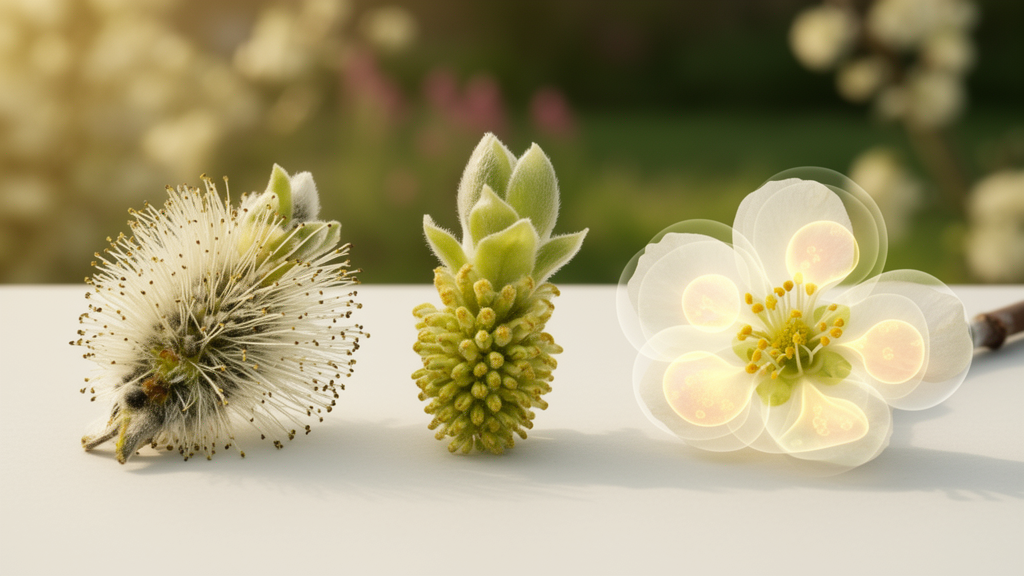
RNA sequencing of male, female and bisexual flowers from the unusual willow Salix × jiangsunensis ‘J795’ identified thousands of genes expressed differently among the three inflorescence types and highlighted members of the high-mobility group (HMG) gene family that were especially highly expressed in male flowers. The study, published in BMC Plant Biology , combined transcriptomic comparisons, genome-wide analysis of the HMG family and quantitative reverse-transcription PCR in a monoecious mutant germplasm that also produces female individuals. Researchers compared RNA sequences from male, female and bisexual inflorescences of ‘J795’.
The analysis found 7,089 differentially expressed genes between female and male flowers, 3,220 between bisexual and male flowers, and 3,688 between bisexual and female flowers. These results show that each pair of floral types was associated with a substantial set of transcriptional differences. The number of differentially expressed genes alone does not establish how the three floral states arise or whether any particular expression change causes male, female or bisexual development.
Gene Ontology enrichment associated the genes differing between female and male flowers, and between bisexual and male flowers, primarily with microtubule-based movement and activity. By contrast, genes distinguishing bisexual from female flowers were enriched in microtubule activity and the regulation of pollen-tube processes. These enrichment results link sex-associated expression differences to biological processes in the source analysis, but they do not demonstrate that changes in those processes cause the observed floral differences.
Genome-wide analysis identified 19 HMG genes in the willow genome, distributed across 12 chromosomes and including six tandem duplicate pairs. Quantitative reverse-transcription PCR classified the 19 genes into three expression categories: highest expression in male flowers, highest expression in female flowers, and relatively high expression in both female and bisexual flowers. Most HMG family members were highly expressed in bisexual flowers, while several members showed markedly elevated expression in male flowers.
HMG18 had the highest expression level in male flowers, leading the researchers to identify it as a potential candidate in male flower development in Salix . The findings point to the HMG family as a subject for further investigation of sex differentiation, stamen development and pistil development in willow, but the evidence remains expression-based. The work was conducted in one unusual cultivar and compares three flower types within ‘J795’; the supplied findings do not establish that the expression patterns occur across other willow genetic backgrounds or developmental conditions.
Nor do they show whether HMG18 or other HMG genes are necessary or sufficient for a particular floral outcome. Described by the authors as the first transcriptomic investigation of sex-related genes using this mutant willow germplasm, the study provides characterized genes and expression profiles that can guide subsequent functional research.
Subject of Research: HMG gene-family expression across male, female and bisexual flowers in the ‘J795’ willow
Article Title: Transcriptome analysis of HMG family in Salix × Jiangsunesis ‘J795’: characterization, expression patterns and roles in sex differentiation
Article References: Wang, P., Liang, L., Zhang, J., & Zhou, J. (2026). Transcriptome analysis of HMG family in Salix × Jiangsunesis ‘J795’: characterization, expression patterns and roles in sex differentiation. BMC Plant Biology. https://doi.org/10.1186/s12870-026-09243-w
Image Credits: AI Generated
DOI: 10.1186/s12870-026-09243-w
Keywords: willow, HMG genes, sex differentiation, RNA sequencing, flower development, bisexual flowers, differential gene expression, microtubule activity, qRT-PCR, gene duplication, Transcriptome, analysis
Cite Scienmag News
Juliet Wilcox. (October 22, 2026). Willow HMG genes show sex-associated expression across three flower types. Scienmag. https://scienmag.com/willow-hmg-genes-show-sex-associated-expression-across-three-flower-types/
Juliet Wilcox. "Willow HMG genes show sex-associated expression across three flower types." Scienmag, 22 October 2026, https://scienmag.com/willow-hmg-genes-show-sex-associated-expression-across-three-flower-types/. Accessed 22 October 2026.
Juliet Wilcox. "Willow HMG genes show sex-associated expression across three flower types." Scienmag. October 22, 2026. https://scienmag.com/willow-hmg-genes-show-sex-associated-expression-across-three-flower-types/


