


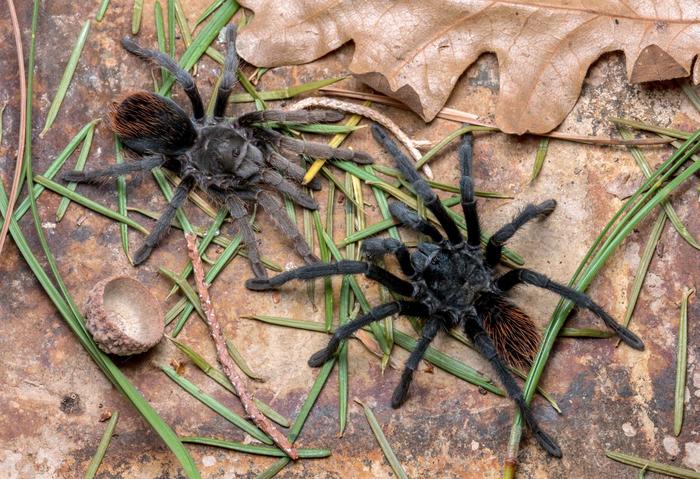
A new species of tarantula spider, Aphonopelma jacobii, has been discovered from the Chiricahua Mountains in southeastern Arizona. This small, black and grey tarantula species has fiery red hairs on its abdomen and can be found in the high-elevation habitats of the Chiricahua Mountains, where it survives through bitterly cold winters.

Credit: Michael A. Jacobi
A new species of tarantula spider, Aphonopelma jacobii, has been discovered from the Chiricahua Mountains in southeastern Arizona. This small, black and grey tarantula species has fiery red hairs on its abdomen and can be found in the high-elevation habitats of the Chiricahua Mountains, where it survives through bitterly cold winters.
The discovery was rather unexpected. “We often hear about new species being discovered from remote corners of Earth, but it is remarkable that these spiders are found in our own backyard, albeit in somewhat difficult-to-access areas of our backyard,” said Dr. Chris Hamilton, assistant professor at the University of Idaho and co-lead author of a study in ZooKeys that reports on the spider. “With Earth in the midst of a human-mediated extinction crisis, it is astonishing how little we know about our planet’s biodiversity, even for conspicuous and charismatic groups such as tarantulas.”
The Chiricahuas, renowned for their exceptional biodiversity and high levels of endemism, compose part of the Madrean Archipelago (colloquially referred to as the Madrean Sky Islands), a complex of forested mountain ranges that span the cordilleran gap between the Colorado Plateau and Rocky Mountains in the southwestern United States and the Sierra Madre Occidental in northwestern Mexico. These montane forest “islands”—separated from each other by low-elevation deserts and arid grasslands—have evolved in isolation, leading to the origin of numerous short-range endemic species, and resulting in a mosaic of biodiversity unlike that of any other region in the United States.
The forests where these tarantulas live are threatened by several factors, perhaps most notably from climate change. Recent studies in the sky island region suggest that these forests will be “pushed off” the mountains over the next several decades as temperatures and precipitation continue to increase and decrease, respectively. Organisms adapted to these cooler and more humid mountain tops—such as these spiders—will likely become extinct as suitable habitat disappears.
Dr. Brent Hendrixson, professor at Millsaps College and co-lead author of the study adds, “These fragile habitats are also threatened by increased exurban development in the San Simon Valley and Portal areas, destructive recreational activities, and wildfires. In addition, there is some concern that these tarantulas will be exploited for the exotic pet trade due to their rarity, striking coloration, and docile disposition. We must consider the impact that unethical collectors might have on these spiders when determining the threats to this species and the implications for its conservation.”
Aphonopelma jacobii is named after Michael A. Jacobi, who helped find several of the first specimens which led to the description of this new species.
“This discovery represents the 30th species of tarantula documented from the United States. Aphonopelma is the most species diverse tarantula genus on the planet (at least for documented species). Our research adds to this number and continues to advance our understanding of the true species diversity in this incredibly interesting and important biodiversity hotspot,”Dr. Hamilton says in conclusion.
Original source
Hamilton CA, Hendrixson BE, Silvestre Bringas K (2024) Discovery of a new tarantula species from the Madrean Sky Islands and the first documented instance of syntopy between two montane endemics (Araneae, Theraphosidae, Aphonopelma): a case of prior mistaken identity. ZooKeys 1210: 61-98.
Journal
ZooKeys
Article Title
Discovery of a new tarantula species from the Madrean Sky Islands and the first documented instance of syntopy between two montane endemics (Araneae, Theraphosidae, Aphonopelma): a case of prior mistaken identity
Article Publication Date
16-Aug-2024
Cite Scienmag News
Sloane Callahan. (August 19, 2024). Will climate change lead to the extinction of a newly discovered tarantula species? Scienmag. https://scienmag.com/will-climate-change-lead-to-the-extinction-of-a-newly-discovered-tarantula-species/
Sloane Callahan. "Will climate change lead to the extinction of a newly discovered tarantula species?" Scienmag, 19 August 2024, https://scienmag.com/will-climate-change-lead-to-the-extinction-of-a-newly-discovered-tarantula-species/. Accessed 3 September 2026.
Sloane Callahan. "Will climate change lead to the extinction of a newly discovered tarantula species?" Scienmag. August 19, 2024. https://scienmag.com/will-climate-change-lead-to-the-extinction-of-a-newly-discovered-tarantula-species/

