


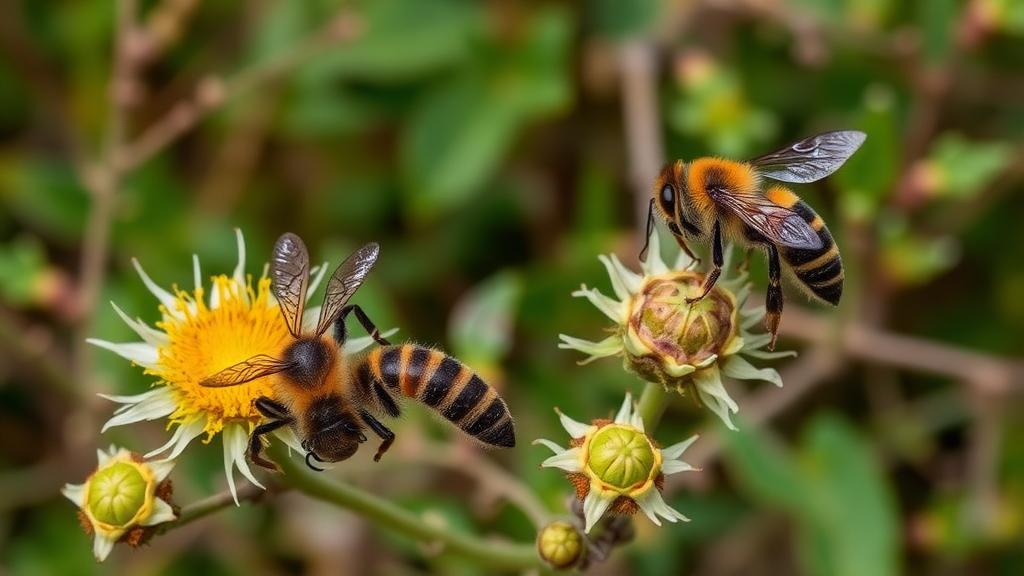
A year-long field study of wild bees in two tropical dry-forest localities in central Mexico recorded 1,076 individuals representing 148 species, 55 genera and five families. The better-vegetated site, El Limón, contained more bees than the more heavily transformed Quilamula site, but the two localities did not differ significantly in three measures of bee diversity. Their species assemblages were markedly different: only 39% of the recorded species were shared, and multivariate analyses found that bee communities varied among both localities and seasons. The results show that similar overall diversity can conceal substantial differences in which bee species occupy a habitat and when they are most abundant.
The study took place from July 2015 to July 2016 in the Balsas River Basin of southern Morelos, Mexico. El Limón lies within the Sierra de Huautla Biosphere Reserve, where continuous dry forest remains relatively well conserved, although grazing, small-scale agriculture and activities associated with white-tailed deer management create some disturbance. Quilamula, outside the reserve’s boundaries, contains a larger proportion of cropland, pasture, secondary vegetation and human settlement, with only 31% of its area inside the reserve. Both localities have a warm subhumid climate and receive about 900 millimetres of rain annually, mainly from May through October, followed by a dry season from November through April.
Researchers sampled flowering understory vegetation on one sunny, rain-free day each month, except in December 2015. Two collectors spent seven hours traversing seven sampling sites at El Limón and five at Quilamula with light-mesh entomological nets measuring 30 centimetres in diameter. Sampling focused on accessible flowering shrubs and herbaceous plants, with trees included when flowering branches could be reached. The researchers described this as haphazard rather than randomized sampling. Individuals of the western honey bee, Apis mellifera, were not collected because the study focused on wild bees. One specimen per species was deposited in the Entomological Collection of the Center of Zoological Studies at the University of Guadalajara.
The researchers compared vegetation cover between the localities using the Modified Soil Adjusted Vegetation Index, or MSAVI. This remote-sensing measure was selected because it is related to leaf area in tropical dry forest and can distinguish sparse vegetation from bare soil in semi-arid ecosystems. For each locality, the team defined a polygon 450 metres wide around the sampling sites and placed 98 points at least 150 metres apart within it. Average MSAVI values were calculated at a spatial resolution of 30 metres for three periods: the 2015 rainy season, the 2015–2016 dry season and the 2016 rainy season. A linear mixed model showed that vegetation cover was higher at El Limón than at Quilamula when results were pooled across seasons, with a reported P value of 0.0003. Cropland occupied a larger area in the Quilamula polygon, whereas dry forest was more continuous around El Limón.
Bee abundance showed a pronounced seasonal cycle. It was highest during the 2015 rainy season at both localities, with 156 bees recorded at El Limón in October and the highest monthly count at Quilamula occurring in September. Counts were low throughout the dry season, and no bees were collected at either site in March. Apidae was the most abundant family, accounting for 524 individuals, or 49% of the catch, followed by Megachilidae with 309 individuals, or 29%. Colletidae was the least abundant family, with nine individuals at El Limón and three at Quilamula. Andrenidae and Colletidae were collected exclusively during the rainy seasons. Family-level abundance differed significantly across localities and seasons, showing that the seasonal totals concealed distinct taxonomic patterns.
Diversity was evaluated with three orders of Hill numbers. Zeroth-order diversity represented species richness, which gives unusual weight to rare species; first-order diversity represented effective species richness based on Shannon entropy and relative abundance; and second-order diversity corresponded to inverse Simpson diversity, which places more weight on common species. Sample coverage ranged from 92% to 100% across the six locality-season communities, indicating that the sampling was high under the study’s estimation method. Despite this coverage, about 24% of recorded species were represented by a single individual. Singletons accounted for 23% of species at El Limón and 24.3% at Quilamula, while species represented by two individuals accounted for 8.1% and 14.9%, respectively, underscoring the prevalence of rare taxa in the tropical bee assemblages.
No significant difference in any of the three diversity orders was detected between El Limón and Quilamula. Diversity instead peaked during the 2015 rainy season at both sites, significantly exceeding levels in the other four locality-season combinations. At El Limón, zeroth-order richness was 76 during the 2015 rains, compared with 13 in the 2016 rainy period and 18 in the dry season. Corresponding values at Quilamula were 73, nine and 17. First- and second-order estimates followed the same broad pattern, showing that both richness and abundance-weighted diversity were highest during the first rainy period. El Limón had greater total abundance than Quilamula, with 622 bees from 107 species and 50 genera, compared with 454 bees from 99 species and 42 genera.
The seasonal contrast must be interpreted alongside unequal sampling duration and rainfall timing. The 2015 rainy season covered four months, from July through October, including peak rainfall in July and September and the end of the wet period. The 2016 rainy season lasted three months, from May through July, and sampling ended because of financial constraints. The longer and wetter 2015 period coincided with greater growth of understory herbs and annual plants, which provide floral resources for bees. The 2016 rainy period covered only the beginning of rainfall. During the dry season, flowers were scarce in the understory, and available floral density came more from trees and shrubs. Because sampling was focused on understory vegetation, the observed communities likely represent only part of each site’s total bee diversity.
Multivariate analysis revealed greater separation among species assemblages than the aggregate diversity figures suggested. A non-metric multidimensional scaling ordination accounted for 54.1% of the variation in community composition, with 32.2% represented by the first axis and 21.9% by the second. An analysis of similarities produced a strong overall difference among the six locality-season communities, with r equal to 0.90 and P equal to 0.00001. All pairwise comparisons were significant. Of the 148 species detected, 57 occurred at both sites, 50 were exclusive to El Limón and 42 to Quilamula. The contrasting vegetation cover and land-use histories were therefore associated with different bee communities even though overall diversity was statistically similar, a pattern consistent with the strong local turnover previously reported among tropical bees.
The findings do not establish that either locality supports a larger total bee diversity, nor do they directly demonstrate that conservation status caused the observed differences. The study compared two sites over a single year, used accessible flowering vegetation for sampling and measured landscape vegetation rather than every habitat feature. It also cannot distinguish whether the first-rainy-season advantage resulted from rainfall itself, flowering phenology, the duration of sampling or a combination of these factors. Responses to disturbance differ among bee taxa: some may benefit from agricultural habitats and annual plants, while others depend on particular floral resources, nesting materials or forest structure. The study’s broader significance lies in showing that a single measure of richness or abundance can conceal major seasonal and geographic turnover, while adding 148 recorded species to the limited baseline knowledge of the bee fauna of Morelos. It also illustrates why habitat comparisons in tropical dry forests need to consider species composition, season, vegetation cover and sampling duration together rather than treating total abundance as a complete measure of bee community health.
Subject of Research: Seasonal diversity and species composition of wild bees in two tropical dry-forest localities in central Mexico.
Article Title: Wild bee diversity in two sites of tropical dry forest in central Mexico
Article References: Martínez-Peralta, C., Fierros-López, H. E., Sánchez-Echeverría, K., Valencia-Esquivel, I., & Aguilar-Dorantes, K. M. (2025). Wild bee diversity in two sites of tropical dry forest in central Mexico. Journal of Hymenoptera Research, 98, 381-404. https://doi.org/10.3897/jhr.98.141108
Image Credits: AI Generated
Keywords: wild bees, biodiversity, tropical dry forest, Mexico, Morelos, pollinators, seasonal ecology, vegetation cover, species composition, conservation, Wild, diversity
Cite Scienmag News
Margaret Porter. (October 19, 2026). Wild bee diversity in two sites of tropical dry forest in central Mexico. Scienmag. https://scienmag.com/wild-bee-diversity-in-two-sites-of-tropical-dry-forest-in-central-mexico/
Margaret Porter. "Wild bee diversity in two sites of tropical dry forest in central Mexico." Scienmag, 19 October 2026, https://scienmag.com/wild-bee-diversity-in-two-sites-of-tropical-dry-forest-in-central-mexico/. Accessed 19 October 2026.
Margaret Porter. "Wild bee diversity in two sites of tropical dry forest in central Mexico." Scienmag. October 19, 2026. https://scienmag.com/wild-bee-diversity-in-two-sites-of-tropical-dry-forest-in-central-mexico/


