


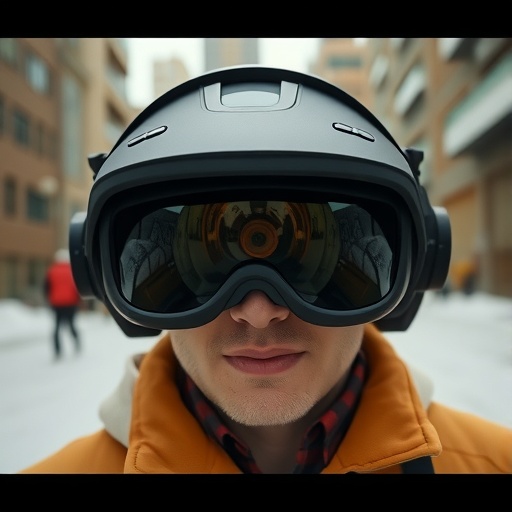
In a groundbreaking advancement poised to reshape the future landscape of augmented reality (AR) and mixed reality (MR) experiences, Lyu and Hua have introduced a revolutionary statically foveated freeform Optical See-Through Head-Mounted Display (OST-HMD) system. This innovative design achieves an unprecedented combination of wide field-of-view (FOV) and superior perceived resolution, promising to overcome longstanding technical challenges in head-worn display technologies. The significance of this development lies not only in its technical prowess but also in its potential to elevate user immersion and visual fidelity to levels previously deemed unattainable.
At the core of this breakthrough is the concept of static foveation, a technique inspired by the human eye’s natural visual acuity, which is highest at the fovea—the central region of the retina—and diminishes progressively toward the periphery. Traditional display systems uniformly allocate pixel density across the entire visual field, which limits maximum achievable resolution due to hardware constraints and power considerations. By contrast, the statically foveated design strategically concentrates optical power and pixel density toward the central visual subregion corresponding to the user’s fovea, while employing a lower resolution in peripheral zones. This targeted approach efficiently harnesses the viewer’s visual processing capabilities, leading to markedly enhanced clarity where it matters most.
The engineering prowess of Lyu and Hua’s OST-HMD system is embodied in the integration of a freeform optical design. Freeform optics utilize non-spherical, asymmetric surfaces that defy conventional rotational symmetries, allowing for imaginative light path manipulation and advanced aberration correction. These surfaces enable intricate tailoring of how light is directed onto the eye, optimizing image formation for wide FOVs without incurring the bulk or distortion typical of traditional spherical lenses. This approach brings distinct advantages, including reduced system weight, compactness, and superior image quality across a wide angular range.
One of the paramount challenges addressed in the system pertains to the wide field-of-view, a critical parameter for immersive AR/ MR experiences. Historically, expanding the FOV in OST-HMDs often compromises either the resolution or the device’s ergonomics. The novel design presented deftly circumvents these limitations by merging static foveation with a freeform optical framework that spatially adapts the image projection. This results in a system that not only covers a large portion of the user’s natural field of vision but also retains sharp image fidelity in the foveal region, avoiding peripheral resolution degradation that diminishes the realism and usability of the display.
To accomplish such optical feats, the researchers employed advanced fabrication techniques that allow precise control over freeform surfaces at micro- and nano-scales. These methodologies are crucial for ensuring the optical elements perform as designed, maintaining the high-resolution focusing effect in the foveated zone while minimizing aberrations that typically plague large FOV optics. This advancement also highlights the progress in manufacturing capabilities that bring complex, bespoke optics from theoretical concepts into practical, scalable hardware.
In addition to the optical hardware, the system incorporates sophisticated image rendering algorithms tailored for static foveation. Unlike dynamic foveated systems requiring eye-tracking to adapt to gaze shifts in real-time, the static approach simplifies the electronics and computational burden by designating a fixed foveated region aligned with the wearer’s typical viewing pattern. This reduction in system complexity not only enhances reliability but also cuts power consumption, paving the way for longer operational times suited for mobile or untethered use cases.
The choice of OST technology rather than video see-through is a deliberate one, as it allows users to experience real-world environments augmented seamlessly with synthetic imagery. This capability is essential for applications requiring precise spatial awareness, such as surgical navigation, military reconnaissance, and complex industrial maintenance. By improving the resolution and FOV, the system enables more intuitive and natural user interactions with augmented content, thereby improving overall task performance and safety.
One cannot overstate the implications of this development for consumer AR devices. Current mainstream OST-HMDs often struggle with the trade-off between FOV and resolution, leading to immersion-limiting ‘tunnel vision’ effects or pixelated imagery. The statically foveated freeform design introduced here promises to deliver crystal-clear visuals across a broad spatial expanse, potentially accelerating adoption in gaming, virtual tourism, education, and remote collaboration sectors. Enhanced visual fidelity enriches user experience, reducing eye strain and fostering deeper engagement.
Furthermore, this technology hints at future possibilities when combined with emerging microLED or other next-generation display panels capable of higher brightness and contrast ratios. When paired with the optical system’s effective focus of resolution, overall image quality could reach lifelike standards previously confined to theoretical or cinematic realms. The enhanced resolution could also catalyze new content creation paradigms, where creators optimize assets for foveated viewing, balancing detail where the user is most likely to focus.
Scientific advances such as those by Lyu and Hua recalibrate the performance benchmarks for AR HMDs, pushing designs toward increasingly naturalistic visual experiences. The marriage of optical innovation, ergonomic design, and computational rendering constitutes a holistic approach that future iterations of wearable displays will surely emulate. This research thus stands as a pivotal milestone, demonstrating the feasibility of ambitious wide-angle, high-resolution OST-HMD systems for practical deployment.
From an engineering perspective, the static foveation mechanism obviates the need for complex, latency-sensitive eye-tracking modules, which have posed integration challenges in lightweight consumer devices. Eliminating or simplifying these components reduces the risks of motion sickness or visual discomfort triggered by delayed or inaccurate focal adjustments. Hence, users can anticipate more comfortable and stable AR experiences, even during prolonged usage sessions.
Moreover, the scalability of freeform optical design techniques suggests that this approach may be adapted to a wide spectrum of device form factors and use cases. For example, compact enterprise AR glasses could benefit from this system’s balance of resolution and FOV without compromising wearability. Simultaneously, the principles underlying the static foveation strategy might inspire hybrid OST-HMDs that combine static and dynamic elements, further optimizing the balance between complexity, cost, and optical performance.
In sum, the statically foveated freeform OST-HMD system unveiled by Lyu and Hua represents a compelling leap forward in augmented reality hardware design. By addressing the fundamental trade-offs between field-of-view and resolution through a marriage of novel optical engineering and foveated display techniques, the system delivers an immersive visual experience of exceptional clarity and breadth. This breakthrough bears significant promise for both consumer and professional AR applications, ultimately enriching human interaction with digital content and the surrounding environment.
Looking ahead, continued research will likely explore integrating this static foveation framework with dynamic eye-tracking to further refine visual realism and efficiency. Parallel efforts in materials science and display technology will enhance brightness, color accuracy, and energy efficiency, synergistically amplifying the gains heralded by this pioneering OST-HMD system. Collectively, such advancements edge us closer to seamless, lightweight, and visually rich AR experiences that can truly augment reality in everyday life.
Lyu and Hua’s work is a testament to the power of interdisciplinary innovation, where optics, computing, and human vision research converge to reshape technology’s interface with perception. As this technology matures and finds traction beyond laboratories, it holds the potential to redefine the standards of immersion, comfort, and practicality, marking a new era for wearable visual devices.
Cite Scienmag News
Denise Maddox. (May 18, 2026). Wide FOV, High-Res Statically Foveated OST-HMD. Scienmag. https://scienmag.com/wide-fov-high-res-statically-foveated-ost-hmd/
Denise Maddox. "Wide FOV, High-Res Statically Foveated OST-HMD." Scienmag, 18 May 2026, https://scienmag.com/wide-fov-high-res-statically-foveated-ost-hmd/. Accessed 3 September 2026.
Denise Maddox. "Wide FOV, High-Res Statically Foveated OST-HMD." Scienmag. May 18, 2026. https://scienmag.com/wide-fov-high-res-statically-foveated-ost-hmd/


