


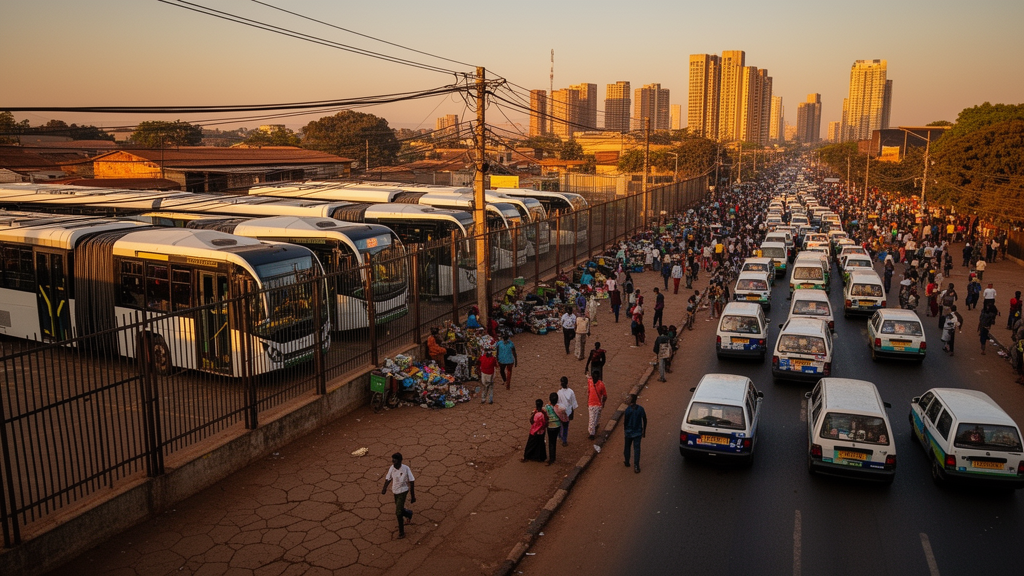
Bus rapid transit, or BRT, has become one of the most widely promoted instruments of urban transport modernisation across the Global South. Cities from Bogotá to Lagos have been urged to adopt dedicated bus corridors, prepaid boarding systems, and high-frequency services as a route out of congestion and unreliable public transport. Yet the promise of these internationally circulating models often collides with local realities. A new study published in Discover Sustainability examines why Harare, Zimbabwe’s capital, saw its proposed BRT initiative stall before reaching full operationalisation, and the answer lies not simply in money or technology but in the intricate interplay of spatial patterns, institutional fragmentation, and everyday mobility practices.
The research, conducted by Fortune Mangara and Nirmala Dorasamy of Durban University of Technology together with Rumbidzai Wendy Muzangaza of North-West University, draws on documentary analysis and non-participant field observations carried out in public transport spaces across Harare. Rather than treating BRT failure as a purely technical shortfall, the authors apply a transport-specific analytical lens they call ordinary mobility, which links the everyday movement practices of commuters and operators to the broader structures of transport planning and governance. This approach reveals how the lived rhythms of a city can quietly undermine even the most carefully designed transit blueprints.
The study identifies four interrelated constraints that together explain why the proposed BRT did not progress. The first is a spatial misalignment between the proposed corridor and the decentralised mobility patterns that actually characterise Harare. BRT systems are typically built around high-demand radial corridors funneling commuters from peripheral residential areas toward a central business district. But Harare’s movement patterns, shaped by decades of uneven urban development and the proliferation of informal settlement areas, do not conform neatly to this model. Passengers travel along multiple dispersed routes that a single trunk corridor cannot adequately serve, meaning the proposed alignment would capture only a fraction of the demand it was designed to accommodate.
The second constraint concerns fragmented institutional responsibility. In Harare, authority over urban transport is dispersed across multiple agencies and levels of government, each with its own mandates, budgets, and political incentives. This fragmentation complicates the coordination required for a capital-intensive project like BRT, which demands unified decision-making on corridor design, licensing, fare collection, and enforcement. Without a single empowered entity capable of steering the project through its lifecycle, momentum dissipates and competing interests pull the initiative in different directions. The researchers argue that this institutional dispersal is not an incidental weakness but a structural feature of the governance environment in which the BRT proposal was embedded.
Financial and operational capacity limitations form the third constraint. BRT systems require sustained investment in dedicated lanes, stations, rolling stock, and maintenance infrastructure, alongside the institutional capacity to manage operations over the long term. The study suggests that the resources available to Harare’s transport authorities were insufficient to support the full spectrum of these requirements, and that the gap between the model’s demands and the city’s fiscal and managerial realities contributed significantly to the stagnation of the initiative. This is not merely a question of securing initial capital but of sustaining an entire operational ecosystem over years and decades.
The fourth and perhaps most culturally significant constraint involves the challenge of establishing social legitimacy within a transport system that is strongly dependent on flexible informal services. Harare’s commuters rely heavily on informal minibus operators, known locally as kombis, which offer door-to-door flexibility, frequent departures, and responsiveness to shifting demand patterns. These services, though often criticised for safety and congestion problems, have become deeply embedded in the daily lives of residents. A formal BRT system, with fixed routes and stations, asks commuters to reorganise their journeys around a different logic, and asks informal operators to surrender routes and livelihoods they have built over years. The study shows that this tension between formal modernisation and entrenched informal practice is a central barrier that purely technical planning cannot resolve.
Synthesising these four constraints, the authors propose what they term a Harare-grounded Failure Pathway of Planned Modernity. This conceptual framework describes how insufficient policy learning, when combined with the spatial, institutional, financial, and social factors outlined above, can reproduce a cycle of implementation stagnation. In other words, when cities import transit models without adequately adapting them to local conditions, and when the lessons of failed implementation are not systematically absorbed into revised planning, subsequent reform attempts tend to encounter the same obstacles. The pathway is not a deterministic prediction but an analytical device for understanding how well-intentioned modernisation projects can become trapped in recurring patterns of non-delivery.
Crucially, the study does not conclude that BRT is impossible in Harare or in similar urban contexts. Instead, it identifies contextual adaptation and hybrid governance as a possible alternative pathway. Rather than pursuing a wholesale replacement of informal services with a formal BRT system, the authors suggest that future mass-transit reform would benefit from incremental and context-sensitive governance arrangements. These would combine formal public oversight with the participation and operational knowledge of existing transport actors, including the informal operators who currently move the majority of the city’s commuters. Such an approach recognises that informal transport networks embody accumulated local knowledge about demand patterns, route viability, and passenger behaviour that formal planning processes often overlook.
The implications of this research extend well beyond Harare. Many cities in sub-Saharan Africa and across the Global South have pursued BRT projects inspired by internationally celebrated examples, only to encounter similar difficulties in translating those models into functioning systems. The study’s central argument, that the limited progression of the proposed BRT cannot be understood solely as a technical or financial problem but rather as the outcome of interactions among policy transfer, institutional capacity, spatial organisation, and existing mobility practices, offers a framework for diagnosing why such projects falter. It shifts the analytical focus from the design of the transit technology itself to the governance and spatial context in which that technology must operate.
The authors are careful to note that the wider applicability of their framework requires comparative testing in other urban contexts, and the study is based on documentary sources and non-participant observation rather than interviews or surveys, which limits the depth of insight into individual commuter and operator perspectives. Nevertheless, the research makes a compelling case that successful transport reform in cities like Harare depends less on importing the right model and more on building the institutional, spatial, and social conditions under which any model can take root. As urban populations across Africa continue to grow rapidly, the stakes of getting this right are enormous, and the lessons from Harare’s stalled BRT initiative offer a sobering reminder that modernisation is as much a governance challenge as an engineering one.
Subject of Research: Institutional, spatial, and mobility constraints limiting bus rapid transit implementation in Harare, Zimbabwe
Article Title: Institutional spatial and mobility constraints limiting bus rapid transit progression in Harare Zimbabwe
Article References: Mangara, F., Dorasamy, N., & Muzangaza, R. W. (2026). Institutional spatial and mobility constraints limiting bus rapid transit progression in Harare Zimbabwe. Discover Sustainability. https://doi.org/10.1007/s43621-026-04874-3
Image Credits: AI Generated
DOI: 10.1007/s43621-026-04874-3
Keywords: bus rapid transit, Harare, Zimbabwe, urban transport, informal transport, urban governance, policy transfer, ordinary mobility, transport planning, public transit, spatial misalignment, sustainable mobility
Cite Scienmag News
Violet Maxwell. (October 18, 2026). Why Harare’s Bus Rapid Transit Dream Stalled: The Hidden Institutional and Spatial Barriers. Scienmag. https://scienmag.com/why-harares-bus-rapid-transit-dream-stalled-the-hidden-institutional-and-spatial-barriers/
Violet Maxwell. "Why Harare’s Bus Rapid Transit Dream Stalled: The Hidden Institutional and Spatial Barriers." Scienmag, 18 October 2026, https://scienmag.com/why-harares-bus-rapid-transit-dream-stalled-the-hidden-institutional-and-spatial-barriers/. Accessed 18 October 2026.
Violet Maxwell. "Why Harare’s Bus Rapid Transit Dream Stalled: The Hidden Institutional and Spatial Barriers." Scienmag. October 18, 2026. https://scienmag.com/why-harares-bus-rapid-transit-dream-stalled-the-hidden-institutional-and-spatial-barriers/


