


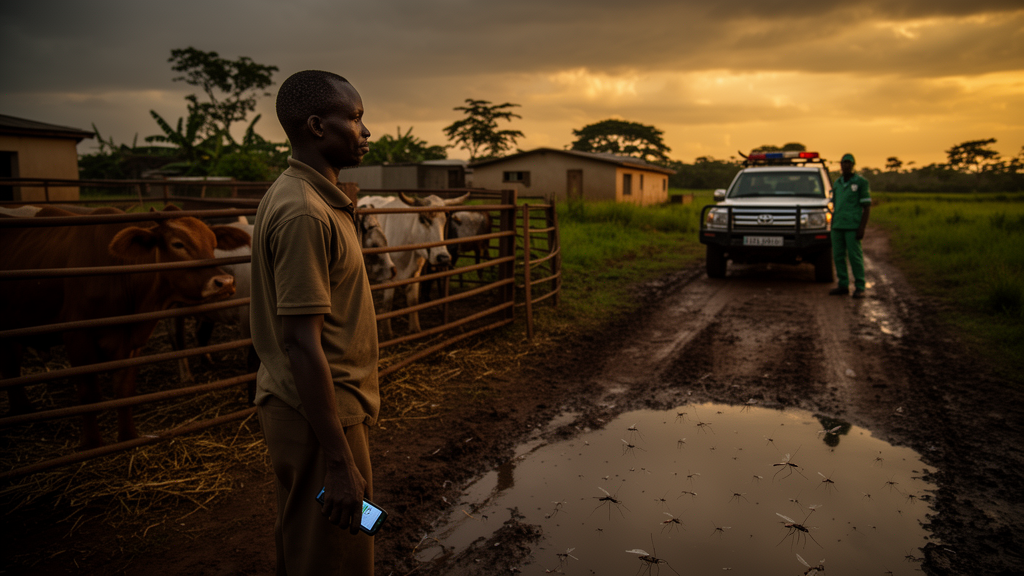
When a cow aborts on a smallholder farm in southwestern Uganda, that single event can carry an enormous amount of information. Abortion storms in livestock are often the first visible signal of Rift Valley Fever, a mosquito-borne viral disease that periodically sweeps through East Africa, killing young animals at devastating rates, devastating herds, and spilling over into human populations through contact with infected animal tissues. Yet in the districts where the virus circulates most readily, the simple act of a farmer picking up a phone or walking to a veterinary office to report an abortion remains far from routine. A new study conducted in Isingiro District, Uganda, and published in PLOS One, has systematically mapped out why that is the case, and its findings offer a behavioral blueprint for fixing one of the weakest links in the region’s epidemic preparedness chain.
The research team, led by Abel W. Walekhwa of the University of Cambridge and colleagues at Makerere University and the University of Nairobi, applied the Capability, Opportunity, Motivation–Behavior framework, a widely used model from behavioral science known as COM-B, to dissect the reporting problem. Rather than treating underreporting as a simple failure of awareness or infrastructure, the framework forces analysts to consider three interacting domains: whether people have the knowledge and skills to act, whether their physical and social environments make action possible, and whether they have reflective and emotional drives to do so. The study grounded this analysis in rich qualitative data drawn from the communities where the surveillance gap is widest.
Between field visits to Isingiro District, a predominantly agro-pastoral area near the Tanzanian border where cattle keeping is central to household livelihoods, the researchers conducted 29 key informant interviews with national and district policymakers, veterinary officers, and technical staff. They complemented these with 17 focus group discussions involving livestock owners, abattoir operators, and local leaders. All transcripts were analyzed deductively in NVivo-12, with independent coding verification and member checking to ensure that the themes faithfully reflected what participants actually said. Barriers and facilitators were then ranked by how frequently they appeared and how much thematic emphasis different participant groups placed on them, allowing the team to compare perspectives across the surveillance hierarchy, from farmers to policymakers.
The single most frequently cited barrier was poor community knowledge about Rift Valley Fever itself. Many livestock owners did not recognize abortion as a disease signal worth reporting, and some attributed pregnancy loss to causes unrelated to infection. This knowledge gap sits squarely in the capability domain of the COM-B model: people cannot report what they do not understand. But the study found that knowledge alone would not close the gap, because the most powerful demotivator identified was something different entirely, namely the absence of feedback after a report is made. Farmers and local leaders who had previously reported suspected cases described hearing nothing back, leaving them uncertain whether their information had any value and reluctant to invest effort in reporting again.
This feedback vacuum illustrates a principle well established in behavioral science: sustained voluntary behavior requires that people perceive their actions as consequential. In surveillance systems designed largely as one-way channels from communities to authorities, the silence that follows a report functions as a form of negative reinforcement. The researchers argue that responsive feedback validates reporters’ contributions and builds the trust on which early warning systems ultimately depend. Without it, even well-informed communities with functioning reporting infrastructure can quietly disengage, and the surveillance network degrades into a paper exercise that detects outbreaks only after they have become obvious.
On the opportunity side of the framework, the study identified several promising facilitators already present in the Ugandan landscape. Mobile phone platforms emerged as a key enabler, offering a low-cost channel through which farmers could report abortions without traveling long distances to understaffed veterinary offices. Community governance structures, including local councils and village leadership networks, provided social scaffolding that could channel reports upward through trusted intermediaries. These existing structures matter because surveillance interventions that import entirely new reporting systems often fail, whereas those that reinforce familiar community institutions can piggyback on established relationships of accountability and mutual obligation.
Motivation, the third COM-B domain, proved to be driven by forces both economic and emotional. Fear of economic loss was a powerful motivator: farmers who understood that an unreported outbreak could wipe out a herd, or trigger trade bans that strangle livestock markets, had a clear financial stake in early reporting. Cultural concerns also played a role, with participants describing the loss of animals in terms that went beyond market value to encompass social status, ceremonial obligations, and family heritage. The study suggests that interventions which speak to these lived stakes, rather than framing reporting as a bureaucratic duty, are more likely to resonate with the communities whose cooperation the system needs.
The comparative analysis across participant groups revealed a further layer of complexity. Policymakers and technical officers tended to frame the problem in terms of system design and resource allocation, while community participants emphasized trust, feedback, and the practical burdens of reporting. Abattoir operators, who occupy a unique position at the interface between livestock and the food system, added their own perspective on how sick or aborted animals move through the market chain. These divergent framings matter for intervention design, because a program built solely around the priorities of district officers may fail to engage the farmers whose behavior it is meant to change. The study’s COM-B lens helped the team identify where these perspectives converged and where targeted efforts would be needed to align them.
From this analysis, the researchers distilled a set of priority interventions that operate simultaneously across all three behavioral domains. They recommend integrating abortion reporting into Uganda’s electronic surveillance platforms so that reports flow into the same digital infrastructure used for other priority diseases. They propose co-developing local names for Rift Valley Fever with communities, a deceptively simple step that can dramatically improve recognition and communication in areas where the disease may be known by folk terms that differ from official nomenclature. They call for establishing reliable feedback mechanisms so that reporters learn what happened to their submissions, addressing veterinary staffing gaps in remote areas so that reports trigger a visible response, and implementing no-blame reporting protocols that remove the fear of punishment or quarantine-related losses that might otherwise discourage farmers from coming forward.
The broader significance of the study extends beyond Uganda’s borders. Rift Valley Fever is endemic across much of Africa and the Arabian Peninsula, and climate variability is expected to alter the frequency and geography of its epidemic cycles. Early warning systems built on community-based livestock reporting represent one of the most cost-effective defenses available, because abortion storms precede human cases by days or weeks and provide a window for vaccination campaigns, vector control, and public health messaging. What the Isingiro study demonstrates is that the engineering of such systems is as much a behavioral science problem as a veterinary one. Sustainable abortion reporting, the authors conclude, requires simultaneous intervention across capability, opportunity, and motivation domains, reinforcing existing community structures while ensuring that the people who provide the first signal of an emerging outbreak see a response that makes their contribution worthwhile. In the race between viral emergence and epidemic response, that feedback loop may prove to be the difference between a contained event and a regional crisis.
Subject of Research: Behavioral determinants of community-based livestock abortion reporting for Rift Valley Fever surveillance in Uganda
Article Title: Facilitators and barriers to community-based livestock abortion reporting for Rift Valley Fever surveillance in Uganda: A COM-B analysis
Article References: Walekhwa, A. W., Conlan, A. J., Namakula, L. N., Nakazibwe, B., Bukachi, S. A., Wood, J. L., & Mugisha, L. (2026). Facilitators and barriers to community-based livestock abortion reporting for Rift Valley Fever surveillance in Uganda: A COM-B analysis. PLOS One, 21(10), e0359872. https://doi.org/10.1371/journal.pone.0359872
Image Credits: AI Generated
DOI: 10.1371/journal.pone.0359872
Keywords: Rift Valley Fever, Uganda, disease surveillance, COM-B framework, livestock abortion reporting, one health, behavioral science, early warning systems, veterinary epidemiology, community health, zoonoses, PLOS One
Cite Scienmag News
Kristina Jarvis. (October 9, 2026). Why Farmers Stay Silent: The Behavioral Roadblocks to Rift Valley Fever Early Warning in Uganda. Scienmag. https://scienmag.com/why-farmers-stay-silent-the-behavioral-roadblocks-to-rift-valley-fever-early-warning-in-uganda/
Kristina Jarvis. "Why Farmers Stay Silent: The Behavioral Roadblocks to Rift Valley Fever Early Warning in Uganda." Scienmag, 9 October 2026, https://scienmag.com/why-farmers-stay-silent-the-behavioral-roadblocks-to-rift-valley-fever-early-warning-in-uganda/. Accessed 9 October 2026.
Kristina Jarvis. "Why Farmers Stay Silent: The Behavioral Roadblocks to Rift Valley Fever Early Warning in Uganda." Scienmag. October 9, 2026. https://scienmag.com/why-farmers-stay-silent-the-behavioral-roadblocks-to-rift-valley-fever-early-warning-in-uganda/


