


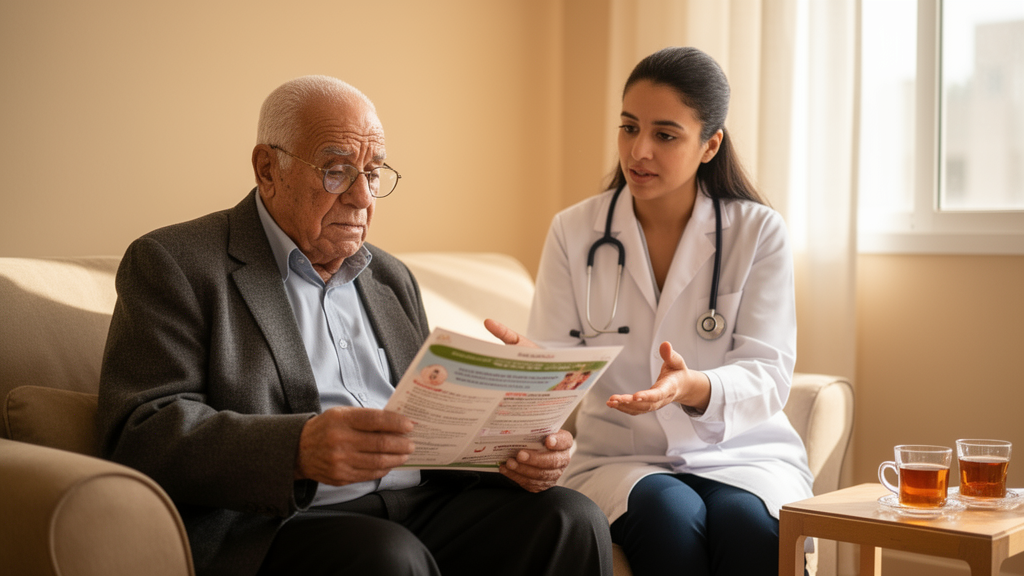
What separates older adults who thrive in their later years from those who merely survive them? A new study from Cairo suggests that one of the most powerful answers may be surprisingly simple: the ability to find, understand, and use health information. Researchers at Kasr Alainy Hospital found that health literacy was strongly and independently linked to successful aging among Egyptians aged 65 and older, with the association holding firm even after accounting for education, income, chronic disease, and a range of demographic factors. The findings, published in BMC Public Health, arrive at a moment when Egypt, like much of the world, is confronting a rapidly aging population and a rising tide of chronic illness.
The research team, led by Hend Samy Ibrahim and Eman Hany Elsebaie of the Department of Public Health and Community Medicine at Cairo University’s Faculty of Medicine, together with Eman Ismail Raslan of the Department of Family Medicine, designed the investigation as a cross-sectional comparative study. Rather than sampling a single group, they deliberately recruited two matched cohorts of older adults: 123 patients living with chronic diseases and 123 healthy controls, all aged 65 or above. This comparative structure allowed the investigators to ask not only whether health literacy and successful aging are connected in general, but whether that connection looks different for people already carrying the burden of long-term illness.
Participants completed two validated instruments that anchor the study’s methodology. The Health Literacy Questionnaire, a widely used multidimensional tool, captures the many faces of health literacy, from the ability to read prescription labels and navigate appointment systems to the confidence to ask questions of clinicians and the social support available for understanding health matters. The Successful Aging Scale, meanwhile, operationalizes a concept that gerontologists have debated for decades: aging well is not simply the absence of disease, but a composite of physical function, psychological resilience, social engagement, and life satisfaction. Measuring both constructs in the same individuals allowed the team to quantify the relationship between them with unusual precision for this population.
The results were striking in their consistency. Older patients with chronic diseases scored significantly lower on both health literacy and successful aging than their healthy counterparts, differences that reached statistical significance at p < 0.001. More importantly, when the researchers examined the relationship across the entire sample, health literacy and successful aging moved together: the correlation coefficient of r = 0.612 indicates a moderately strong positive association, meaning that older adults who scored higher on understanding and using health information also reported markedly better aging outcomes. In epidemiological terms, this is a substantial effect, and it held regardless of whether a participant was in the chronic disease group or the healthy control group.
Correlation alone, however, rarely settles a scientific question, so the team turned to regression analysis to test whether health literacy would remain predictive once other influences were controlled. It did, and emphatically so: health literacy emerged as the strongest independent predictor of successful aging in the regression model. This statistical robustness matters because it suggests the association is not merely a shadow cast by education or wealth. While higher educational attainment and higher income were both associated with better successful aging scores, and while older age, rural residence, and smoking each exerted negative effects, none of these factors displaced health literacy from its position at the top of the predictive hierarchy.
The demographic patterns the study uncovered paint a sobering picture of vulnerability in Egyptian aging. Rural residence emerged as a negative factor, a finding that resonates with longstanding inequities in access to health services, information, and preventive care between urban centers like Cairo and the country’s rural governorates. Smoking, unsurprisingly, was associated with worse aging outcomes, reinforcing decades of evidence about its toll on respiratory and cardiovascular health in later life. The negative effect of advancing age itself underscores the biological reality that successful aging becomes harder to maintain with each passing year, making modifiable factors like health literacy all the more valuable as levers for intervention.
Why might health literacy exert such a powerful influence on how people age? The plausible mechanisms are multiple and mutually reinforcing. Older adults with strong health literacy are better equipped to manage medications correctly, recognize warning symptoms early, and adhere to treatment regimens, all of which can slow the progression of chronic disease. They are more likely to engage in preventive behaviors, from vaccination to screening, that preserve function over time. Beyond the clinical domain, the Health Literacy Questionnaire’s multidimensional design captures social dimensions, including the support people receive from family and community in understanding health matters, which may itself feed into the social engagement and psychological well-being components of successful aging. Health literacy, in this framing, is not merely a cognitive skill but a form of personal and social capital that compounds across the life course.
The Egyptian context gives these findings particular urgency. The country’s population is aging at a pace that outstrips many of its public health preparations, and chronic diseases such as diabetes, hypertension, and cardiovascular conditions impose a growing burden on both families and the health system. Kasr Alainy Hospital, as one of Cairo’s largest and oldest public teaching institutions, serves a patient population that reflects this reality in full: older adults of varying educational backgrounds, incomes, and geographic origins, many managing multiple chronic conditions with limited resources. If health literacy is indeed a modifiable determinant of aging well, then interventions that build it, from clearer medication counseling to community health education programs tailored to older Egyptians, could deliver outsized returns for a health system under strain.
The authors are careful about what their study can and cannot establish. As a cross-sectional design, it captures a single moment in time and cannot prove that higher health literacy causes better aging outcomes; it is equally conceivable that older adults who are aging well find it easier to engage with health information. The team explicitly calls for future research employing longitudinal designs that follow participants over years, community-based probability sampling that extends beyond hospital patients to the broader population, fully validated Arabic versions of the study instruments with psychometric properties reported in the target population, and, ultimately, randomized evaluations of health-literacy interventions to determine whether improving literacy genuinely improves successful-aging outcomes. This candor about limitations is a model of scientific restraint in a field where cross-sectional findings are often oversold.
Even with those caveats, the study’s central message is difficult to ignore. Among older adults in Egypt, the capacity to understand and act on health information travels hand in hand with aging successfully, and it does so more powerfully than income, education, or any other factor the researchers measured. For policymakers, the implication is that investments in health literacy, in plain-language health communication, in patient education, and in the social supports that help older people navigate an increasingly complex medical landscape, may be among the most cost-effective tools available for helping a growing population of seniors not just live longer, but live better. For the rest of the world’s rapidly aging societies, the Cairo findings offer a provocative hypothesis worth testing: the secret to a good old age may begin with something as ordinary as understanding what your doctor just told you.
Subject of Research: The association between health literacy and successful aging among elderly patients in Egypt
Article Title: Health literacy and successful aging among elderly patients at Kasr Alainy Hospital: a cross-sectional comparative study
Article References: Ibrahim, H. S., Raslan, E. I., & Elsebaie, E. H. (2026). Health literacy and successful aging among elderly patients at Kasr Alainy Hospital: a cross-sectional comparative study. BMC Public Health, 26(1), Article 2927. https://doi.org/10.1186/s12889-026-29518-z
Image Credits: AI Generated
DOI: 10.1186/s12889-026-29518-z
Keywords: health literacy, successful aging, elderly patients, gerontology, chronic disease, public health, Egypt, cross-sectional study, Cairo University, healthy aging, geriatric health, health communication
Cite Scienmag News
Beatrice Stafford. (October 9, 2026). Health Literacy Emerges as the Strongest Predictor of Successful Aging in Egyptian Seniors. Scienmag. https://scienmag.com/health-literacy-emerges-as-the-strongest-predictor-of-successful-aging-in-egyptian-seniors/
Beatrice Stafford. "Health Literacy Emerges as the Strongest Predictor of Successful Aging in Egyptian Seniors." Scienmag, 9 October 2026, https://scienmag.com/health-literacy-emerges-as-the-strongest-predictor-of-successful-aging-in-egyptian-seniors/. Accessed 9 October 2026.
Beatrice Stafford. "Health Literacy Emerges as the Strongest Predictor of Successful Aging in Egyptian Seniors." Scienmag. October 9, 2026. https://scienmag.com/health-literacy-emerges-as-the-strongest-predictor-of-successful-aging-in-egyptian-seniors/


