


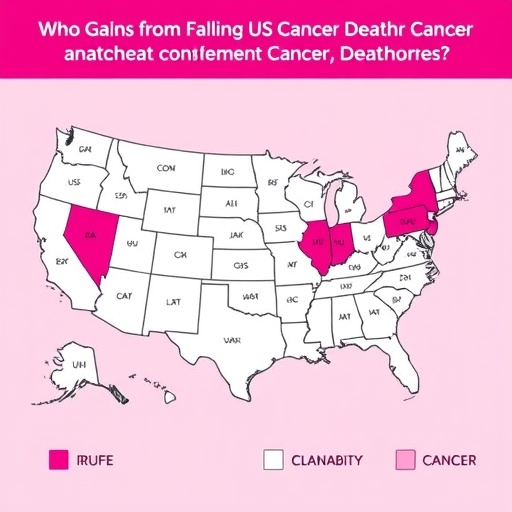
In a groundbreaking new study published in the British Journal of Cancer, researchers have unveiled striking disparities in the decline of cancer mortality rates across communities in the United States. While the overall national cancer mortality has seen a dramatic reduction over recent decades, this comprehensive analysis reveals that the benefits of this progress are unevenly distributed, raising crucial questions about the social and geographic dynamics influencing health outcomes.
The study presents a detailed investigation into who exactly is reaping the rewards of improved cancer care, prevention efforts, and early detection. By focusing on place-based disparities, the research shines a light on how location—the specific community or region where a person lives—can profoundly impact the likelihood of benefitting from medical advances. This nuanced approach moves beyond traditional demographic categories like age, race, or income, illustrating that geography itself acts as a significant determinant in cancer survival.
Over the past 30 years, advancements in cancer screening technologies, treatment modalities, and public health initiatives have led to markedly lower death rates from cancers such as lung, colorectal, and breast cancers. However, this study reveals that these gains are not uniform across the vast and diverse landscape of the United States. Instead, individuals living in certain metropolitan and suburban areas have experienced far more rapid mortality declines compared to those residing in rural or economically disadvantaged regions.
The implications of this analysis are profound. It suggests that systemic inequalities in healthcare access, environmental exposures, educational opportunities, and economic resources are not only persisting but may be exacerbating disparities in cancer outcomes. For example, regions with greater concentrations of medical oncology specialists and cancer screening facilities report steeper declines in mortality, underscoring the critical role of healthcare infrastructure in driving positive trends.
Furthermore, the study integrates complex spatial analytic techniques combined with epidemiological data spanning multiple decades. This methodological rigor allowed the researchers to map cancer mortality reductions down to the zip code level, unveiling previously hidden pockets where progress has stagnated or even reversed. Such granularity provides an invaluable tool for policymakers and public health officials aiming to target interventions where they are most urgently needed.
One particularly striking finding is the correlation between economic deprivation and slower rates of decline in cancer deaths. Communities marked by persistent poverty, limited health insurance coverage, and higher prevalence of risk factors such as smoking and obesity exhibit comparatively little improvement. This finding aligns with broader social determinants of health theory, emphasizing that medical innovation alone is insufficient to overcome entrenched health inequities without simultaneous social policy reform.
The research also highlights the differential impact of cancer subtypes and stage at diagnosis. In places where early detection programs have been successfully implemented, death rates plummeted more rapidly. Conversely, in areas lacking such resources, cancers are more frequently diagnosed at an advanced stage, leading to poorer prognoses. These nuances reveal how targeted interventions can make a substantial difference but also how uneven application perpetuates disparities.
Adding another layer of complexity, the study sheds light on environmental exposures as an underappreciated factor influencing geography-specific cancer mortality trends. Areas with higher pollution levels, industrial contamination, or limited access to healthy foods showed less improvement, indicating that environmental justice must be integrated into cancer control strategies.
Importantly, the researchers underscore that the observed disparities are not immutable. By identifying the precise locations where mortality declines lag, their work provides a roadmap for deploying resources more equitably. This can include expanding access to cancer screening and treatment, improving health literacy, and addressing social determinants such as housing, employment, and education simultaneously.
The findings also have implications for future research priorities, suggesting that epidemiological studies must increasingly incorporate spatial analytic approaches to uncover hidden patterns of disease burden and intervention impact. The capability to link cancer outcomes at the neighborhood level with social and environmental data represents a powerful step forward in precision public health.
The study’s authors advocate for urgent action to transform these insights into concrete policy interventions. Without focused efforts to reduce geographic disparities, the uneven progress threatens to leave behind some of the most vulnerable populations, perpetuating cycles of poor health outcomes and widening health inequities.
This research arrives at a moment when healthcare equity is a central public concern. The disparate benefits from the decline in cancer mortality mirror broader societal inequities highlighted by COVID-19 and other health crises, reinforcing the need for integrated, place-sensitive health policies.
In summary, while the overall trend in U.S. cancer mortality is encouraging, this pioneering work demands a deeper reckoning with who truly benefits. Efforts to extend the cancer survival gains must reckon with place-based disparities that affect access, environment, and social opportunity. Only through such comprehensive strategies can the promise of scientific progress be fulfilled equitably across all American communities.
This detailed spatial epidemiologic work not only maps progress but also exposes critical fault lines in the cancer control landscape. Its powerful message is clear: science alone cannot solve disparities without targeted policies addressing the multifaceted barriers that vary by place. In doing so, it charts a hopeful course towards a future where declining cancer mortality is a reality accessible to all.
Cite Scienmag News
Nathaniel Bowman. (March 31, 2026). Who Gains from Falling US Cancer Death Rates? Scienmag. https://scienmag.com/who-gains-from-falling-us-cancer-death-rates/
Nathaniel Bowman. "Who Gains from Falling US Cancer Death Rates?" Scienmag, 31 March 2026, https://scienmag.com/who-gains-from-falling-us-cancer-death-rates/. Accessed 3 September 2026.
Nathaniel Bowman. "Who Gains from Falling US Cancer Death Rates?" Scienmag. March 31, 2026. https://scienmag.com/who-gains-from-falling-us-cancer-death-rates/


