


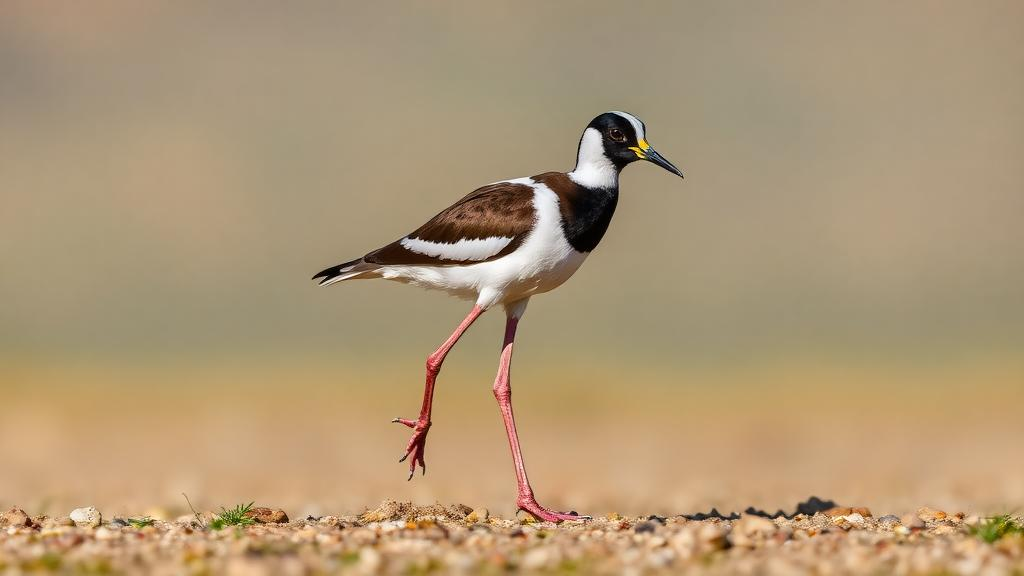
Ornithologists have documented the first confirmed breeding record of the White-tailed Lapwing (Vanellus leucurus) in Georgia, a discovery that marks a significant milestone in the species’ apparent westward range expansion across the Caucasus region. The finding, published in the journal Caucasiana, adds a new country to the known breeding range of this striking shorebird and highlights the growing importance of an unprotected wetland site near the Georgian capital.
The White-tailed Lapwing is a medium-sized wader whose core distribution stretches from the Middle East through Central Asia to South Asia, with populations recorded from central and south-eastern Türkiye, eastern Syria and Jordan, north-east through Azerbaijan and Transcaspia to Lake Balkhash in south-eastern Kazakhstan, and south-east through Iraq and Iran to western Pakistan. The species is easily recognised by its pale brownish-grey body, white underparts, a prominent white tail, and long yellow legs that extend well beyond the tail in flight. Both sexes look alike throughout the year, and during the breeding season, which spans spring and summer, the birds occupy wetlands, marshes, and the edges of lakes and rivers. They typically form small colonies alongside other waterside species such as Black-winged Stilts, Northern Lapwings, pratincoles, and terns, preferring salty or semi-saline marshes and riverbanks with sparse vegetation, where they nest on the ground in shallow depressions.
Until this discovery, the White-tailed Lapwing was classified in Georgia as an irregular visitor. Only twelve records were documented between 1984 and 2023, and the authors of the new study consider a series of seven observations along the Black Sea coast in April and May 2022 to have involved repeated sightings of the same flock of six individuals, seen in small groups or as solitary birds around the Chorokhi river delta near Batumi and the Maltakva river mouth near Poti for about a month. Historical records elsewhere in the country have come mostly from inland lakes and reservoirs, including Paravani Lake in 1984, the Alazani river valley in 1991, Madatapa Lake in 2003, Jandari Lake on several occasions, Gurjaani Fishpond in 2019, and Shida Kartli in 2021, as well as the coastal sites.
The circumstances surrounding the 2024 discovery illustrate how modern birdwatching networks contribute to documenting range changes. The first birds of the year were reported at Kumisi Lake in the Gardabani municipality, Kvemo Kartli region, on 16 May by visiting birdwatchers Gheorghe Ticu, Jonathan Hecke, and Florian Klingel. The following day, another group of visiting observers, Nayib Hamdoun, Fernando Casado Angulo, and Miguel Pérez Sainz, reported possible breeding. On 23 May, Giorgi Natsvlishvili observed six individuals at the site. By the time the research team visited on 27 May, four individuals were present, and the observers documented behaviour that left little doubt about nesting.
Working from dense bushes at a safe distance, the team watched the birds in a colony of breeding Black-winged Stilts and Northern Lapwings. The territorial pair chased away Black-winged Stilts that walked close to the suspected incubating pair or nest, and they also showed agitated behaviour by pursuing a flying Western Marsh Harrier out of their territory. One individual was observed sitting on the nest. The presence of the species was subsequently confirmed on 8 June, when two individuals were still on the nest, and again on 6 July, when six individuals were recorded. Observers used a spotting scope and binoculars, supplemented by digital cameras and mobile phones, to document the birds, nests, and habitat without causing disturbance, and after the nesting territory was checked, the pair returned within five to ten minutes and one of the birds resumed incubation.
The nesting habitat itself offers instructive detail about the ecological requirements of the species. The breeding pair was found in the close vicinity of a shallow standing pond and a slow-flowing creek near the Kumisi reservoir, an area that floods during the rainy season and dries into marshy meadows and salt-shrub terrain during the breeding period. The nest was situated in a damp, sparsely vegetated area near salt water. Two nests were found at the site, one belonging to the White-tailed Lapwing and the other to a Black-winged Stilt, allowing a direct comparison of the two species’ nesting styles. The lapwing’s nest consisted of a sparse lining of plant material and held four eggs coloured buff to yellow-buff with dark brown markings. The stilt’s nest, by contrast, contained more vegetation in the form of grass fibres and small sticks, more shell fragments, and cream-coloured eggs mottled brown-grey, consistent with descriptions in the standard literature on the breeding biology of these birds.
The Georgian record fits into a broader pattern of westward expansion that has been building for decades. Recent confirmed breeding records from Romania, Armenia, and Cyprus, together with breeding documented in Gujarat in north-west India, suggest that the species is extending its range at both edges of its distribution. The adjacent-country accounts reviewed in the paper trace this spread in detail. In Azerbaijan, the White-tailed Lapwing was a rare breeder, with the first breeding record in the early 1950s; the species then expanded within the country, with the first breeding at Aghgol National Park recorded in 1962, and by the late 1980s the estimated national total was fewer than one hundred breeding pairs. In Armenia, the first record came from the Armash fishponds in July 1989, possible breeding was noted in late May 1999, the species was found presumably incubating at the same location in late May 2000, and breeding was finally confirmed on 9 June 2001. The Armenian population remains restricted to the Ararat Plain within the Armash Wetlands, with the most recent estimate standing at seventy-four to eighty-nine breeding pairs. In Türkiye, the first breeding birds were found in the 1970s at around five different sites, but the Turkish Breeding Bird Atlas lists only a few known breeding locations with an estimated abundance of zero to nine pairs. Breeding has also been recorded in southern Russia, west of the Volga river near the Russia-Kazakhstan border.
Against this regional backdrop, the Kumisi Lake record represents a logical step in the species’ spread from neighbouring countries into Georgia, and it also underscores the conservation significance of the site itself. Kumisi Lake serves as an important stop-over location during migration for charadriiform birds and other species, and its surroundings host a remarkable array of notable birds, including Greater Flamingo, Greater Sand Plover, Eurasian Spoonbill, Terek Sandpiper, Broad-billed Sandpiper, Red-footed Falcon, and Blue-cheeked Bee-eater. The lake is arguably even more important in winter, because when the lakes on the Javakheti Plateau freeze, much of the wintering waterfowl in the region seeks alternative resting places nearby. Kumisi Lake provides habitat for the globally vulnerable Common Pochard and has supported roughly twenty-five thousand Eurasian Coots for two consecutive years, and there are occasional observations of the globally endangered White-headed Duck. These figures highlight the regional importance of a waterbody that, as of today, is not protected under Georgian law and remains a well-known local hunting spot.
As a breeding site, Kumisi Lake has traditionally been considered less significant, but it still supports small populations of local waterside species. Black-winged Stilts nest around the lake in small colonies, and Whiskered Terns occasionally breed there, along with Great-crested Grebes, Little Grebes, Black-necked Grebes, and Ruddy Shelducks. The newly discovered nesting White-tailed Lapwing is therefore an important addition both to the breeding bird list of the lake and to that of the country as a whole. Whether the species becomes an established breeder in Georgia, as it has in parts of Azerbaijan and Armenia, will likely depend on the persistence of suitable shallow, saline wetland habitat and on the protection such sites receive. The documentation of a breeding attempt at an unprotected site so close to the capital adds weight to ongoing discussions about the value of nominally ordinary wetlands, which can hold nationally significant biodiversity even when they fall outside formal protected-area networks.
Subject of Research: First documented breeding record of the White-tailed Lapwing in Georgia
Article Title: The first documented breeding record of White-tailed Lapwing Vanellus leucurus (Lichtenstein, 1823) in Georgia
Article References: Budagashvili, N., & Turkalj, J. (2024). The first documented breeding record of White-tailed Lapwing Vanellus leucurus (Lichtenstein, 1823) in Georgia. Caucasiana, 3, 163-169. https://doi.org/10.3897/caucasiana.3.e128928
Image Credits: AI Generated
DOI: 10.3897/caucasiana.3.e128928
Keywords: White-tailed Lapwing, Georgia, Kumisi Lake, range expansion, breeding record, shorebirds, wetland conservation, Caucasus, ornithology, birdwatching, Vanellus leucurus, Kvemo Kartli
Cite Scienmag News
Margaret Porter. (October 17, 2026). White-tailed Lapwing Confirmed Breeding in Georgia for the First Time. Scienmag. https://scienmag.com/white-tailed-lapwing-confirmed-breeding-in-georgia-for-the-first-time/
Margaret Porter. "White-tailed Lapwing Confirmed Breeding in Georgia for the First Time." Scienmag, 17 October 2026, https://scienmag.com/white-tailed-lapwing-confirmed-breeding-in-georgia-for-the-first-time/. Accessed 17 October 2026.
Margaret Porter. "White-tailed Lapwing Confirmed Breeding in Georgia for the First Time." Scienmag. October 17, 2026. https://scienmag.com/white-tailed-lapwing-confirmed-breeding-in-georgia-for-the-first-time/


