


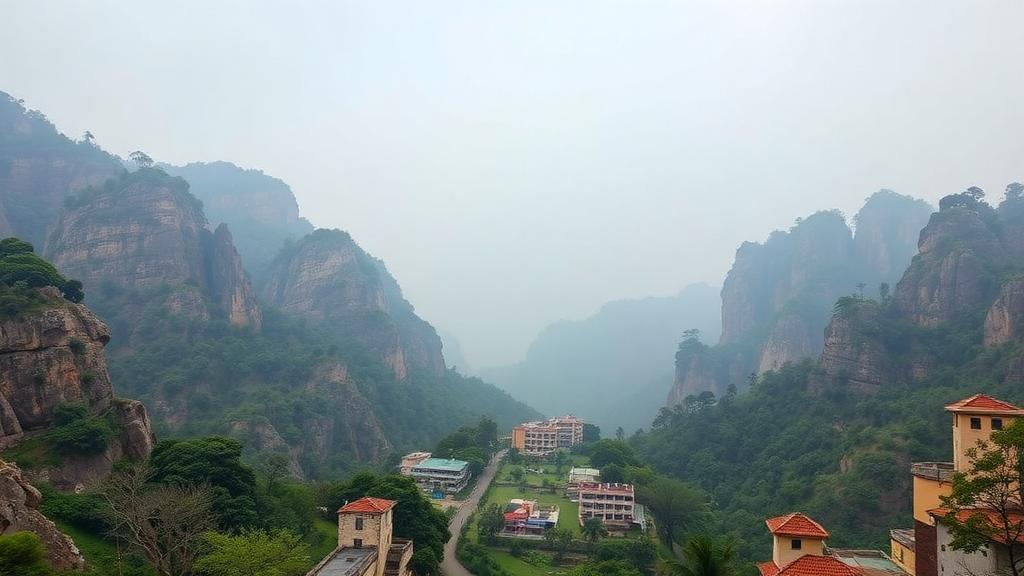
In the heart of New Delhi, wedged into the South Central Ridge of one of the world’s oldest fold mountain systems, a university campus has been quietly doing something remarkable: growing greener for more than three decades while sheltering a surprising array of native life. A new study published in Frontiers in Ecology and Evolution has now put numbers on that quiet success, and the results carry a twist that urban ecologists everywhere should heed. Satellite records show that vegetation cover on the 57-year-old Jawaharlal Nehru University campus has climbed steadily since 1992, with the maximum Fractional Vegetation Index rising from 0.33 that year to 0.60 in 2025. Yet on the ground, the researchers found that some of the most visible greenery belongs to invasive species, revealing what the authors call a potential greening paradox: more green does not always mean more biodiversity.
The setting matters as much as the numbers. The Aravalli Range, one of the oldest geological formations in India, stretches from Gujarat through Rajasthan and Haryana into Delhi, where it forms the Delhi Ridge and serves as a natural barrier against desertification. Urban expansion in Delhi, Gurugram, and Jaipur has fragmented these habitats, stripped vegetation, and disrupted hydrological systems, while aggressive invaders such as Neltuma juliflora, formerly known as Prosopis juliflora, have colonized degraded tracts and displaced native plant communities. Within this pressured landscape, the roughly 1,019-acre JNU campus, with its undulated quartzite terrain, semi-arid climate, and forest patches rich in soil organic carbon, functions as a relatively protected ecological refuge, a role the authors argue could position university landscapes as Other Effective area-based Conservation Measures in rapidly urbanizing cities.
To capture the campus’s socio-ecological gradient, the team selected six contrasting sites: the high-use Yamuna Hostel zone, the protected quartzite outcrop of Parthasarathy Rocks, the New Transit House gardens, the low-lying Chandrabhaga Lake wetland, the isolated JNU Caves woodland, and the busy Brahmaputra-Mahanadi Hostel complex. Between November 2022 and March 2023, they laid transect lines at intervals of up to 100 meters and surveyed 76 quadrats, each measuring 10 by 10 meters, recording every woody plant with the help of handheld GPS, citizen science platforms such as Pl@ntNet and iNaturalist, and classic references including the Flora of Delhi and Trees of Delhi. Scientific names were verified against the Plants of the World Online database, and species were classified as native, introduced, or invasive following an established catalogue of India’s alien flora.
The field survey documented 57 woody plant species across the six sites, comprising 36 tree species from 17 families and 21 shrub species from 16 families. The overwhelming majority, 42 species or 73.68 percent, were native, with 11 introduced and only 4 invasive. Diversity indices revealed pronounced spatial variation: Shannon diversity values ranged from 1.61 to 2.41, and Menhinick Richness Index values from 0.52 to 1.07. Parthasarathy Rocks emerged as the standout site, recording the highest Simpson’s Diversity Index at 0.88, the highest Shannon Index at 2.41, and the highest richness at 1.07, driven by its wealth of native species. Statistical comparisons confirmed these differences were real, with significant variation among sites for dominance, Simpson’s diversity, Shannon diversity, and evenness, though shrub richness did not differ significantly, likely because the invasive shrub Lantana camara homogenized understory communities across the campus.
That homogenizing force is the study’s central warning. Despite accounting for only a small fraction of total species richness, invasive taxa dominated the vegetation structure. Lantana camara recorded the highest Importance Value Index of any shrub at all six sites, with values ranging from 37.60 to 72.45, forming dense thickets that suppress native shrubs and block regeneration. Among trees, Leucaena leucocephala dominated at three sites with IVI values as high as 81.62, aided by prolific seed production and allelopathic effects that chemically inhibit neighboring plants, while Neltuma juliflora dominated the two interior woodland sites with IVI values of 73.87 and 48.29. The authors stress that these invaders, though few in number, exert outsized ecological influence, contributing to biotic homogenization and limiting opportunities for native regeneration even as overall canopy cover expands.
The satellite analysis adds a crucial temporal dimension. Using Landsat imagery from 1992, 2002, 2012, and 2025, averaged over winter months to minimize seasonal and cloud effects, the team computed the Fractional Vegetation Index, a remote sensing parameter that estimates the proportion of vegetation within each pixel on a scale from 0 for bare surface to 1 for complete cover. The index was derived from the Normalized Difference Vegetation Index using a pixel dichotomy model with a bare-soil endmember of 0.05 and a vegetation saturation threshold of 0.70. Maximum FVI climbed from 0.33 in 1992 to 0.47 in 2002, 0.51 in 2012, and 0.60 in 2025, with the greatest expansion around the JNU Caves and the Brahmaputra-Mahanadi hostel complex. But the authors caution that this greening must be read alongside species composition, since higher cover can mask invasive dominance rather than signal ecological improvement.
What makes the study resonate beyond ecology is its social layer. An online survey of 68 stakeholders, 94.1 percent of them students, rated the campus greenery exceptionally high for physical wellbeing at 4.51 on a five-point scale and emotional and mental wellbeing at 4.49, with the overall importance of campus greenery scoring 4.67. Wildlife encounters were woven into daily life: 91 percent of respondents reported seeing birds, 89.6 percent the Nilgai, Asia’s largest antelope, and 88.1 percent squirrels, with peacocks, monkeys, and porcupines also commonly observed. Walking was universal, nature observation reached 95.5 percent, and photography 68.7 percent. Air quality improvement was the most valued ecosystem service at 95.5 percent, followed by biodiversity conservation at 88.1 percent, and the campus is known to register lower air pollution levels than the rest of Delhi.
The most striking statistical finding links these two worlds. Pearson correlation analysis showed that public preference for revisiting sites correlated strongly and positively with Menhinick Species Richness at r = 0.822, and moderately with Shannon diversity at r = 0.615, while dominance by a few species correlated negatively at r = −0.499. Parthasarathy Rocks, the most diverse site, was also the most preferred destination. The authors interpret this biodiversity-perception nexus carefully, noting it is an association across only six site-level observations rather than proof of causation, and that accessibility, aesthetics, and familiarity also shape preferences. Still, the pattern aligns with global evidence that vegetation diversity boosts aesthetic appreciation, psychological restoration, and user satisfaction in urban green spaces, and it suggests that maintaining diverse native vegetation may simultaneously serve ecological integrity and human wellbeing.
The policy implications are direct. If left unmanaged, passive succession will keep increasing canopy cover while invaders erode understory evenness and richness, so the authors recommend targeted eradication of Lantana camara and enrichment planting of diverse native species as ecologically justified measures that protect both conservation value and the cultural ecosystem services people clearly cherish. To turn research into stewardship, the team also built an open-access digital repository, the JNU Campus Flora database, consolidating photographs and taxonomic records of the campus’s woody plants as a permanent resource for biodiversity assessment and environmental literacy in the National Capital Territory. Funded through the Anusandhan National Research Foundation’s PAIR programme, the work offers a scalable model for ecologically sensitive campus planning in rapidly urbanizing environments.
In an era when cities are the primary engines of biodiversity loss, the message from this Delhi campus is quietly viral: universities can be more than places of learning, they can be living laboratories where multi-decadal greening, native species conservation, and human nature connectedness grow together. The greening paradox reminds us that ecological quality is measured not by green cover alone but by the diversity, composition, and evenness beneath the canopy. If a 57-year-old campus on an ancient mountain ridge can double its vegetation density while teaching a new generation to see the difference between green and truly alive, the blueprint for urban conservation may already be written on the grounds of the world’s universities.
Subject of Research: University campus green spaces’ potential for biodiversity conservation and ecosystem services
Article Title: University campus green spaces’ potential for biodiversity conservation and ecosystem services
Article References: Panwar, M., Sharma, R., Mina, U., & Verma, N. (2026). University campus green spaces’ potential for biodiversity conservation and ecosystem services. Frontiers in Ecology and Evolution, 14, Article 1886362. https://doi.org/10.3389/fevo.2026.1886362
Image Credits: AI Generated
DOI: 10.3389/fevo.2026.1886362
Keywords: University, campus, green, spaces, potential, biodiversity, conservation, ecosystem, services, scientific research
Cite Scienmag News
Margaret Porter. (October 17, 2026). Inside India’s Oldest Mountains, a University Campus Quietly Rewrites Urban Conservation. Scienmag. https://scienmag.com/inside-indias-oldest-mountains-a-university-campus-quietly-rewrites-urban-conservation/
Margaret Porter. "Inside India’s Oldest Mountains, a University Campus Quietly Rewrites Urban Conservation." Scienmag, 17 October 2026, https://scienmag.com/inside-indias-oldest-mountains-a-university-campus-quietly-rewrites-urban-conservation/. Accessed 17 October 2026.
Margaret Porter. "Inside India’s Oldest Mountains, a University Campus Quietly Rewrites Urban Conservation." Scienmag. October 17, 2026. https://scienmag.com/inside-indias-oldest-mountains-a-university-campus-quietly-rewrites-urban-conservation/


