


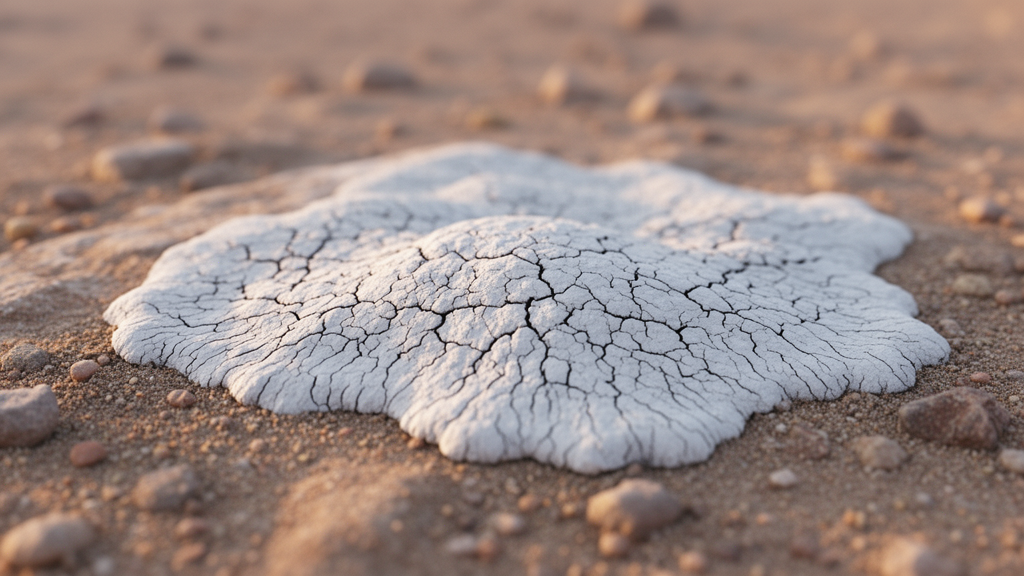
A group of pale, cracked lichens that encrust sun-baked rocks across the deserts of western North America has just undergone its most thorough overhaul in nearly a century. In a study published in MycoKeys, researchers from the Acarosporaceae working group re-examined herbarium specimens, generated new DNA sequences and applied a strict staining protocol to untangle the so-called Acarospora strigata group, a lineage of crust-forming fungi whose members share a strikingly similar appearance adapted to arid habitats. The result is a revised taxonomy for six North American species, one brand-new species described from Montana, Nevada and Utah, and the rejection of a long-standing synonymy that had quietly erased a common North American lichen from the books.
The story begins with a decision made by the Swedish lichenologist Adolf Hugo Magnusson in 1929. Magnusson, who dominated the taxonomy of this group for decades, synonymized the North American species Acarospora peltata under the South American Acarospora strigata, effectively treating the two as one variable species ranging from the Andes to the American Southwest. The new study rejects that synonymy. Based on morphological measurements and molecular data, the authors conclude that Acarospora peltata is the common species of western North America, while Acarospora strigata is a relatively rare South American endemic known from Argentina, Bolivia and Chile. The two names are once again attached to two different organisms.
What makes the strigata group so distinctive is its phenotype, a suite of traits shaped by life in some of the harshest environments on Earth. The thalli are composed of small areoles or squamules, typically white and dusted with pruina held in a polysaccharide epicortex that can be 10 to 110 micrometers thick. That white surface reflects sunlight, an albedo effect that reduces heat absorption in full desert sun, although the authors note that actual heat radiation has never been measured in these species. The epicortex is presumed to protect the algal layer and conserve moisture, but that hypothesis, too, remains untested. The surface is broken by fissures in patterns ranging from radial to crosshatched, and these fissures deepen over time into abscission fissures that allow the lichen to replicate by division, slowly building colonies on limestone, caliche, granite, sandstone and lava.
Worldwide, thirteen species of the group have been described, distributed across Asia, North Africa, Europe and the Americas. The first, Acarospora strigata, was described by Nylander in 1855 from material collected in Chile. Until now, however, the group’s North American representatives had never been critically revised with modern tools. The new study examined specimens from major herbaria and private collections, studied anatomy in hand sections at 1000-times magnification, performed thin layer chromatography on 32 specimens, and extracted and sequenced DNA from 18 dried herbarium specimens.
The molecular work targeted three genetic regions: the nuclear ribosomal internal transcribed spacer (ITS), the large subunit of nuclear ribosomal DNA (nLSU) and the small subunit of mitochondrial ribosomal DNA (mtSSU). The researchers concatenated the three markers into a combined matrix of 1,596 aligned characters from 60 specimens, of which 334 characters were parsimony-informative. Bayesian inference in MrBayes and maximum likelihood analyses in RAxML produced a family phylogeny congruent with previous studies, recovering five members of the strigata group in the upper Acarospora clade: Acarospora strigata from South America and four North American species, A. coloradiana, A. lactea, A. peltata and A. utahensis.
One of the most intriguing findings concerns the relationship between the South American and North American species. In the Bayesian tree, Acarospora strigata is nested among five specimens of A. peltata, and a newly sequenced collection from limestone in Bolivia shares 98 percent ITS and LSU similarity with the epitype of A. peltata from caliche in Joshua Tree National Park, with 100 percent mtSSU similarity. Yet the authors decline to merge the two. Anatomically, A. strigata differs in having euamyloid hymenial gel, staining dark blue with iodine, where A. peltata is hemiamyloid, staining red, a character they treat as species-level in the family. A. strigata also has a wider parathecium, 40 to 80 micrometers versus 10 to 40, smaller areoles, narrower ascospores and a thinner epicortex. Whether A. peltata is a single species or a species complex remains unresolved.
The study also exposes how historical methodology muddied the taxonomy. Magnusson’s 1929 description of A. strigata was a composite built from at least twenty specimens spanning South America, California, Colorado, Wyoming, Egypt, Iran and Siberia, so it described no single organism. And because there was no protocol in the nineteenth century, or in Magnusson’s time, for reproducible iodine reactions, records of hymenial gel color cannot be compared directly with modern results. The authors use a strict protocol with fresh Merck’s Lugol solution, replaced monthly and kept in the dark, distinguishing euamyloid dark-blue reactions from hemiamyloid red ones. Under this protocol, all South American material of A. strigata proved euamyloid, raising the possibility that a second, hemiamyloid species may lurk in the Andes.
The centerpiece of the taxonomic revision is a new species, Acarospora lactea, described from Montana, Nevada and Utah and named for the beautiful non-translucent milky-white epicortex of its areoles when wet. It is best developed along the Missouri River Breaks in Montana, where the holotype was collected on hard sandstone in 2011. A. lactea has euamyloid hymenial gel, like A. coloradiana, but differs in that its pruinose surface stays opaque and brightens when wetted, whereas A. coloradiana turns translucent and brown or gray. Remarkably, several specimens of A. lactea are parasitic, overgrowing other lichens such as Pyrenodesmia albovariegata in competition for space. The authors also publish new descriptions of A. coloradiana, A. nevadensis, which is unique in the group in producing gyrophoric acid, and A. utahensis, which has by far the largest ascospores at 9 to 13 by 4 to 5 micrometers. Acarospora peltastica, a rare southern California species with globose ascospores of 3.5 to 5 micrometers, is recognized from its lost holotype and a handful of historical collections, and may have been overlooked because collectors never sectioned its apothecia.
Perhaps the most conceptually significant result is evolutionary. The phylogeny shows that the strigata phenotype, the white, pruinose, fissured crust so characteristic of deserts, has evolved numerous times independently and is not recovered as a single clade. Convergent evolution has repeatedly sculpted different Acarospora lineages into the same drought-adapted form, which explains why morphology alone misled taxonomists for nearly a century. A companion phenotype with carbonized epihymenial accretions has likewise arisen multiple times. The authors caution that their family phylogeny, drawing on specimens from North America and Europe plus a handful from China and South America, hardly represents a family that occurs on all seven continents, and they have deliberately left genus names unchanged pending broader genomic sampling.
For field lichenologists, the practical outcome is a published key to the six North American members of the group, hinging on secondary chemistry, ascospore size and shape, and the iodine reactions of the hymenial gel. The most common species by far is A. peltata, which ranges from Arizona and California to Montana, Texas and Wyoming, and whose largest, most fissured thalli develop in canyons with intermittent flooding and partial shade, while stunted, sterile forms cling to boulders in full desert sun. The rarest are A. peltastica in California and A. utahensis in Utah. The study is a reminder that even the most familiar-looking organisms in a landscape can conceal unresolved diversity, and that revisiting century-old type specimens with modern sequencing and standardized chemistry can still rewrite the map of life in North America’s deserts.
Subject of Research: Taxonomic revision and molecular phylogeny of the Acarospora strigata group of crustose lichens in North America
Article Title: White and fissured: the Acarospora strigata group ( Acarosporales , Acarosporaceae ) in North America
Article References: Knudsen, K., Kocourková, J., Kondrysová, E., Leavitt, S., Hollinger, J., Noell, N., Malíček, J., & Wheeler, T. (2026). White and fissured: the Acarospora strigata group (Acarosporales, Acarosporaceae) in North America. MycoKeys, 142, 73-102. https://doi.org/10.3897/mycokeys.142.208759
Image Credits: AI Generated
DOI: 10.3897/mycokeys.142.208759
Keywords: lichenology, Acarospora, Acarosporaceae, taxonomy, phylogenetics, desert lichens, new species, Acarospora lactea, Acarospora peltata, Mycology, North America, convergent evolution
Cite Scienmag News
Roger Howard. (October 19, 2026). White and fissured: DNA study rewrites the story of North America’s desert crust lichens. Scienmag. https://scienmag.com/white-and-fissured-dna-study-rewrites-the-story-of-north-americas-desert-crust-lichens/
Roger Howard. "White and fissured: DNA study rewrites the story of North America’s desert crust lichens." Scienmag, 19 October 2026, https://scienmag.com/white-and-fissured-dna-study-rewrites-the-story-of-north-americas-desert-crust-lichens/. Accessed 19 October 2026.
Roger Howard. "White and fissured: DNA study rewrites the story of North America’s desert crust lichens." Scienmag. October 19, 2026. https://scienmag.com/white-and-fissured-dna-study-rewrites-the-story-of-north-americas-desert-crust-lichens/


