


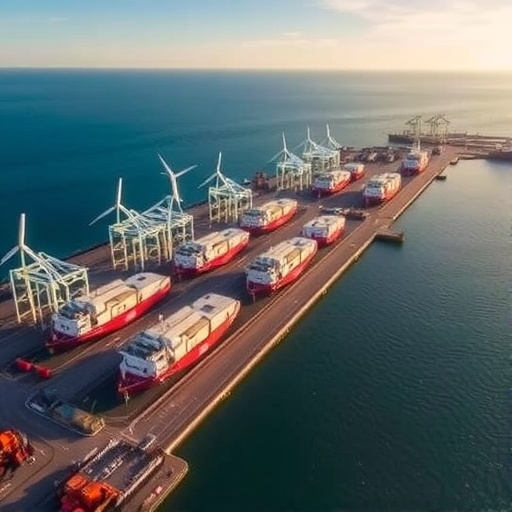
Spain’s offshore-wind ambitions may be constrained by an unexpectedly terrestrial problem: not the strength of the wind at sea, but the ability of ports on land to receive, store, assemble and repair the enormous machines needed to capture it. A new analysis of 53 Spanish state-owned ports finds that only a small group can support the most demanding stages of an offshore wind farm’s life cycle. The study identifies port depth and storage space as the decisive bottlenecks, with just six facilities meeting the water-depth requirements needed for major platform integration and replacement maintenance. The results offer a detailed logistics map for a country seeking to expand renewable energy while confronting rising greenhouse-gas emissions and accelerating sea-level rise.
Offshore wind turbines are becoming larger, heavier and more complex, particularly as the industry moves toward floating platforms that can operate in deeper waters. Their logistics chain can include manufacturing, component delivery, marshalling, assembly, turbine integration, installation, operation, maintenance and eventual dismantling. Each stage places different demands on a port. A facility suitable for storing blades or performing basic maintenance may be unable to accommodate a floating foundation, turbine tower and nacelle assembled as a single structure. The difference is governed by practical engineering limits: quay strength, available land, navigation-channel geometry, crane capacity, vessel access and, above all, the depth of the water beside the dock.
The researchers evaluated Spanish ports using a multicriteria decision-making framework that combined physical, logistical, environmental, operational, economic and social information. They began by reviewing 19 previous studies of offshore wind and port performance, then consolidated overlapping measures into 30 criteria. These included quay length, berth depth, navigation access, vessel capacity, quay load-bearing strength, component-handling equipment, proximity to wind-farm areas and suppliers, railway connections, manufacturing and workshop space, storage capacity, wave conditions, tidal range, wind speed, port efficiency, safety, charges, offshore experience, investment requirements, job creation and sustainability practices. The broad approach reflects a central reality of offshore construction: no single measurement can determine whether a port is genuinely useful.
To establish how much each factor should matter, the team surveyed 57 experts working in universities, research organizations, shipyards, technology companies, port authorities, consultancies, offshore wind developers and public institutions. Participants rated each criterion on a five-point scale, from very low to very high importance. Storage-area availability received the greatest overall weight, accounting for 12.02 percent of the normalized assessment, followed closely by berth depth at 11.49 percent. Navigation-channel characteristics ranked third at 8.48 percent, followed by quay length at 6.16 percent and quay load capacity at 5.02 percent. Estimated investment costs, berthing capacity and the length of workable weather windows followed. In contrast, investment in green equipment, previous offshore-farm experience and sustainability practices received the lowest weights, although the researchers did not treat them as irrelevant.
The team then applied three established decision-making methods: the Weighted Sum Method, TOPSIS and the Analytic Hierarchy Process. In the weighted-sum calculation, each port’s normalized score for a criterion is multiplied by that criterion’s expert-derived weight, and the results are added. TOPSIS measures how close each port is to an ideal facility while also measuring its distance from a worst-case alternative. The Analytic Hierarchy Process was used as a complementary comparison, with pairwise ratios derived from weighted-sum scores rather than from thousands of direct expert comparisons. Combining the three rankings reduced dependence on any one algorithm, although the researchers acknowledge that the AHP results are not fully independent because they originate partly from the weighted-sum calculation.
The analysis considered two engineering scenarios based on draft, the depth of water required beneath a vessel or floating structure. Scenario A covered construction, assembly and basic maintenance activities that require at least 12 metres of draft. Under this less restrictive condition, Huelva ranked first overall, followed by Barcelona, Bilbao, Ferrol’s outer port, Valencia, Bahía de Algeciras, Las Palmas, Gijón, A Coruña’s outer port and Vigo. These rankings describe comparative logistical potential rather than an automatic guarantee that every listed port can perform every operation. Ports with less than 12 metres of draft, including several specialized or smaller facilities, were excluded from the technically feasible group for this scenario.
Scenario B examined platform integration with the tower and turbine, along with replacement maintenance, operations that require at least 20 metres of draft. The requirement sharply narrowed the field. Ferrol’s outer port ranked first, followed by Huelva, Bilbao, A Coruña’s outer port, Las Palmas, Gijón, Bahía de Algeciras, Vigo, Barcelona and Ferrol’s inner port. Yet only six of these facilities actually met the 20-metre draft threshold: Ferrol’s outer port, Bilbao, A Coruña’s outer port, Las Palmas, Gijón and Bahía de Algeciras. Huelva’s high position illustrates why rankings must be interpreted carefully. Its large storage areas, workshop potential and port facilities boosted its overall score, but its insufficient depth rules it out for the most demanding operations under the study’s stated technical assumptions.
Water depth is not merely a matter of convenience. Fixed-bottom platforms and less demanding assembly work may require roughly 6 to 12 metres, while ports handling semi-submersible floating platforms can need 12 to 20 metres for storage and pre-assembly. Full integration of the floating platform with the wind turbine tower may require at least 20 metres, depending on the design. A port may instead float the platform out and complete integration offshore, reducing the dock-depth requirement but increasing dependence on sea conditions and offshore installation procedures. Maintenance creates another constraint: tow-to-port replacement work can require 15 to 20 metres, whereas an operations-and-maintenance base may function with approximately 7 metres. Extreme concepts such as vertical assembly of spar structures could demand waters deeper than 80 metres, conditions that do not currently exist in Spanish ports.
The study also reveals why a single national “best port” would be misleading. Vigo ranked well because its estuarine location offers favourable metocean conditions and available land, but heavy traffic limits the large operational areas needed for more demanding projects. Vilagarcía benefits from proximity to prospective Atlantic wind-farm zones and suitable operating conditions without dominating any individual technical category. Ferrol’s inner port gains from its experience with wind-turbine blade logistics, yet its depth and working-area limitations restrict the roles it can play. Cabezuela-Puerto Real performs strongly in part because the Bahía de Cádiz Port Authority has heavy-load machinery, compensating for limited open land. Salinetas combines deep water and high efficiency, but its short quay and specialized role supplying energy resources to Las Palmas reduce its potential as an offshore-wind hub.
The findings suggest that Spain could benefit more from a coordinated network of specialized ports than from attempting to equip every facility for every stage of offshore wind development. One port might manufacture or marshal components, another could handle deep-water platform integration, and others could provide maintenance, storage or feeder services. Such a distributed system could reduce duplication of expensive infrastructure, shorten transport routes and make the supply chain more resilient if one facility becomes unavailable. Port authorities interested in entering the sector may need to prioritize dredging, quay reinforcement, wet-storage basins, workshops and large areas of open land. The researchers caution that future expansion plans were not fully incorporated because publicly available technical data were limited. Their rankings are therefore a snapshot of current capacity, not a fixed prediction of which ports will dominate the offshore-wind economy.
The work has limitations that are important for interpreting its viral headline result. Some criteria had to be assessed qualitatively because consistent quantitative data were unavailable, introducing subjectivity into the comparison. The 57-person expert survey provided a cross-section of academic, industrial and governmental perspectives, but a larger sample could improve statistical representativeness. The criteria were assembled from existing literature and may not capture every requirement used by offshore wind developers, especially for rapidly evolving floating-turbine designs. Social and economic effects were also treated less deeply than infrastructure. Even so, the analysis shows that the race to build offshore wind farms will be decided partly by infrastructure that rarely appears in turbine-focused illustrations. Spain may have abundant offshore energy potential, but turning moving air into reliable electricity will require enough depth, space, strength and coordination at the shoreline.
Cite Scienmag News
Faith Mcneil. (August 28, 2026). Which Spanish Ports Are Best Equipped for Offshore Wind Development? Scienmag. https://scienmag.com/which-spanish-ports-are-best-equipped-for-offshore-wind-development/
Faith Mcneil. "Which Spanish Ports Are Best Equipped for Offshore Wind Development?" Scienmag, 28 August 2026, https://scienmag.com/which-spanish-ports-are-best-equipped-for-offshore-wind-development/. Accessed 3 September 2026.
Faith Mcneil. "Which Spanish Ports Are Best Equipped for Offshore Wind Development?" Scienmag. August 28, 2026. https://scienmag.com/which-spanish-ports-are-best-equipped-for-offshore-wind-development/


