


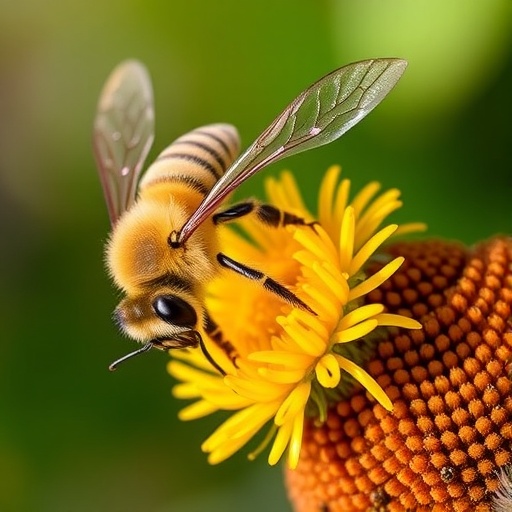
In a groundbreaking study published in the esteemed journal Nature Communications, a team of Australian evolutionary ecologists has unveiled critical insights into the vulnerability of native bee species to climate change, driven by their nesting behaviors. Through meticulous experimental analysis of heat tolerance among 95 native bee species spanning the latitudinal expanse of eastern mainland Australia, the research delineates how nesting habitats profoundly influence thermal resilience and the consequent survival prospects under escalating global temperatures.
Bees, acknowledged globally for their indispensable role as pollinators, underpin both natural ecosystems and global agriculture. Australia’s native bee fauna is diverse, encompassing approximately 1,700 species with a range of nesting strategies. These strategies segregate primarily into three categories: subterranean burrow nesters, wood cavity inhabitants, and those that make their homes within plant stems or small twig cavities. Intriguingly, the study identifies stem-nesting bees as the most vulnerable group to rising thermal stress, due to their limited ability to shelter from extreme environmental heat.
Dr. Carmen da Silva, the study’s lead author and a prominent figure at Macquarie University’s Pollinator Futures Research Centre, elucidates the mechanism underlying this susceptibility. Stem-nesting bees inhabit narrow, often exposed plant structures that lack insulating properties, subjecting them to ambient temperatures that can fluctuate dramatically and reach hazardous levels. In contrast, ground-nesting species benefit from the buffering effect of soil, which maintains more moderate temperatures, affording them greater physiological refuge during heatwaves and thermal extremes.
The thermal environment that a bee experiences is a pivotal selective force shaping its evolutionary trajectory. Researchers comprehensively measured critical thermal maxima—the highest temperatures at which bees maintain functional activity—across species with distinct nesting ecologies. Results revealed that heat tolerance evolution aligns closely with these nesting preferences. Yet, paradoxically, species with the highest heat tolerances often reside in already thermally extreme tropical climates near the equator, rendering them precariously close to their physiological limits.
Dr. Vanessa Kellermann of La Trobe University highlights the nuanced relationship between heat tolerance and vulnerability. “Thermal safety margins,” or the buffer between organisms’ heat tolerance and ambient temperature, are diminishing fastest in tropical species. Such bees may have adapted to survive elevated temperatures historically but may now face detrimental climate accelerations beyond their adaptive thresholds. These findings underscore a looming crisis for tropical pollinators, with cascading effects on both biodiversity and food security.
The ecological ramifications of bee declines are profound. Pollination services provided by native bees facilitate the reproduction of myriad plant species, sustaining agroecosystems and natural habitats alike. Notably, tropical native bees pollinate economically valuable crops including macadamia nuts, avocados, mangos, and lychees. The loss or reduction of these pollinators due to climate-induced stress could manifest as decreased yields, threatening agricultural livelihoods and ecological stability.
Methodologically, this multidisciplinary investigation integrated field sampling with laboratory thermal assays to simulate heat stress scenarios. By spanning latitudinal gradients, the study captured a comprehensive thermal landscape representative of Australian bee biodiversity. The collaboration among experts from Macquarie University, The University of Sydney, La Trobe University, Flinders University, University of Wollongong, Adelaide University, and The University of Queensland lent a robust interdisciplinary approach to addressing one of ecology’s preeminent challenges.
The findings compellingly advocate for the inclusion of behavioral ecology in climate vulnerability assessments. Traditional models have often emphasized species’ physiological capabilities without accounting for microhabitat-specific refuges or exposures shaped by nesting strategy. Here, nesting behavior emerges as a critical predictor of evolutionary heat tolerance and climate sensitivity, signaling the need for finely tuned conservation strategies.
Conservation initiatives must therefore recognize the disproportionately high risks borne by stem-nesting bees. Habitat management practices could aim to enhance availability of cooler microhabitats or promote vegetative complexity that buffers temperature fluctuations. Additionally, targeted monitoring of vulnerable tropical populations can facilitate early intervention, potentially mitigating losses before population declines become irreversible.
Dr Ros Gloag, a senior evolutionary biologist involved in the research, stresses the broader implications: “Our study reveals vast knowledge gaps about Australia’s native bees, despite their ecological prominence. Understanding behavioural ecology is not merely academic—it is foundational for preserving these essential species in an era defined by rapid climate upheaval.”
The urgent call from this research aligns with global conservation priorities emphasizing pollinator health as integral to ecosystem resilience. As climate change accelerates, the nuanced interactions between species’ life history traits and environmental stressors will dictate biodiversity outcomes. This study serves as a clarion call to integrate such perspectives into both scientific inquiry and policy frameworks, ensuring the persistence of native bee communities that underpin Australia’s unique ecology and agriculture.
In conclusion, the evolutionary response of bees to heat stress is inextricably linked to their nesting behavior, with stem-nesting species facing the most immediate threats from increasing temperatures. The intricate balance between physiology, ecology, and climate necessitates a multifaceted approach to research and conservation. By illuminating these dynamics, Australian scientists are advancing global understanding of climate vulnerability, fostering strategies that could secure pollinator futures in a warming world.
News Publication Date: 15-Jun-2026
Web References:
Cite Scienmag News
Gavin Prescott. (June 15, 2026). Which Bees Struggle Most with Heat? Exploring Why Some Are More Vulnerable to Climate Change. Scienmag. https://scienmag.com/which-bees-struggle-most-with-heat-exploring-why-some-are-more-vulnerable-to-climate-change/
Gavin Prescott. "Which Bees Struggle Most with Heat? Exploring Why Some Are More Vulnerable to Climate Change." Scienmag, 15 June 2026, https://scienmag.com/which-bees-struggle-most-with-heat-exploring-why-some-are-more-vulnerable-to-climate-change/. Accessed 3 September 2026.
Gavin Prescott. "Which Bees Struggle Most with Heat? Exploring Why Some Are More Vulnerable to Climate Change." Scienmag. June 15, 2026. https://scienmag.com/which-bees-struggle-most-with-heat-exploring-why-some-are-more-vulnerable-to-climate-change/


