


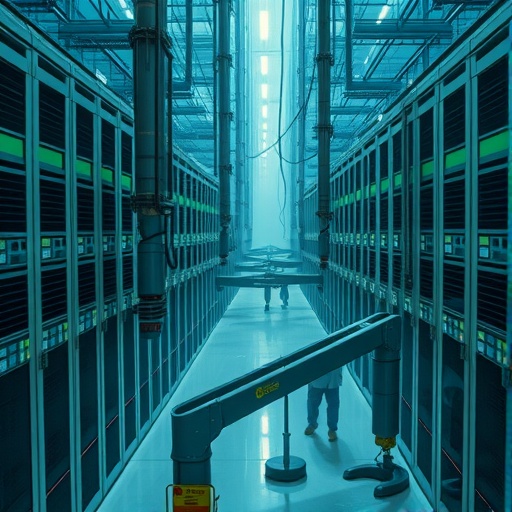
The cloud is not floating in some distant wilderness. It is taking shape alongside highways, neighborhoods, power corridors and former industrial sites in and around America’s cities. A new study from researchers at New York University’s Tandon School of Engineering has found that data centers—the physical infrastructure behind artificial intelligence, streaming, cloud computing and online services—are overwhelmingly an urban phenomenon.
Published in Nature Cities, the study analyzed the locations of 4,283 data centers across the contiguous United States. The researchers found that 97.5 percent are located within metropolitan or micropolitan statistical areas, regions that include urban centers and their surrounding communities. Even the small fraction technically outside those designations is not truly remote: on average, those facilities sit only 8.5 miles from the nearest urban boundary. The finding overturns a popular image of data centers as isolated warehouses hidden deep in rural America.
“ There is a prevailing narrative of these data centers being somewhere in the middle of nowhere, in rural areas, being a positive force for employment, and being the future of rural communities,” said Maurizio Porfiri, lead researcher and an Institute Professor at NYU Tandon. Porfiri, who directs the university’s Center for Urban Science + Progress and the NYU Urban Institute, said the study “dramatically challenged” that view. Instead of abandoning cities, the digital economy is concentrating where infrastructure, labor and connectivity are already abundant.
The distribution is particularly concentrated in a handful of metropolitan regions. Washington–Arlington–Alexandria leads the country with 610 facilities, or 14.2 percent of the national total. Chicago has 241, Dallas–Fort Worth has 192, New York has 163 and Phoenix has 154. Together, those five metropolitan areas contain nearly one-third of all the facilities examined. Northern Virginia’s dominant position reflects the region’s role as a global interconnection hub, where dense fiber-optic networks, major internet exchanges and extensive electrical infrastructure allow data to move rapidly between users, companies and cloud platforms.
The strongest predictor of data-center location is electricity capacity: the amount of power local generators and transmission systems can reliably deliver. Unlike most commercial buildings, data centers operate around the clock and maintain thousands of servers that produce heat continuously. Their electrical demand is both enormous and unusually steady. A site may therefore be attractive not because land is cheap or distant, but because it can connect quickly to high-voltage transmission lines, substations and generation capacity without requiring years of grid expansion.
The researchers also identified a powerful link to America’s fossil-fuel past. Closed coal plants near cities are emerging as potential magnets for new data-center construction because the infrastructure built for the old energy system remains in place after the plants stop operating. Transmission lines, substations, road access and industrial parcels can all reduce the cost and complexity of developing a new facility. In some cases, data-center companies can reuse parts of the former plant site; in others, they can connect to the electrical network that once carried power from the plant to surrounding communities.
That pattern is visible in federally designated Energy Communities, areas targeted for investment after the decline of coal mining and fossil-fuel power generation. In metropolitan areas that overlap with those communities, data centers under development were twice as likely to be located there as in cities without the designation. The result suggests that the next phase of the digital economy may be growing directly on the industrial foundations of the previous one, potentially bringing new investment to regions affected by plant closures while also raising questions about whether the electricity serving these facilities will come from genuinely cleaner sources.
The environmental consequences vary sharply from one state to another because a data center’s operational carbon footprint depends largely on the local power mix. According to the study, a typical facility in Montana or North Dakota produces more than 350,000 tons of carbon dioxide emissions annually, while the average facility in Vermont, New Hampshire or Arkansas produces fewer than 3,000 tons. These differences reflect the contrast between grids dominated by coal and those supplied more heavily by hydropower, nuclear energy, natural gas or other lower-carbon sources. As artificial-intelligence workloads expand, the location of new computing capacity could therefore influence national emissions as much as the technology used inside the buildings.
Electricity is not the only urban advantage. Data centers also tend to cluster where information-technology workers, fiber-optic networks and high-speed internet connections are readily available. Surprisingly, the study found that local water shortages appear to have less influence on siting decisions, despite the large quantities of water some facilities use in cooling systems. Many data centers rely on evaporative cooling or hybrid systems to remove heat from densely packed servers, creating potential competition with households, farms and ecosystems in water-stressed regions. The researchers warn that the industry’s limited transparency makes these impacts difficult to evaluate. “Where the infrastructure already exists, the data centers follow,” said co-author Anton Rozhkov. “The question now is whether that is the future we want to build.” Their work is intended to help utilities and regulators assess future sites before construction begins, including through AI-driven simulations that could compare grid stress, emissions, water use and local economic effects.
Web References: Nature Cities article; Maurizio Porfiri; NYU Center for Urban Science + Progress
References: Ancona, C., Lauber Bonomo, O., Rozhkov, A. et al. “Urban infrastructure and fossil fuel industrial legacy drive US data center siting.” Nature Cities (2026). DOI: 10.1038/s44284-026-00487-z
Keywords
Data centers, artificial intelligence, urban infrastructure, electricity demand, coal plants, Energy Communities, carbon emissions, water use, cloud computing, data-center siting
Cite Scienmag News
Denise Maddox. (August 1, 2026). Where America’s Data Centers Actually Live Within the Urban Machine. Scienmag. https://scienmag.com/where-americas-data-centers-actually-live-within-the-urban-machine/
Denise Maddox. "Where America’s Data Centers Actually Live Within the Urban Machine." Scienmag, 1 August 2026, https://scienmag.com/where-americas-data-centers-actually-live-within-the-urban-machine/. Accessed 3 September 2026.
Denise Maddox. "Where America’s Data Centers Actually Live Within the Urban Machine." Scienmag. August 1, 2026. https://scienmag.com/where-americas-data-centers-actually-live-within-the-urban-machine/


