


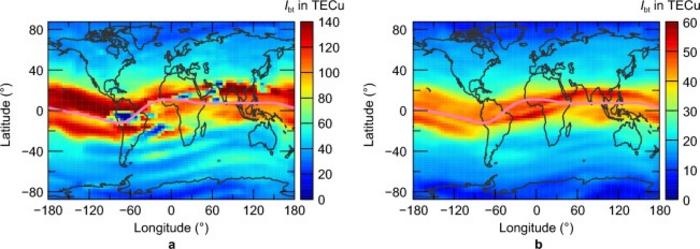
Around midday, Earth’s ionosphere is sometimes jolted by an intriguing phenomenon known as a noontime bite-out. This distinct occurrence manifests as rapid, short-lived reductions in the ionosphere’s electron density, which can have profound implications for radio communications and satellite navigation systems. A recent study, characterized by its comprehensive approach, sheds light on these midday disruptions, offering new insights into their global behavior, particularly across different solar activity cycles.
The research team from Hohai University and Beihang University has undertaken an in-depth analysis of noontime bite-outs, utilizing remarkably detailed, five-minute resolution global ionospheric map (GIM) data. Their findings, published in the journal Satellite Navigation in May 2025, represent the most exhaustive examination of these phenomena to date. By comparing data from two distinct years—2014, a peak solar activity period, and 2020, a time of minimal solar activity—the study meticulously illustrates how the intricacies of solar behavior can dramatically influence ionospheric dynamics.
During the years of high and low solar activity examined in the study, the team observed that noontime bite-outs were not merely anomalies but rather patterns with specific characteristics influenced by the sun’s cycles. The researchers noted significant differences in the frequency and geographical spread of these bite-outs, particularly emphasizing that such events were more prevalent in regions situated at mid and high latitudes during periods of solar minimum.
Delving further into the study’s findings, it becomes evident that the phenomenon of noontime bite-outs is particularly pronounced during the winter months. This seasonal observation is likely tied to lower levels of ionospheric electron content and diminished solar radiation, which naturally creates conditions more conducive to these electron density dips. By employing various intensity metrics, the research team could delineate the disparities in how bite-outs materialize across different geographical regions, enhancing our understanding of their diverse manifestations.
Timing was also a critical element in this study. The majority of noontime bite-outs were recorded to peak around 13:00 local time, with the duration of these events varying significantly. Most bite-outs lasted between 2.5 and 6 hours, with longer instances generally noted during summer months and periods of heightened solar activity. This provides a fascinating look into the ionosphere’s daily rhythms and the factors influencing its fluctuations.
The research team identified that the underlying mechanisms driving noontime bite-outs are not uniform across all regions; they vary intriguingly with latitude. Near the equator, dynamic plasma activities such as the fountain effect were found to be the dominant drivers of these midday dips. In contrast, at higher latitudes, the interplay of poleward winds and neutral atmospheric processes had a more substantial impact, further complicating the picture of how these bite-outs operate.
The implications of this research are profound, as it establishes a new benchmark for the study of ionospheric dynamics globally. “This work marks a major advance in our ability to monitor and understand daily ionospheric fluctuations,” stated Dr. Cheng Wang, senior author of the study. He emphasized that the findings provide the first time-resolved global observation of noontime bite-outs, shedding light on their behavior under various solar and seasonal conditions.
The significance of this study extends far beyond academic interest; it holds critical ramifications for future modeling of space weather phenomena and its impact on navigation and communication systems. As noontime bite-outs can disrupt signals vital for technology that relies on the ionosphere, establishing clear patterns surrounding their occurrence equips scientists and engineers alike with vital knowledge to enhance the resilience of satellite systems against unpredictable ionospheric changes.
In addition to providing insight into the timing and geographical prevalence of bite-outs, the methodology developed could be utilized for future studies exploring the variability of the ionosphere. By merging the findings from this research with real-time data and advanced physical models, it may be possible to generate predictive tools that fortify the capabilities of communications and global navigation satellite systems (GNSS).
Moreover, as solar activity continues to oscillate, understanding the spatiotemporal characteristics of these noontime bite-outs offers crucial forecasting tools. These insights ensure that the scientific community is better prepared to navigate the challenges posed by sudden electron density changes, which could have widespread implications for the reliability and accuracy of satellite-based systems.
The work of the Hohai and Beihang University researchers not only deepens our understanding of the ionospheric environment but also highlights the interconnectedness of solar activity with terrestrial technologies. Their comprehensive study parallels ongoing global efforts to improve technology resilience in the face of natural phenomena, underscoring the importance of interdisciplinary research in addressing the complexities of space weather.
As advancements in satellite technology continue to evolve, the knowledge gleaned from this research will be instrumental in framing future scientific inquiries and engineering solutions that address the nuances of ionospheric variability. Rather than viewing noontime bite-outs as isolated events, this research promotes a holistic approach to understanding the intricate behavior of Earth’s ionosphere in the context of our increasingly interconnected technological systems.
In conclusion, the exploration of ionospheric noontime bite-outs opens a vital dialogue between atmospheric science and practical technology applications. By fostering an understanding of how these midday disruptions correlate with solar activity, researchers are paving the way for robust engineering solutions to bolster the reliability of navigation and communication networks in an ever-evolving technological landscape.
News Publication Date: 22-May-2025
Web References: Satellite Navigation
References: DOI: 10.1186/s43020-025-00164-x
Keywords
Ionosphere, noontime bite-outs, solar activity, electron density, satellite navigation, space weather, atmospheric science, geographical distribution, predictive modeling.
Cite Scienmag News
Grant Pearson. (June 5, 2025). When the Sky Dips at Noon: Exploring Global Patterns in Ionospheric Disruptions. Scienmag. https://scienmag.com/when-the-sky-dips-at-noon-exploring-global-patterns-in-ionospheric-disruptions/
Grant Pearson. "When the Sky Dips at Noon: Exploring Global Patterns in Ionospheric Disruptions." Scienmag, 5 June 2025, https://scienmag.com/when-the-sky-dips-at-noon-exploring-global-patterns-in-ionospheric-disruptions/. Accessed 4 September 2026.
Grant Pearson. "When the Sky Dips at Noon: Exploring Global Patterns in Ionospheric Disruptions." Scienmag. June 5, 2025. https://scienmag.com/when-the-sky-dips-at-noon-exploring-global-patterns-in-ionospheric-disruptions/


