


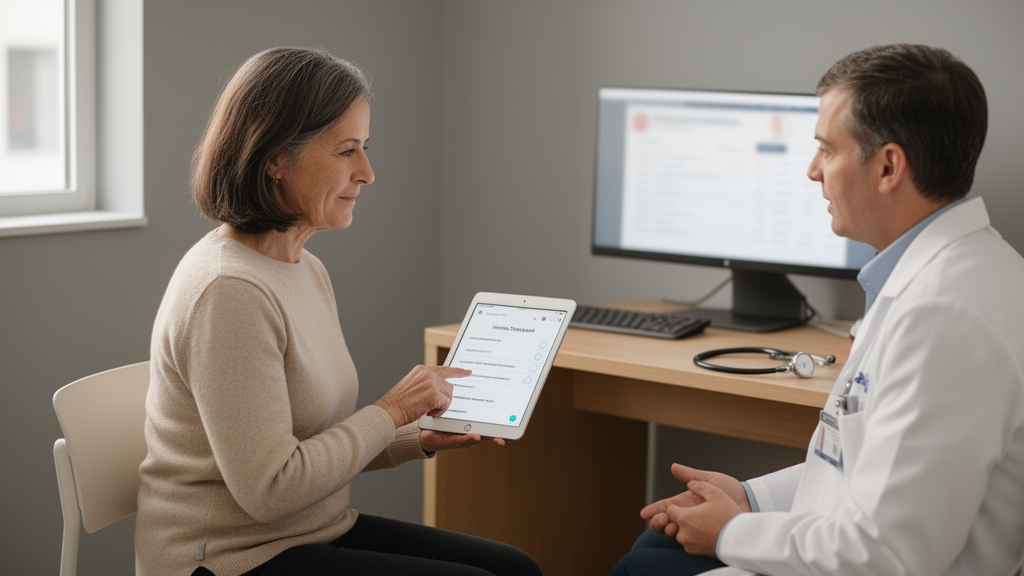
Chronic diseases now kill roughly 41 million people every year, and the daily grind of managing them — diabetes, heart failure, arthritis, chronic pain, cancer — falls on patients who often feel their own symptoms are the least measured thing in the clinic. A new systematic review from the University of Calgary, published in Frontiers in Health Services, takes the most direct measure of that problem yet: what actually happens when the questionnaires patients fill out about their own symptoms are wired directly into the electronic health record (EHR) systems their doctors already use, rather than sitting in a separate survey platform nobody opens.
The review, led by Monica Cepoiu-Martin and colleagues at the Cumming School of Medicine, followed PRISMA reporting guidelines and was registered with PROSPERO. The team searched seven databases — MEDLINE, Embase, CINAHL, PsycINFO, the Cochrane Library, Scopus and Web of Science — from January 2000 to February 2026, hunting for quantitative studies of patient-reported outcome measures (PROMs) that were not merely collected electronically but genuinely integrated into routine clinical workflows inside EHR systems. After screening 10,177 records and removing 5,033 duplicates, only ten studies made the final cut — a strikingly small yield for a question this consequential.
The technical distinction at the heart of the review is between passive and active integration. A PROM is a standardized questionnaire completed directly by the patient, without clinician or proxy interpretation, capturing symptoms, functioning and quality of life. Measurement-based care (MBC) is the systematic routine use of such measures to track treatment response and inform shared decision-making. But the review’s authors found that most prior literature stopped at feasibility — whether patients can complete the forms — rather than testing what happens when the data flows into the record itself, triggering alerts, triage rules and decision support during actual encounters. The ten included studies, mostly from the United States and published between 2016 and 2026 with eight appearing from 2019 onward, spanned oncology, rheumatology, primary care, chronic pain and spine surgery, running on platforms such as Epic Systems and Oracle Health Millennium.
The results split cleanly into three patterns. First, symptom identification and monitoring improved consistently. In a cluster-randomized stepped-wedge trial of 24,874 oncology patients, 85 percent reported at least one clinically actionable symptom, and EHR-facilitated collaborative care produced statistically significant reductions in anxiety (−0.12, 95% CI −0.19 to −0.05) and depression (−0.08, 95% CI −0.15 to −0.01). In a community cancer center feasibility study, 36 percent of completed surveys identified at least one severe symptom in real time. In a comprehensive cancer center implementation study, more than half of assessments triggered at least one clinical alert, with 41.8 percent specifically flagging nutritional needs that might otherwise have gone unnoticed.
Second, clinic efficiency and resource utilization showed some of the most dramatic numbers. A UK rheumatology study found that electronic PROM completion rose from 25 percent on paper to 66 percent electronically, cutting wait times roughly in half — from 12.1 to 6.4 weeks — and saving approximately 1,500 clinic hours per year, while improving the new-to-follow-up visit ratio from 1:3.1 to 1:2.2. A spine surgery pre-post study found clinic visit duration dropped from 127.9 to 117.0 minutes, a 10.1 percent reduction, with electronic capture rates reaching about 98 percent. In oncology, PROM completion was associated with a 22 percent reduction in emergency room visits and a 20 percent reduction in hospitalizations, alongside shorter hospital stays — 5.8 versus 7.0 days — and social work referrals rising from zero to 10.3 percent of patients.
Third — and this is where the viral headline meets the sober caveat — the downstream clinical outcomes were far less consistent. A cluster-randomized trial in chronic pain found no significant difference in patient satisfaction (9.28 versus 9.01, P = 0.20). A controlled interrupted time series in rheumatoid arthritis found no significant change in visit volume, flare rates or care delays despite PROM-guided scheduling recommendations, of which only 17.6 percent were actually implemented. A primary care dementia screening trial did show increased diagnostic activity — dementia diagnoses rose from 12.4 to 15.4 percent (AOR = 1.31, 95% CI 1.05 to 1.64) and diagnostic evaluations from 29.0 to 36.7 percent — but whether earlier detection translates into better long-term outcomes remains unproven. Heterogeneity across the ten studies was so substantial that the authors could not pool the data in a meta-analysis at all.
The review’s most important technical insight is that integration depth appears to determine effectiveness. Studies using active integration strategies — real-time alerts, automated triage systems, clinician-facing dashboards and decision-support rules — were more likely to report positive outcomes than those collecting PROM data passively without a clear pathway to clinical action. In the community cancer center study, good uptake (66 percent completion) still resulted in limited additional clinical action because many flagged symptoms were already under management; only 26 percent of flagged symptoms led to triage action. The authors also note a technological generation effect: EHR systems of the mid-2010s typically supported only electronic capture and display, whereas later platforms added patient-portal administration, computerized adaptive testing (CAT), automated alerts and triage rules — meaning findings should be read in the context of contemporary EHR platforms rather than older record systems.
Setting mattered too. Oncology studies more consistently demonstrated improvements in symptom detection and management, possibly because symptom monitoring is already well embedded in cancer care and patients in active treatment experience more severe or rapidly changing symptoms. Primary care and rheumatology studies more frequently reported gains in clinic efficiency and resource utilization rather than direct patient-level benefits. The review’s authors conclude that the effectiveness of PROM integration is highly context-dependent rather than universally reproducible — a finding that tempers the enthusiasm of health systems rushing to embed these tools everywhere at once.
The limitations are significant and the authors are candid about them. Nine of ten studies were conducted in the United States, most within academic health centers, raising questions about generalizability to other healthcare systems. Five of the ten focused on oncology populations. Many studies used observational or quality improvement designs with potential risk of bias — incomplete outcome data, high non-response, uncontrolled confounding and uncertain intervention fidelity. Follow-up periods were often short, limiting the ability to detect longer-term impacts, and certain chronic conditions were underrepresented. The review also raises an equity concern the authors flag for future research: not all patients have equal access to the digital technologies required to complete electronic assessments, and the digital divide could exacerbate existing disparities if PROM integration scales without attention to socioeconomic factors.
For clinicians and health system leaders, the practical takeaway is precise: EHR-integrated PROMs offer their clearest value in supporting triage, remote monitoring and early identification of patient needs, particularly in populations with high symptom burden such as oncology. Successful implementation requires careful workflow engineering — automated alerts, clinician-facing dashboards and decision-support tools appear essential to maximizing impact, while poorly integrated systems risk contributing to alert fatigue or underutilization. The Calgary team calls for larger, multi-center randomized controlled trials with longer follow-up, standardized outcome measures, and greater inclusion of diverse populations and healthcare systems outside the United States. Until then, the promise of measurement-based care embedded in the record is real but conditional: the data must not merely be collected — it must act.
Subject of Research: Effectiveness of integrating patient-reported outcome measures into electronic health records for measurement-based care in chronic illness
Article Title: Effectiveness of integrating patient-reported outcome measures into electronic health records for measurement-based care in patients with chronic illnesses: a systematic review
Article References: Effectiveness of integrating patient-reported outcome measures into electronic health records for measurement-based care in patients with chronic illnesses: a systematic review. (n.d.). https://doi.org/10.3389/frhs.2026.1930126
Image Credits: AI Generated
DOI: 10.3389/frhs.2026.1930126
Keywords: patient-reported outcome measures, electronic health records, measurement-based care, chronic disease, systematic review, symptom monitoring, clinic efficiency, healthcare utilization, oncology, rheumatology, primary care, clinical decision support
Cite Scienmag News
Ophelia Keating. (October 16, 2026). When Patients Rate Their Own Care: EHR-Embedded Symptom Scores Show Real Gains — and Real Limits. Scienmag. https://scienmag.com/when-patients-rate-their-own-care-ehr-embedded-symptom-scores-show-real-gains-and-real-limits/
Ophelia Keating. "When Patients Rate Their Own Care: EHR-Embedded Symptom Scores Show Real Gains — and Real Limits." Scienmag, 16 October 2026, https://scienmag.com/when-patients-rate-their-own-care-ehr-embedded-symptom-scores-show-real-gains-and-real-limits/. Accessed 16 October 2026.
Ophelia Keating. "When Patients Rate Their Own Care: EHR-Embedded Symptom Scores Show Real Gains — and Real Limits." Scienmag. October 16, 2026. https://scienmag.com/when-patients-rate-their-own-care-ehr-embedded-symptom-scores-show-real-gains-and-real-limits/


