


How effective medications are depends on various factors, including the time of day when they are administered. Why? Because our bodies don’t always function exactly the same. Instead, they follow the cycle set by their internal clock, otherwise known as circadian rhythm. But since each person’s circadian rhythm is different and depends on a number of different factors, it is difficult to tailor medication schedules to an individual patient’s body clock. Researchers at Charité – Universitätsmedizin Berlin have now developed a method for determining the optimum time of cancer treatment based on certain breast cancer cell lines. They describe their approach in the journal Nature Communications.*

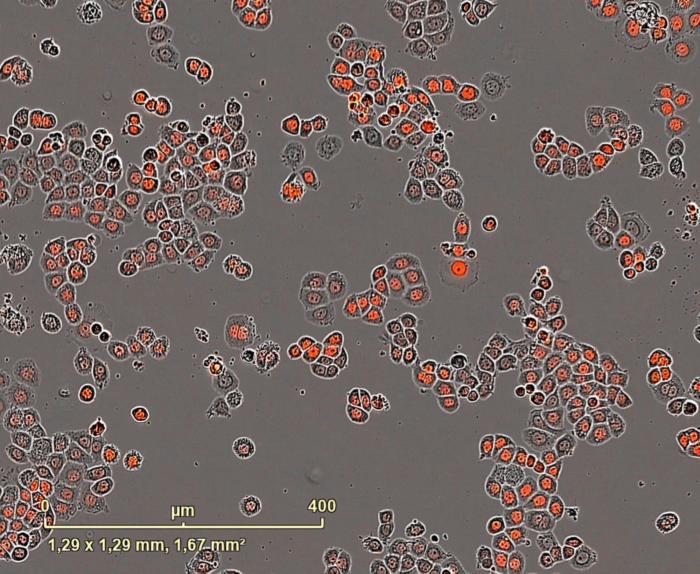
Credit: © Charité | Granada Lab
How effective medications are depends on various factors, including the time of day when they are administered. Why? Because our bodies don’t always function exactly the same. Instead, they follow the cycle set by their internal clock, otherwise known as circadian rhythm. But since each person’s circadian rhythm is different and depends on a number of different factors, it is difficult to tailor medication schedules to an individual patient’s body clock. Researchers at Charité – Universitätsmedizin Berlin have now developed a method for determining the optimum time of cancer treatment based on certain breast cancer cell lines. They describe their approach in the journal Nature Communications.*
A person’s internal clock sets the rhythm of many different bodily functions and metabolic processes, such as sleep and digestion. But the organs aren’t the only things that are more or less active depending on the time of day. Individual cells also follow a cycle set by a person’s body clock, so they respond differently to external influences at different times of the day. This is hugely important to chemotherapy administered to treat cancer. Previous studies have shown that chemotherapy is most effective when the tumor cells are dividing. But this finding has been hardly used at all in clinical treatment to date.
An interdisciplinary team at Charité headed by Dr. Adrián Enrique Granada from the Charité Comprehensive Cancer Center (CCCC) set out to close this gap. The team began looking for the optimum time to administer medication, based on the individual circadian rhythms of the tumors.
Triple-negative breast cancer as an example
“We cultured cells from patients with triple-negative breast cancer to observe how they respond at different times of day to the medications administered,” explains Carolin Ector, a research associate in Granada’s working group. Triple-negative breast cancer is a highly aggressive form of breast cancer, with few effective treatments available. “We used live imaging, a method of continuously monitoring living cells, and complex data analysis techniques to monitor and evaluate the circadian rhythms, growth cycles, and medication responses of these cancer cells in detail.”
In this way, the researchers identified certain times of the day at which cancer cells are most responsive to medication-based treatments. For example, the chemotherapeutic drug 5-fluorouracil (5-FU) turned out to have peak efficacy against a certain cancer cell line between eight and ten a.m. As the study also shows, the crucial aspects here are certain cellular and genetic factors. The scientists were even able to identify which genes are key to the circadian effects of certain medications. “We call them ‘core clock genes’. They have a significant impact on how responsive cancer cells are to treatments administered at different times of day,” Granada explains.
Profiles show how cancer cell types respond to medications
This approach can be used to create detailed profiles showing how different types of cancer cells respond to different medications at various times. “This can help to identify the most effective combinations of drugs,” Granada says. “Overall, our findings indicate that personalized treatment plans based on individual circadian rhythms could substantially improve the efficacy of cancer treatment”, he concludes. Moreover, undesirable side effects could also be reduced.
For these findings to contribute to clinical practice soon, the results should be validated in studies involving larger groups of patients. “We’re also planning to study the molecular mechanisms behind the circadian influences on medication sensitivity to further optimize treatment times and identify new therapeutic targets,” Granada says.
About the study
The study was conducted at the Charité Comprehensive Cancer Center (CCCC) under the leadership of Dr. Adrián Enrique Granada (last author). He is in charge of the Granada Lab there, which focuses on systems oncology. Carolin Ector, the first author of the publication, is a research associate at the CCCC and a graduate student at the Humboldt-Universität zu Berlin.
The team worked closely with the Department of Chronobiology at Charité, led by Prof. Achim Kramer, to collect complex time series data on the cell’s biological clocks. The data analysis was created in cooperation with Prof. Hanspeter Herzel from the Institute for Theoretical Biology at Humboldt-Universität zu Berlin and the working group headed by Prof. Thomas Sauter at the University of Luxembourg. Sources of funding for the study included the German Federal Ministry of Education and Research (BMBF) and the German Research Foundation (DFG).
*Ector C et al. Time-of-day effects of cancer drugs revealed by high-throughput deep phenotyping. Nat Commun 15, 7205 (2024), doi: 10.1038/s41467-024-51611-3
Journal
Nature Communications
Method of Research
Imaging analysis
Subject of Research
Cells
Article Title
Time-of-day effects of cancer drugs revealed by high-throughput deep phenotyping
Article Publication Date
22-Aug-2024
Cite Scienmag News
Nathaniel Bowman. (August 23, 2024). When is the best time of day for cancer treatment? Scienmag. https://scienmag.com/when-is-the-best-time-of-day-for-cancer-treatment/
Nathaniel Bowman. "When is the best time of day for cancer treatment?" Scienmag, 23 August 2024, https://scienmag.com/when-is-the-best-time-of-day-for-cancer-treatment/. Accessed 4 September 2026.
Nathaniel Bowman. "When is the best time of day for cancer treatment?" Scienmag. August 23, 2024. https://scienmag.com/when-is-the-best-time-of-day-for-cancer-treatment/

