


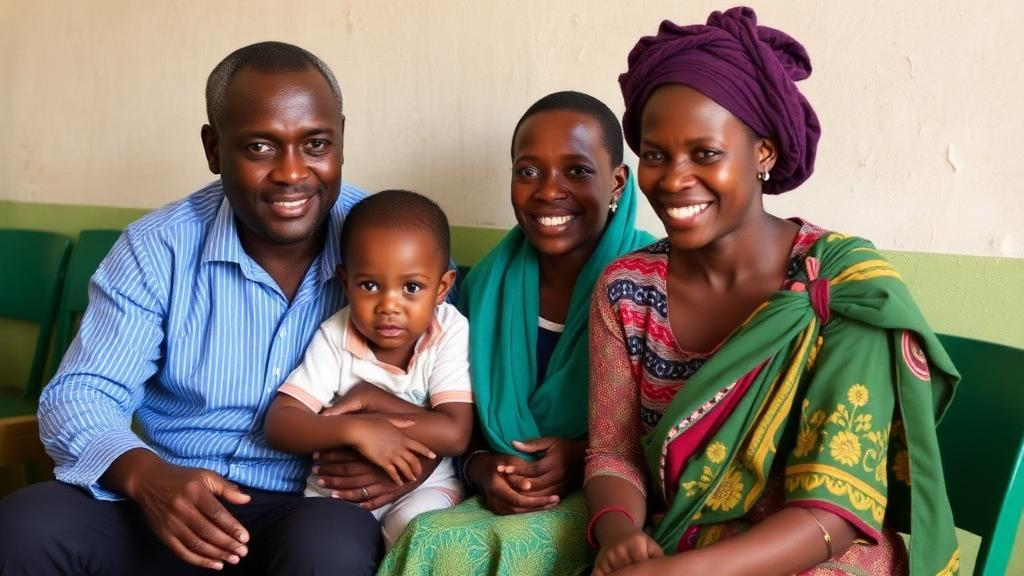
In the lakeside city of Mwanza, Tanzania, a parenting program designed for couples rather than mothers alone is offering a rare longitudinal glimpse into how families change when fathers are brought deliberately into the work of raising young children. A new qualitative study published in PLOS Global Public Health followed mothers who participated in Familia Bora, a pilot parenting intervention delivered to couples with young children across six communities between July and November 2024. The findings paint a consistent picture of perceived transformation: mothers described gentler discipline, more playful and responsive caregiving, better child nutrition, closer partnerships, and an easing of the mental strain that so often accompanies solo caregiving.
The research team, led by Valencia J. Lambert and colleagues including Joshua Jeong, set out to answer a question that has been surprisingly neglected in global early childhood research. While parenting programs have long targeted mothers as the default caregivers, interest has grown in engaging fathers as well, on the theory that nurturing care, psychosocial support, and healthy early childhood development are household enterprises rather than maternal duties. Few studies, however, have asked how mothers themselves perceive and benefit from participating in such interventions alongside their partners. The Mwanza pilot provided an opportunity to document those perceptions as they unfolded over time rather than reconstructing them in a single retrospective interview.
Methodologically, the study leaned on the strengths of longitudinal qualitative design. Mothers were interviewed in depth at three points: baseline, midline, and endline of the program. Participants were recruited through both random and purposive sampling, and by the endline round a total of 22 mothers had completed interviews. Crucially, 15 of those mothers, roughly 68 percent of the endline sample, were purposively re-interviewed from the original baseline group, allowing the researchers to trace perceived changes within the same individuals across the course of the intervention. This within-person tracking matters: it distinguishes genuine shifts in a mother’s own account from differences that might simply reflect comparing unrelated women with different temperaments, marriages, or family circumstances.
The interviews were structured around five domains in which the researchers hypothesized change might occur: parenting practices, gender roles and attitudes, couples’ relationship dynamics, maternal mental health, and complementary feeding practices, the foods and feeding behaviors introduced as children transition from breast milk to solid diets. This framework reflects a broad view of what a parenting intervention can touch. Rather than treating discipline, nutrition, and marital life as separate technical topics, Familia Bora was positioned as an entry point into the whole ecosystem of the household, and the analysis asked mothers to describe movement in each of these connected domains.
Across all five domains, mothers commonly reported improvements. In caregiving, they described increased use of responsive parenting, the practice of noticing and appropriately answering a child’s cues of distress, curiosity, or hunger, alongside more frequent early learning activities such as talking, playing, and structured interaction with young children. Equally striking was what diminished: mothers reported reductions in harsh discipline, suggesting that the program’s messages about positive guidance were displacing punitive strategies rather than simply being layered on top of them. In the nutritional domain, mothers described gains in knowledge about child feeding and corresponding changes in what and how they fed their children, a shift with direct relevance to growth and development during the critical early years.
Perhaps the most consequential findings concern the redistribution of care within the household. Mothers repeatedly highlighted greater father involvement in childcare, and they connected that involvement to more supportive relationship dynamics between partners. From a technical standpoint, this is the mechanism that gives couples-based programs their distinctive promise. When a father absorbs a meaningful share of childcare tasks, the mother’s caregiving burden lightens; when partners communicate and collaborate around parenting, everyday friction can give way to cooperation. The mothers in this study perceived exactly that chain of effects, describing how shared parenting reduced their load and, in turn, supported their mental health.
That link between father engagement and maternal psychosocial well-being carries real weight for global child health policy. Maternal depression and stress are recognized risk factors for compromised caregiving and adverse child outcomes, and in many low-resource settings mothers carry a disproportionate share of childcare with limited support. If a relatively brief couples-based program can catalyze a perceptible shift toward shared caregiving and warmer partner relations, it offers a dual dividend: direct benefits for the mother and indirect benefits for the child, who grows up in a less stressed, more nurturing environment. The study’s authors frame this as father-inclusive programming having the potential to catalyze household-level shifts that benefit mothers, children, and the family as a whole.
The choice of Mwanza as the setting is also significant. Tanzania, like much of sub-Saharan Africa, has seen rapid expansion of nurturing-care and early childhood development initiatives, often modeled on programs first tested elsewhere. Evidence generated within Tanzanian communities, in Swahili-speaking household contexts with local facilitators, helps establish what these approaches look like when they are genuinely delivered at community level rather than under ideal research conditions. A pilot implementation study such as this one sits deliberately close to practice: it asks not only whether an intervention can work under controlled circumstances, but what participants perceive as it is rolled out in real neighborhoods by real programs.
At the same time, the study’s qualitative and longitudinal design shapes what can be concluded. Perceived changes are mothers’ own accounts, rich in texture and mechanism but not equivalent to measured changes in observed parenting behavior, validated mental health scores, or child growth outcomes. The sample of 22 endline participants, with 15 followed longitudinally, is well suited to illuminating how and why change happens, but it was not designed to estimate effect sizes. Self-reports collected during a program may also carry an optimism bias, since participants who have invested time in an intervention have reasons to feel, and to convey, that it is helping. The value of the study lies in mapping the pathways mothers themselves identify, pathways that future quantitative and observational work can test.
Even with those caveats, the direction of the evidence is coherent and encouraging. Across interviews conducted months apart, the same mothers described a cluster of interlocking improvements: more responsive and playful caregiving, less harsh punishment, smarter and more attentive child feeding, more hands-on fathers, steadier partnerships, and lighter emotional loads. That internal consistency across time and across domains suggests that couples-based parenting programs may operate less like a single-message intervention and more like a lever that moves several parts of family life at once. For practitioners designing early childhood programs in Tanzania and beyond, the implication is that engaging fathers is not an optional add-on but a potential catalyst, and for the mothers of Mwanza, it appears to have meant something concrete: more support, less strain, and a household better arranged around the needs of their young children.
Subject of Research: Mothers' perceived changes following a couples-based parenting program for families with young children in Mwanza, Tanzania
Article Title: Perceived changes in mothers’ outcomes following a pilot parenting program for couples with young children in Mwanza, Tanzania: A longitudinal qualitative study
Article References: Lambert, V. J., Bhojani, A., Sangarara, G., Joseph, J., Yang, N. T., Joachim, D., & Jeong, J. (2026). Perceived changes in mothers’ outcomes following a pilot parenting program for couples with young children in Mwanza, Tanzania: A longitudinal qualitative study. PLOS Global Public Health, 6(10), e0006203. https://doi.org/10.1371/journal.pgph.0006203
Image Credits: AI Generated
DOI: 10.1371/journal.pgph.0006203
Keywords: parenting program, father engagement, Tanzania, early childhood development, maternal mental health, responsive caregiving, gender roles, complementary feeding, couples intervention, qualitative research, nurturing care, Mwanza
Cite Scienmag News
Courtney Benton. (October 10, 2026). When Fathers Join Parenting Classes, Mothers in Tanzania Report Sweeping Gains. Scienmag. https://scienmag.com/when-fathers-join-parenting-classes-mothers-in-tanzania-report-sweeping-gains/
Courtney Benton. "When Fathers Join Parenting Classes, Mothers in Tanzania Report Sweeping Gains." Scienmag, 10 October 2026, https://scienmag.com/when-fathers-join-parenting-classes-mothers-in-tanzania-report-sweeping-gains/. Accessed 10 October 2026.
Courtney Benton. "When Fathers Join Parenting Classes, Mothers in Tanzania Report Sweeping Gains." Scienmag. October 10, 2026. https://scienmag.com/when-fathers-join-parenting-classes-mothers-in-tanzania-report-sweeping-gains/


