


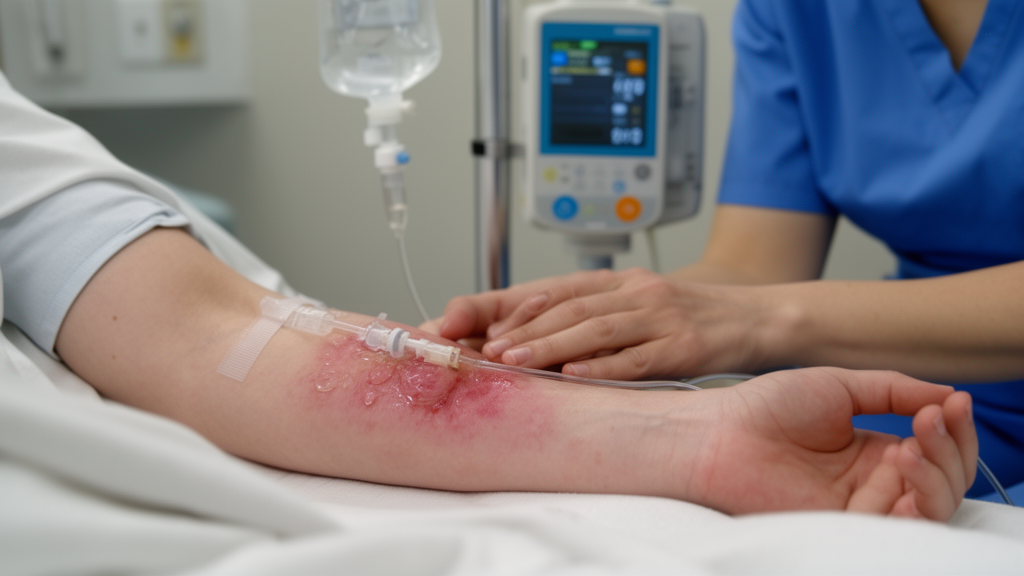
A rare but serious infusion accident has been documented for the first time in the medical literature. Urologists at University Hospital Münster in Germany report the case of a 56-year-old man with metastatic urothelial carcinoma who suffered a central venous extravasation of the antibody-drug conjugate enfortumab vedotin combined with the immunotherapy pembrolizumab, a regimen now established as first-line treatment for metastatic urothelial cancer following the pivotal EV-302/KEYNOTE-A39 trial. The drug mixture escaped from a dislocated port catheter into the subcutaneous tissue of the infraclavicular region, causing extensive tissue necrosis that ultimately required surgical debridement and vacuum-assisted wound closure. According to the team, writing in the Journal of Cancer Research and Clinical Oncology, this is the first reported case of a central venous EV-P extravasation graded 3 on the Common Terminology Criteria for Adverse Events that demanded surgical intervention.
Extravasation is the accidental leakage of intravenously administered medication into the tissue surrounding a vein rather than into the bloodstream itself. It is a recognized complication of chemotherapy, but its consequences vary enormously depending on the drug involved. Some agents are irritants that provoke localized inflammation and pain, while others are vesicants capable of causing severe blistering, ulceration, and deep tissue death. Enfortumab vedotin belongs to the class of antibody-drug conjugates, molecules engineered to deliver a cytotoxic payload directly to tumor cells. In this case, the payload is monomethyl auristatin E, a potent antimitotic agent that disrupts microtubule assembly and halts cell division. Because of this cytotoxic cargo, the authors argue that enfortumab vedotin in particular may pose a high risk of severe local complications when it extravasates.
The clinical course in this patient illustrates just how destructive such an event can be. During the first treatment cycle, the port catheter, which had been inserted into the cephalic vein to provide reliable central venous access, became dislodged from its intended position. The infusate then escaped into the subcutaneous tissue of the infraclavicular region, the area just below the collarbone. What followed was extensive subcutaneous necrosis, the death of a broad zone of tissue beneath the skin. Conservative measures alone could not contain the damage, so the surgical team performed debridement, removing the dead tissue, and applied a vacuum-assisted closure system, a device that applies controlled negative pressure to promote wound healing. The wound then healed by secondary intention, a slower process in which the body fills the defect with new tissue from the base upward.
Despite the severity of the injury, the outcome was ultimately favorable in functional terms. The wound closed with a residual scar, but the patient experienced no lasting pain and no impairment of arm or shoulder movement. Treatment was not abandoned. Instead, the oncology team resumed the EV-P regimen through a peripheral venous catheter, a simpler line placed in a peripheral vein, and the patient went on to achieve a deep partial response, meaning his metastatic disease regressed substantially under therapy. Written informed consent was obtained from the patient for publication of the clinical data, and the authors note that local ethics committee approval was not required because the report documents clinical treatment and its complications rather than a research project involving human subjects.
The significance of this case extends beyond a single patient. The EV-302/KEYNOTE-A39 study demonstrated that combining enfortumab vedotin with pembrolizumab produces superior outcomes in metastatic urothelial carcinoma compared with platinum-based chemotherapy, and the regimen has since been adopted as a new first-line standard. With rapidly increasing use worldwide, the Münster team emphasizes that documenting and publishing unexpected side effects and complications is essential to systematize procedures for managing them. Until now, the literature on EV-P extravasation has been essentially empty, leaving clinicians without evidence-based guidance on how to recognize, grade, and treat such events. This report, together with a mini review of the current literature, begins to fill that gap.
The technical anatomy of enfortumab vedotin helps explain the danger. The molecule consists of a monoclonal antibody targeting Nectin-4, a cell adhesion protein abundantly expressed on urothelial cancer cells, linked to monomethyl auristatin E through a cleavable linker. When the antibody binds its target and the conjugate is internalized, the payload is released inside the tumor cell, where it destroys the microtubule network and triggers cell death. This targeted delivery is what makes the drug so effective against bladder cancer, but it also means that any drug escaping into healthy subcutaneous tissue carries a cytotoxic weapon. Tissue exposed to monomethyl auristatin E can undergo the same kind of cell death that the drug inflicts on tumors, producing necrosis rather than simple inflammation.
Pembrolizumab, by contrast, is a monoclonal antibody without a cytotoxic payload. It works by blocking the PD-1 receptor on T cells, releasing the brakes that tumors place on the immune system. As a pure immunotherapy, it is generally considered less likely to cause severe local tissue damage on extravasation, although any large-volume infusion into tissue can provoke irritation. The combination regimen therefore presents a mixed risk profile, with enfortumab vedotin as the dominant concern for local complications. The authors stress that because of its cytotoxic payload, EV in particular may pose a high risk of local complications in the context of extravasations, a point with direct implications for infusion practice as the regimen spreads through oncology departments globally.
The route of administration matters as much as the drug itself. Central venous access devices such as implanted ports are widely used in cancer care to protect peripheral veins and allow long-term infusion, but they introduce their own failure modes. Catheter dislocation, as occurred in this patient, can redirect infusate into tissue while the external signs of a properly functioning line remain reassuring. Recognizing an extravasation from a central line can therefore be more difficult than from a peripheral cannula, where swelling and pain at the insertion site are immediately visible. The Münster case, graded 3 under CTCAE criteria, demonstrates that central venous EV-P extravasation can produce damage severe enough to require operative management, a scenario clinicians managing the regimen should now anticipate.
For the growing population of patients receiving EV-P, the practical lessons are concrete. Infusion teams should maintain vigilance for catheter dislocation even with central lines, and any suspicion of leakage should prompt immediate assessment. When necrosis occurs, surgical debridement combined with vacuum-assisted closure offers a pathway to wound healing with acceptable functional outcomes, as this patient’s recovery shows. Crucially, an extravasation event need not end cancer treatment: therapy was successfully resumed via a peripheral venous catheter, and the deep partial response achieved suggests that a severe local complication, managed promptly and systematically, does not necessarily compromise the antitumor effect. As the authors conclude, with increasing use of the regimen, careful documentation of such events is the foundation for standardized procedures, turning isolated case reports into the evidence base that clinicians will need as this powerful combination becomes a global standard of care.
Subject of Research: First reported surgical case of central venous EV-P extravasation in metastatic urothelial carcinoma
Article Title: Management of extravasations of enfortumab vedotin and pembrolizumab: a case report and mini review of the current literature
Article References: Management of extravasations of enfortumab vedotin and pembrolizumab: a case report and mini review of the current literature. (n.d.). https://doi.org/10.1007/s00432-026-06646-y
Image Credits: AI Generated
DOI: 10.1007/s00432-026-06646-y
Keywords: enfortumab vedotin, pembrolizumab, extravasation, urothelial carcinoma, antibody-drug conjugate, case report, Management, extravasations, enfortumab, vedotin, case, report
Cite Scienmag News
Nathaniel Bowman. (October 16, 2026). When Cancer Drugs Leak: First Surgical Case of EV-P Extravasation Reported. Scienmag. https://scienmag.com/when-cancer-drugs-leak-first-surgical-case-of-ev-p-extravasation-reported/
Nathaniel Bowman. "When Cancer Drugs Leak: First Surgical Case of EV-P Extravasation Reported." Scienmag, 16 October 2026, https://scienmag.com/when-cancer-drugs-leak-first-surgical-case-of-ev-p-extravasation-reported/. Accessed 16 October 2026.
Nathaniel Bowman. "When Cancer Drugs Leak: First Surgical Case of EV-P Extravasation Reported." Scienmag. October 16, 2026. https://scienmag.com/when-cancer-drugs-leak-first-surgical-case-of-ev-p-extravasation-reported/


