


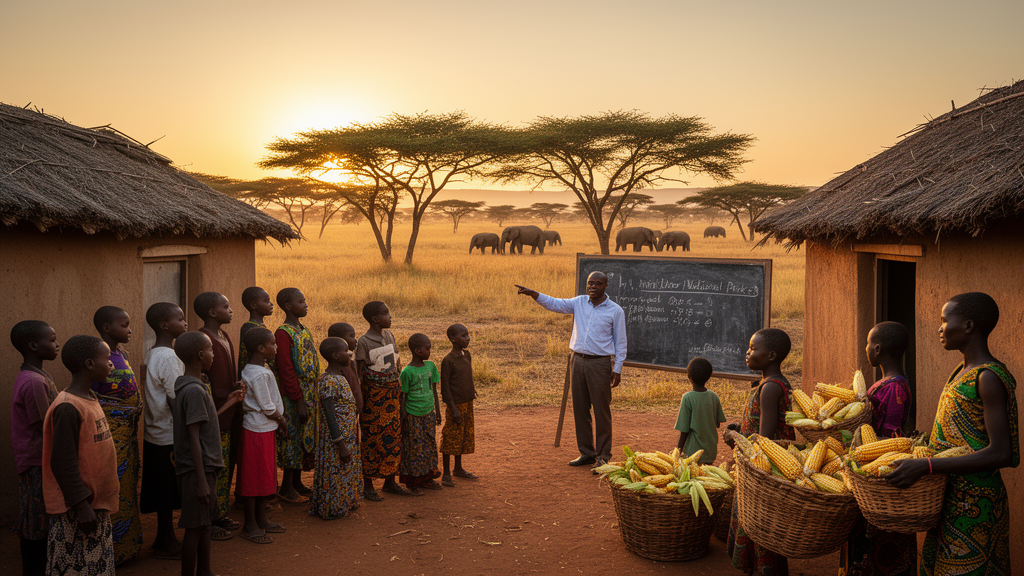
Deep in northern Tanzania, along the border with Kenya, lies Mkomazi National Park, a transfrontier conservation area that anchors the greater Tsavo-Mkomazi ecosystem. The park is ringed by 22 villages whose residents are mostly small-scale farmers and livestock keepers, and for decades their relationship with the protected area has been complicated by crop raids, livestock depredation, and a history of evictions stretching back to the 1950s. A new study published in Frontiers in Sustainable Resource Management has now dissected exactly what drives the wildlife conservation attitudes of these communities, and the results challenge some long-held assumptions about how to win local hearts and minds for conservation.
The research, led by Gasto Lyakurwa of the College of African Wildlife Management in Mweka, Tanzania, and Pennsylvania State University, together with Edwin Sabuhoro of Pennsylvania State University, applied an expectancy-value model of attitude formation to survey data collected from households adjacent to the park between June and August 2023. The expectancy-value framework, rooted in classic social psychology, holds that a person’s attitude toward an object is a product of their beliefs about that object’s attributes and the value they place on those attributes. In this context, the model suggests that attitudes toward wildlife conservation emerge from the interplay of demographic characteristics, socio-economic conditions, perceptions of benefits, and lived experiences of human-wildlife conflict.
To capture these dynamics, the team randomly selected respondents from village register books across eight villages and conducted face-to-face interviews in Kiswahili, administered by trained research assistants fluent in both Kiswahili and English. Out of 267 respondents initially interviewed, 212 provided complete responses that could be analyzed. The surveyed population was dominated by farmers, who outnumbered pastoralists roughly six to one, and included people from diverse ethnic backgrounds, primarily Pare and Maasai. Slightly more female-headed households participated than male-headed ones. The average age of household heads was 49 years, and average annual household income was approximately 1,115 US dollars. Notably, 75.9 percent of respondents had completed only primary education, while 17.5 percent had no formal education at all.
The statistical heart of the study was a multiple logistic regression model that treated conservation attitude as a binary outcome, coding positive attitudes as one and negative attitudes as zero. The model tested the influence of gender, education level, household income, household size, land ownership, livestock numbers, health insurance status, food sufficiency, distance to health centers, and perception of conservation benefits. The researchers validated their approach with a Box-Tidwell test, confirming that the assumption of linearity in the logit was satisfied for all continuous predictors. The final model was statistically significant, with a chi-square value of 33.776 and a p-value of 0.001, and it correctly classified 69.3 percent of cases.
Three predictors stood out as statistically significant. First, household heads with formal education, defined as completion of primary school or above, were associated with a 539 percent increase in the likelihood of reporting a positive conservation attitude compared with those lacking formal education. Second, respondents who perceived benefits from wildlife were 300 percent more likely to express positive conservation attitudes than those who did not. Third, and perhaps most counterintuitively, households reporting higher food sufficiency were actually 41 percent less likely to hold positive attitudes toward conservation, a finding that inverts the intuitive expectation that food security and conservation support go hand in hand.
The food security result deserves particular attention because it reveals a tension at the heart of conservation policy. The authors suggest that people who work hard to produce enough food may be more anxious about the threat that wildlife poses to their crops and livestock than those with less at stake. In communities where elephants raid maize fields and carnivores take cattle, the very act of achieving food security can heighten vulnerability to wildlife damage, and therefore breed resentment toward the animals and the park that protects them. This interpretation aligns with prior research from Zimbabwe’s Save Valley Conservancy, where residents felt unsafe when wildlife affected their livelihoods, and with studies showing that crop damage and livestock depredation significantly undermine household food security in Tanzanian communities near protected areas.
Beyond the regression model, the study employed chi-square tests to examine the relationship between human-wildlife conflict and conservation attitudes. The results showed a significant association between the perceived trajectory of conflict, whether increasing, decreasing, or stable, and conservation attitude, with a p-value of 0.009. Respondents who felt that conflict was decreasing were far more likely to report positive attitudes. However, there was no significant association between simply being aware of human-wildlife conflict and holding positive attitudes, nor between the raw frequency of conflict encounters and attitude. This distinction matters because it suggests that it is not the mere occurrence of conflict but rather the perceived direction of change that shapes how people feel about conservation. When residents believe the situation is improving, their support for conservation strengthens accordingly.
The overall picture that emerges from the survey is sobering. Respondents were significantly more likely to report negative conservation attitudes than positive ones, with 136 expressing negative views and only 76 expressing positive views, a difference that was statistically significant at p less than 0.001. This skew toward negativity likely reflects the cumulative burden of living alongside wildlife without commensurate benefits. Compared to famous destinations like Serengeti and Kilimanjaro National Parks, Mkomazi has not yet attracted enough tourism to generate meaningful economic returns for surrounding communities, leaving residents to bear the costs of conservation without enjoying its rewards.
The findings carry important implications for conservation policy and practice. The authors argue that to foster positive wildlife conservation attitudes, development policies should be designed to provide knowledge through education, ensure food security through effective human-wildlife conflict mitigation, and enhance the opportunities and ecosystem services that conservation activities can deliver, including ecotourism potential and employment in the wildlife sector. The education finding is particularly consequential, echoing research from Kenya and from Tanzania’s own Ngorongoro region showing that formal schooling and school-based environmental clubs can positively shape young people’s perceptions of wildlife and conservation.
At the same time, the authors caution that the relationship between education and conservation behavior is not always straightforward, and that attitudes are highly context-specific and temporally dynamic. Conservation benefits alone do not guarantee positive attitudes, as prior work near the Selous Game Reserve demonstrated when communities accepted material benefits but still held negative perceptions of the reserve itself. What this study ultimately makes clear is that winning local support for conservation requires more than handing out benefits or building fences. It requires understanding the specific social, economic, and psychological landscape of each community, and designing interventions that address the real drivers of attitude formation, from classroom education to conflict mitigation to equitable benefit sharing. As human populations grow and pressure on protected areas intensifies, this granular, place-based understanding may prove to be the most valuable conservation tool of all.
Subject of Research: Demographic and socio-economic drivers of wildlife conservation attitudes among communities adjacent to Mkomazi National Park in Tanzania
Article Title: Demographic and socio-economic influences on self-reported wildlife conservation attitude: a case study of communities adjacent to Mkomazi National Park in Tanzania
Article References: Lyakurwa, G., & Sabuhoro, E. (2026). Demographic and socio-economic influences on self-reported wildlife conservation attitude: a case study of communities adjacent to Mkomazi National Park in Tanzania. Frontiers in Sustainable Resource Management, 5, Article 1891779. https://doi.org/10.3389/fsrma.2026.1891779
Image Credits: AI Generated
DOI: 10.3389/fsrma.2026.1891779
Keywords: wildlife conservation, human-wildlife conflict, Mkomazi National Park, Tanzania, expectancy-value model, food security, conservation attitudes, protected areas, community-based conservation, ecotourism, logistic regression, environmental education
Cite Scienmag News
Margaret Porter. (October 17, 2026). What Shapes Local Support for Wildlife Conservation? Education, Food and Benefits Hold the Key Near a Tanzanian National Park. Scienmag. https://scienmag.com/what-shapes-local-support-for-wildlife-conservation-education-food-and-benefits-hold-the-key-near-a-tanzanian-national-park/
Margaret Porter. "What Shapes Local Support for Wildlife Conservation? Education, Food and Benefits Hold the Key Near a Tanzanian National Park." Scienmag, 17 October 2026, https://scienmag.com/what-shapes-local-support-for-wildlife-conservation-education-food-and-benefits-hold-the-key-near-a-tanzanian-national-park/. Accessed 17 October 2026.
Margaret Porter. "What Shapes Local Support for Wildlife Conservation? Education, Food and Benefits Hold the Key Near a Tanzanian National Park." Scienmag. October 17, 2026. https://scienmag.com/what-shapes-local-support-for-wildlife-conservation-education-food-and-benefits-hold-the-key-near-a-tanzanian-national-park/


