


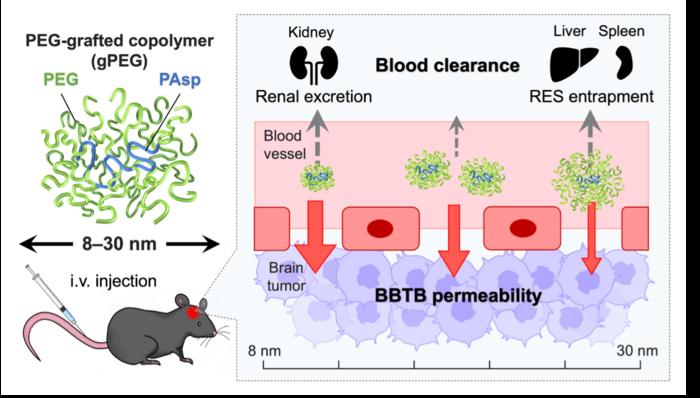
Innovation Center of NanoMedicine (iCONM; Center Director: Kazunori Kataoka; Location: Kawasaki, Japan) has announced with the Graduate School of Engineering of The University of Tokyo that a group led by Prof. Kanjiro Miyata, Visiting Scientist of iCONM (Professor, Department of Materials Engineering, The University of Tokyo), has found that the threshold for tissue permeability of brain tumors was in the range of 10−30 nm, using “Nanoruler” (Note 1) which is a biocompatible polymer used for measurement of “gaps in the body”. Especially, by adjusting the size of the nanoruler to 10 nm, it achieves an unprecedentedly high brain tumor accumulation. Obtained results have provided significant guidance for the design of future brain tumor nanomedicine.

Credit: Kanjiro Miyata’s Lab
Innovation Center of NanoMedicine (iCONM; Center Director: Kazunori Kataoka; Location: Kawasaki, Japan) has announced with the Graduate School of Engineering of The University of Tokyo that a group led by Prof. Kanjiro Miyata, Visiting Scientist of iCONM (Professor, Department of Materials Engineering, The University of Tokyo), has found that the threshold for tissue permeability of brain tumors was in the range of 10−30 nm, using “Nanoruler” (Note 1) which is a biocompatible polymer used for measurement of “gaps in the body”. Especially, by adjusting the size of the nanoruler to 10 nm, it achieves an unprecedentedly high brain tumor accumulation. Obtained results have provided significant guidance for the design of future brain tumor nanomedicine.
Currently, there is no effective treatment for glioblastoma multiforme (GBM), the most frequent and malignant type of brain tumors. Some low molecular weight antitumor agents are used to permeate the gaps between endothelial cells in the BBTB (Blood−Brain Tumor Barrier), which is a characteristic blood vessel structure and formed by the partial collapse of the blood−brain barrier, but they are rapidly excreted from the kidneys, resulting in low GBM accumulation. Besides, their nonspecific distribution in healthy tissues often induces severe side effects such as myelosuppression and immunosuppression. It is known that 30−100 nm-sized nanomedicines avoid rapid renal excretion and increase drug accumulation efficiency in some tumor models. However, the GBM accumulation level of such nanomedicines remains limited, presumably because of the relatively low blood vessel permeability in the BBTB. Thus, Miyata et al. studied about size-dependent GBM targetability using a size-tunable stealth polymer, termed “polymeric nanoruler”, and reported the results in an international journal “Bioconjugate Chemistry” (Note 2) as follows:
Y. Ishibashi, M. Naito,* Y. Watanuki, M. Hori, S. Ogura, K. Taniwaki, M. Cho, R. Komiya, Y. Mochida, and K. Miyata*, Bioconjugate Chemistry, in press
In conclusion, this study explored the size effect of nanomedicine on passive GBM targeting with size-tunable poly(ethylene glycol)-grafted copolymers (gPEGs) as polymeric nanorulers (ranging from 8.5 to 30 nm). Small gPEGs exhibited efficient brain tumor accumulation, with 10 nm of gPEGs achieving the highest accumulation level (19 times higher than that in the normal brain region and 4.2 times higher than that of 30 nm of gPEGs), presumably because of the optimal size associated with enhanced BBTB permeability and prolonged blood circulation.
Miyata et al. will report the drug conjugation and optimization for the enhanced GBM-targeted drug delivery in their future work. Overall, this study provides a useful molecular design to develop GBM-targeted nanomedicines for chemotherapy, radiation therapy, photodynamic/thermal therapy, and diagnostics.
The novelty of this study
- “Nanorulers” using biocompatible polymers to measure “gaps in living organisms” were created.
- It was demonstrated that the threshold for brain tumor tissue permeability was in the range of 10 to 30 nm.
- By adjusting the size of the nanorulers to 10 nm, an unprecedentedly high brain tumor accumulation was obtained.
The future contribution of this study
- Clarification of size effects in brain tumor targeting has provided significant guidance for the design of future brain tumor nanomedicine.
- The size-optimized gPEGs can be loaded with contrast agents to enable highly sensitive imaging of brain tumors.
- The size-optimized gPEG can be loaded with anti-cancer drugs to enable more effective medicines for brain tumors.
Note 1: About Nanoruler
“Nanoruler” is a biocompatible polymer used for measurement of “gaps in the body”. In 2023, Miyata et al. used size adjusted gPEGs in the range of 11–32 nm by changing the molecular weights (MWs) of the grafted PEGs from 2 to 20 kDa to examine biodistribution and the size effect on muscle accumulation.
Note 2: About Bioconjugate Chemistry
Bioconjugate Chemistry is a peer-reviewed scientific journal on bioconjugation, published since 1990 by the American Chemical Society. The mission of the journal is to communicate to advances in fields including Biomolecular/macromolecular conjugates, conjugation reactions, and assemblies.
Journal
Bioconjugate Chemistry
Method of Research
Experimental study
Subject of Research
Animals
Article Title
Size-Dependent Glioblastoma Targeting by Polymeric Nanoruler with Prolonged Blood Circulation
Article Publication Date
3-Jul-2024
COI Statement
None of the authors declare COI matters.
Cite Scienmag News
Cassandra Pierce. (July 8, 2024). What is the optimal size that is more likely to accumulate in brain tumors selectively? Scienmag. https://scienmag.com/what-is-the-optimal-size-that-is-more-likely-to-accumulate-in-brain-tumors-selectively/
Cassandra Pierce. "What is the optimal size that is more likely to accumulate in brain tumors selectively?" Scienmag, 8 July 2024, https://scienmag.com/what-is-the-optimal-size-that-is-more-likely-to-accumulate-in-brain-tumors-selectively/. Accessed 5 September 2026.
Cassandra Pierce. "What is the optimal size that is more likely to accumulate in brain tumors selectively?" Scienmag. July 8, 2024. https://scienmag.com/what-is-the-optimal-size-that-is-more-likely-to-accumulate-in-brain-tumors-selectively/

