

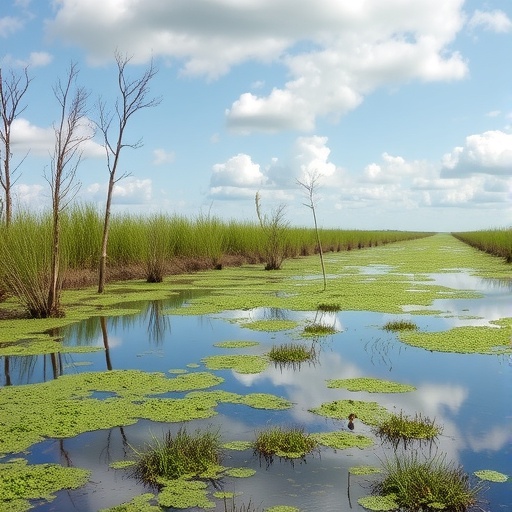
Recent research challenges established climate mitigation strategies involving wetland restoration, revealing that complete flooding of peat-rich lowlands may exacerbate greenhouse gas emissions rather than curb them. While wetlands occupy a mere six percent of global terrestrial surface area, they store approximately 30 percent of Earth’s soil organic carbon, highlighting their critical role in the climate system. Denmark’s ambitious Green Tripartite Agreement aims to flood 140,000 hectares of bogs and meadows to reduce CO₂ emissions by retarding organic decay. However, new findings from the University of Copenhagen underscore the intricate biogeochemical dynamics that complicate this approach.
Traditionally, flooding organic soils has been seen as a straightforward method to reduce CO₂ release by slowing microbial decomposition under anaerobic conditions. Yet, this very anaerobic environment fosters the production of methane (CH₄), a greenhouse gas with a global warming potential up to 30 times greater than CO₂ over a 100-year horizon. The study’s long-term measurements and sophisticated modeling from Denmark’s Maglemosen wetland—a relatively pristine peatland ecosystem—demonstrate that maintaining a fully saturated soil profile triggers methanogenesis, overwhelming the climate benefits initially anticipated.
The key nuance revealed by this research lies in the role of soil microbial communities, especially methane-oxidizing bacteria that utilize oxygen to convert methane into carbon dioxide before it escapes to the atmosphere. These aerobic methanotrophs inhabit the upper soil layers and require oxygen, which is rapidly depleted when soil is fully inundated. Consequently, a fully flooded water table effectively halts methane oxidation, leading to significantly elevated methane emissions. The implication is profound: the conventional notion of “just flood the wetland” may be a misguided oversimplification.
Professor Bo Elberling, who led the study, emphasizes that instead of saturating the soil entirely, an optimized water table management strategy involves keeping it slightly below the surface—approximately 10 centimeters beneath ground level in Maglemosen’s case. At this depth, sufficient oxygen persists to sustain methane oxidation, thereby mitigating methane emissions while still impeding CO₂ release from soil organic matter degradation. This “climatic sweet spot” balances the trade-offs between carbon dioxide and methane fluxes, maximizing overall greenhouse gas mitigation.
Extensive fieldwork dating from 2007 to 2023 involved continuous gas flux monitoring, detailed hydrological observations, temperature profiling of soil and air, and vegetation surveys at Maglemosen. Using this rich dataset, the research team developed dynamic models simulating greenhouse gas emissions under variable water table regimes. The models unequivocally supported intermediate saturation levels as the most effective management practice for reducing net radiative forcing caused by wetland gases. Though the exact optimal water level can vary—from 5 to 20 centimeters below the surface depending on local ecological and soil properties—the principle of maintaining a stable, sub-surface water table is broadly applicable.
Maintaining such precise hydrological control constitutes a significant engineering challenge. Fluctuating precipitation patterns, seasonal droughts, and episodic flooding complicate water table regulation. Drawing on lessons from the Netherlands, a country adept at water management with technologically advanced pumping and drainage infrastructure powered increasingly by renewable energy, Danish wetland managers may need to adopt similar approaches. Continuous monitoring combined with adaptive water control systems could stabilize water tables year-round, ensuring the delicate oxygen-methane balance needed to minimize emissions.
Additionally, shifts in wetland plant communities impact greenhouse gas dynamics. The dominance of species like Canary grass in Maglemosen highlights the role of vegetation in mediating gas exchange. Canary grass facilitates oxygen transport into the rhizosphere and channels methane from anoxic deeper layers to the atmosphere, potentially bypassing microbial oxidation zones. This plant-mediated methane emission pathway means that even with controlled water tables, plant species composition will influence net methane releases and must be factored into adaptive management strategies.
Another potent greenhouse gas affected by water table management is nitrous oxide (N₂O), possessing approximately 300 times the global warming potential of CO₂ over a century. N₂O emissions tend to spike under unstable, fluctuating wetland hydrology. Maintaining a stable water table not only curtails methane but also suppresses nitrous oxide emissions, thereby amplifying the climatic benefits of optimized wetland rewetting.
This multifaceted study underscores that maximizing the climate mitigation potential of wetlands requires sophisticated, ecologically informed water management strategies. It dispels the simplicity of “re-flooding equals climate good” and highlights the intertwined roles of microbial ecology, soil chemistry, hydrology, and vegetation dynamics. Moving forward, effective wetland restoration will rely heavily on interdisciplinary approaches, real-time environmental monitoring, and infrastructure capable of fine-scale water table manipulation powered by green energy sources.
The implications extend beyond Denmark, offering a vital blueprint for global wetland conservation and rewetting projects aiming to sequester carbon without triggering counterproductive methane surges. As climate change intensifies hydrological extremes worldwide, adaptive, evidence-based wetland management becomes ever more essential to safeguarding these critical carbon reservoirs while minimizing unintended greenhouse gas feedbacks.
Subject of Research: Wetland rewetting strategies and their effects on greenhouse gas emissions, focusing on methane and carbon dioxide dynamics influenced by water table fluctuations.
Article Title: Optimized wetland rewetting strategies can control methane, carbon dioxide, and oxygen responses to water table fluctuations
News Publication Date: 9-Jan-2026
Web References:
http://dx.doi.org/10.1038/s43247-025-03163-7
Image Credits:
Bo Elberling / University of Copenhagen
Keywords: Wetlands, Greenhouse gases, Methane emissions, Carbon dioxide, Nitrous oxide, Water table management, Peat soils, Microbial ecology, Climate mitigation, Water control engineering


