


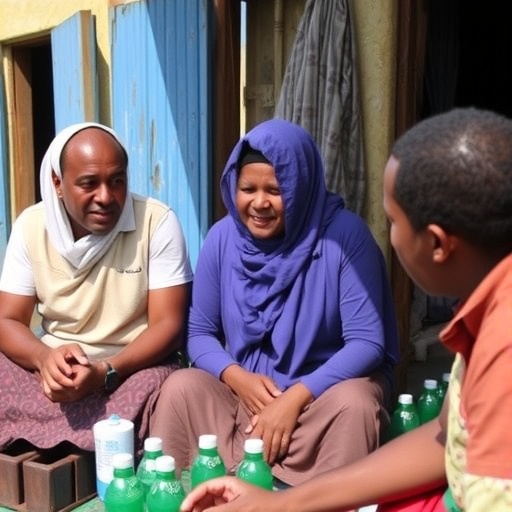
In the sprawling informal settlement of Monwabisi Park on Cape Town’s south-eastern periphery, more than 43,000 residents live in over 13,000 households, nearly 84 percent of them below the poverty line, with high unemployment, limited electricity in newer sections, and elevated levels of violence. Yet when researchers sat down with residents to talk about their lives, they found something that conventional statistics rarely capture: moderate life satisfaction today and, remarkably, a strong sense of optimism about the future. A new open-access study published in Applied Research in Quality of Life argues that this optimism is not an anomaly but evidence that well-being in the world’s rapidly urbanizing informal settlements is driven by far more than income—and that the science of measuring happiness has been systematically overlooking the communities where those insights matter most.
The research, led by Sigrid Busch, Shaharin Annisa, and Astrid Ley of the Department of International Urbanism and Design at the University of Stuttgart, together with Michael Krause of the Violence Prevention through Urban Upgrading (VPUU) organization in Cape Town, is part of the EU-funded WISER project (2023–2026), which seeks to identify the non-economic drivers of sustainable quality of life. The team chose Monwabisi Park, an informal settlement in Khayelitsha, as a case study precisely because it is one of the places where aggregated national well-being statistics tend to obscure as much as they reveal. South Africa has one of the longest traditions of quality-of-life research anywhere in the world, dating back to the township riots of the late 1970s and the pioneering South African Quality of Life Trends study, which combined objective and subjective measures decades before economists such as Joseph Stiglitz and Amartya Sen recommended the same approach internationally. But as the authors note, national and regional surveys often reveal entrenched social divides through large standard deviations while failing to reflect the lived experience of marginalized groups—particularly residents of informal settlements, where 19 percent of Cape Town households lived in shacks without adequate sanitation as of 2022.
To correct that blind spot, the researchers adopted an explicitly qualitative, phenomenological approach centered on VPUU, a program launched in 2005 that has become nationally recognized as a model for “Safety through Environmental Design” and was incorporated into South Africa’s 2016 White Paper on Safety and Security. VPUU operates on an area-based strategy grounded in Johan Galtung’s framework of direct, cultural, and structural violence, treating unhealed trauma as a root cause of crime and combining social development, institutional leadership training, and situational crime prevention through infrastructure upgrades. Crucially for the study, VPUU does not simply deliver services to residents; it builds a hybrid governance architecture in which the community co-produces its own social infrastructure. Three tiers of intermediaries structure this arrangement: VPUU itself links the community to local government, an elected body called the Safe Node Area Committee connects community groups and updates the local Community Action Plan, and locally recruited “Change Makers” on short-term public employment contracts raise awareness, share information, and bring tangible economic benefits into the settlement.
The researchers examined four co-produced interventions as embedded case studies. Emthonjeni is a multifunctional facility combining Early Childhood Development services with public space; Urban Food Gardens transform unused land into productive plots that enhance food security and supply local ECD centers; a Waste-to-Resource initiative builds a community-driven composting and waste management cycle; and V-NET is a co-produced WiFi network advancing digital inclusion through affordable internet access and local content. Data collection took place during an on-site community workshop in October and November 2024 and combined a joint participatory mapping focus group, four project-specific focus groups of eight to twelve community members each, four transect walks with go-along interviews, and eighteen semi-structured interviews with residents selected through community-based purposive sampling. The interview guide blended standardized Personal Wellbeing Index items—chosen for their cross-cultural validity—with open-ended questions, and the team deliberately contextualized the measures: the “work-life balance” domain from the OECD’s Better Life Index was excluded because in a settlement where employment is scarce the concept caused confusion rather than insight.
Analytically, the study constructed a model that fuses the OECD’s three clusters of well-being domains—material conditions, quality of life, and subjective well-being—with the five livelihood capitals of the Sustainable Livelihood Approach: natural, physical, economic, human, and social capital. Transcripts were coded using reflexive thematic analysis in three stages with the software MaxQDA, and themes were mapped to quality-of-life domains to trace causal influences and identify drivers of positive change. The findings that emerged are striking in their consistency. Employment status was the single most influential theme in residents’ life satisfaction, cited both as a key contributor and a significant detractor. Social connections with friends and family were the second most commonly mentioned enhancer, and self-efficacy gained through civic engagement—the sense of agency that comes from participating in community activities—ranked alongside them. When asked about anticipated life satisfaction five years hence, most interviewees expected substantial improvement, anchoring their hopes in education, skills gained through VPUU programs, and aspirations to start or grow their own businesses.
The study’s central conceptual contribution is a novel framework identifying five mutually reinforcing categories of well-being drivers in informal settlements. Eudaimonic drivers encompass sense of purpose, fulfillment, personal growth, and belonging; altruistic drivers capture community flourishing and support for others, particularly vulnerable groups and younger generations; relational drivers include trust, social capital, and accountability; formative drivers cover human capital, skill development, and safety; and material drivers denote economic opportunities alongside improved physical and environmental conditions. The authors show that these categories interact in dense loops: personal fulfillment inspires people to help others grow, which initiates skill development; skills unlock access to material resources, which, once secured, are shared as food, knowledge, or time; altruistic activity generates social interactions that open doors to employment; employment itself provides fulfillment and widens relationship networks; and diverse relationships create opportunities for learning and belonging. What looks like a material outcome on the surface, the authors argue, is in reality a layered interplay of drivers that conventional income-based metrics cannot disentangle.
Underneath these dynamics runs the reciprocal relationship between quality-of-life domains and livelihood capitals. Employment in VPUU projects provides immediate financial support, but it also builds confidence, encourages social participation, and creates lasting pathways to entrepreneurship, simultaneously boosting economic, human, and social capital. Education and skills primarily strengthen human capital but cascade into employability, financial stability, and civic engagement. Social connections offer direct emotional support and belonging while indirectly building resilience, trust with institutions, and community-driven development. The researchers also note a context-specific refinement: in settlements where formal employment is rare, the “income and wealth” domain had to be expanded to include alternative means of reimbursement, such as theft-resistant vouchers, food, and compost, used alongside or in place of money—a recognition that conventional monetary indicators systematically understate real livelihoods in informal economies.
The findings carry pointed implications for governance. The authors document how VPUU has gradually shifted from direct management to a facilitative, advisory role, handing over mobilization and implementation to the Safe Node Area Committee while retaining strategic functions such as securing funding. This evolution toward hybrid governance—combining grassroots participation with NGO support—appears to be particularly effective in contexts where institutional trust in government is low, eroded by inadequate service delivery, corruption perceptions, and frequent protests. Because trust is built slowly through positive shared experiences, the intermediaries function as a foundation on which broader institutional trust can eventually rest, and prior research cited in the study indicates that institutional trust in turn predicts higher assessments of one’s own well-being. Yet the study is candid about the fragility of this model. Intermediaries can generate dependency if not embedded in local democratic processes, placemaking and co-production initiatives can be captured by influential local stakeholders, and residents pressed by the daily demands of survival often cannot participate fully, producing uneven representation. Sustaining co-production also depends on continuous financial, institutional, and municipal backing that frequently evaporates when project cycles end, and the authors stress that it is neither realistic nor equitable to expect communities and non-profits to shoulder infrastructure responsibilities that belong to municipal authorities.
On the methodological front, the team emphasizes that its purposive sampling and limited timeframe restrict generalizability, and that the findings do not capture heterogeneity by age, gender, ethnicity, or length of residence. Triangulation across interviews, focus groups, and transect walks was used to mitigate research bias and positionality. Even so, the authors argue that the case demonstrates the value of localized, disaggregated, context-specific well-being assessment as a complement to aggregated statistics. Their recommendations are directed at global, national, and municipal policymakers: integrate eudaimonic, altruistic, relational, and formative drivers explicitly into policy frameworks; adopt holistic assessment tools such as the Sustainable Livelihood Framework alongside quality-of-life domains; sustain hybrid governance arrangements with long-term institutional support rather than short-term project funding, since withdrawal of support is often perceived by communities as betrayal; and create collaborative, reflective spaces that involve a broad range of residents in assessing progress and adapting programs. The deeper message, the authors conclude, is a call to abandon traditional top-down, donor-recipient paradigms in favor of reciprocal and collaborative engagement, in which community agency is balanced with enduring institutional partnership—and in which the infrastructure that cities build is designed, from the outset, to function as social infrastructure that nurtures purpose, trust, and belonging as deliberately as it delivers water, power, and shelter.
Cite Scienmag News
Courtney Benton. (September 10, 2026). Well-Being Drivers Explored in Cape Town’s Informal Settlements. Scienmag. https://scienmag.com/well-being-drivers-explored-in-cape-towns-informal-settlements/
Courtney Benton. "Well-Being Drivers Explored in Cape Town’s Informal Settlements." Scienmag, 10 September 2026, https://scienmag.com/well-being-drivers-explored-in-cape-towns-informal-settlements/. Accessed 10 September 2026.
Courtney Benton. "Well-Being Drivers Explored in Cape Town’s Informal Settlements." Scienmag. September 10, 2026. https://scienmag.com/well-being-drivers-explored-in-cape-towns-informal-settlements/


