


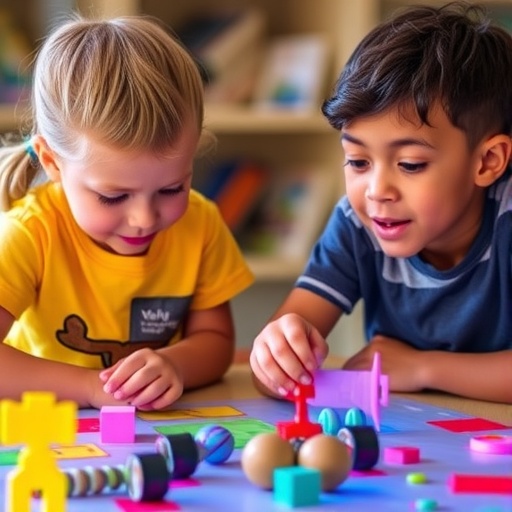
Six-year-olds in a remote Australian classroom watched a science facilitator appear almost life-size on a large screen, asking them why playdough changes shape when squashed. One child answered without hesitation: because it’s flexible. That small exchange sits at the heart of a new study suggesting that the ingredients which make a physical classroom fertile ground for creative thinking—materials, conversation, and emotional safety—can be successfully carried across hundreds of kilometers of fiber optic cable into online learning environments, with a few surprising adjustments along the way.
The research, published in the Early Childhood Education Journal, was conducted by Kimberly Maslin, Karen Murcia, Susan Blackley, and Geoff Lowe of the School of Education at Curtin University in Western Australia. It forms part of a larger project within the Australian Research Council Centre of Excellence for the Digital Child and examined what the authors call the element of “place” in online STEM learning—specifically, how the resources, communication patterns, and socio-emotional climate of a virtual classroom shape the creative thinking of children as young as six. The study’s title, drawn from a child’s tentative remark early in the sessions—”I’ll just watch you for now”—captures the delicate process by which young learners move from passive observation to confident creative participation when their teacher exists only as a face on a screen.
The theoretical backbone of the study is the A-E of Children’s Creativity framework, developed by Murcia and colleagues in 2020 to identify and nurture children’s creative thinking during activities with digital technologies. The framework adapts Rhodes’ classic Four Ps of Creativity—person, process, product, and press (or place)—to the specific context of young children and STEM. Within the “place” element, the framework identifies three sub-elements: resources, which include intentional provocation, stimulating and adequate materials, and time for exploration; communication, which covers intentional conversations, valuing children’s ideas, open questioning, and dialogic exchange; and socio-emotional climate, characterized by stress-free, non-judgmental, and non-prescriptive conditions built on trust and mutual respect. The researchers set out to test whether these elements, well established in physical classrooms, could be translated to a synchronous online environment.
The case study followed a first-grade class of 25 children in regional Western Australia, roughly 700 kilometers from a Perth-based Science Discovery Centre. Over six months between July and December 2022, the children took part in ten weekly STEM workshops delivered live via Microsoft Teams and Zoom. Six sessions were school-based, projected onto a large audiovisual screen in the classroom with the teacher in a supporting role; four were after-school “STEM club” sessions run from the children’s homes, with parents present. Materials for every activity were posted in advance to the classroom teacher and to the parents of the participating children. Three children—given the pseudonyms Beth, Chloe, and Jett—served as in-depth case studies, participating in both settings, and were interviewed multiple times over the course of the study.
The methodological apparatus was correspondingly detailed. A GoPro camera captured each case child’s verbal and non-verbal behavior, while screen recordings captured the real-time interaction between children and facilitators. Using V-Note Pro video analysis software, the team segmented the footage into 1,053 episodes defined by the type of communication occurring on screen, then coded them for four types of creative moments: two materials-based (making and experimenting) and two ideas-based (predicting and problem-solving). Semi-structured interviews with the children, their teacher, their parents, and the two Science Discovery Centre facilitators were transcribed and analyzed thematically, first inductively and then deductively against the A-E framework. Facilitators logged into sessions early to build rapport, and the researchers triangulated video, interview, and field-note data to guard against bias.
The findings on resources were instructive. Both the classroom teacher and parents valued receiving materials by post, which made participation easy and accessible. The children engaged enthusiastically—Beth reported that a white, fluffy pipe cleaner “gave me an idea” because it reminded her of a bunny’s tail, while Chloe relished an investigation called Bend, Twist, Stretch and Squash because she “got to do all the squishing.” Yet constraints emerged. The facilitators noted that shipping limited what could fit into postal satchels, with one reflecting that there were “slightly less creative opportunities mostly because of the resourcing.” Time also proved a persistent pressure: the teacher noted that by the time children finished constructing string telephones, little time remained to experiment with them—a familiar complaint in face-to-face STEM education, where time constraints are the most frequently cited challenge.
Communication, however, emerged as a striking strength of the online format. Multimodal video analysis revealed that dialogic communication between facilitators and children accounted for 55.85 percent of all observed session time, while adult-to-adult talk was nearly negligible at 0.78 percent. The facilitators effectively became the primary educators, directly eliciting children’s thoughts, ideas, and questions. Children called out observations, walked up to the screen to show their work, and guessed at sounds coming from a facilitator’s cup (“it sounded like rain falling on a tin roof”). In the classroom, the large AV screen made the remote facilitator appear almost life-size, countering a known limitation of synchronous online learning, in which small video windows and cropped bodies hamper rapport. At home, a two-camera setup allowed the afterschool facilitator to show both her face and her hands at work, scaffolding the children’s constructions in real time.
The socio-emotional climate proved equally adaptable. Every participant spoke positively about the experience, and the classroom teacher remarked that she did not feel it was “so different than if she was actually here in the room.” The children’s own frames of reference mattered: Beth found online sessions “more fun” because they felt like phone-calling her friends, and “normal” because she was already accustomed to screens. Deliberate strategies sustained the warm atmosphere—weekly continuity on the classroom screen helped children build a genuine relationship with the remote facilitator, and logging in early allowed personal connections to form before formal instruction began. Synchronous delivery meant children received immediate feedback and real-time guidance, mirroring the responsiveness of a physical classroom.
Perhaps the most counterintuitive finding concerns headphones. Previous research on blended synchronous learning, largely conducted with adult learners, has recommended headsets with built-in microphones to minimize background noise and improve concentration. In this study, headphones became a barrier: in one episode, a father could not hear the facilitator’s instructions because his daughter’s headphones blocked the audio, stalling the activity until the headphones were removed. The authors argue that young children’s online learning needs differ meaningfully from those of adults, and that involving children directly in online learning research is essential to uncovering such nuances. Similarly, the assumption that children need quiet, distraction-free rooms was complicated by observation: one boy participating from an open-plan dining area occasionally encountered sibling distractions but also received sibling feedback and support that enhanced his creative outcomes.
The study also illuminated the role of parents, who were present during the home-based sessions and grew increasingly involved—kneeling beside their children to watch designs take shape, offering suggestions, and providing encouragement. One mother remarked how rare and precious it was to see her daughter’s after-school learning unfold, describing it as “cute seeing her interact and doing it herself and being independent.” The authors highlight this as an affordance unique to home-based online delivery: a meaningful opportunity for family engagement with children’s creative learning that a conventional after-school program would not provide.
From these findings, the researchers distilled a practical checklist for educators and service providers preparing online STEM experiences for young children, organized against the three place elements of the A-E framework. The recommendations cover shipping stimulating materials in advance, protecting time for independent exploration, using large displays and multiple cameras to simulate physical presence, employing verbal and non-verbal rapport-building cues such as using children’s names and leaning into the camera, keeping headphones off for young learners, and ensuring a supportive adult is available in the room for fine-motor tasks and emotional scaffolding. The authors caution that their case study involved a small participant group and settings with high-quality technology, limiting generalizability, and they call for future research with larger samples, asynchronous modalities, and cross-cultural replication. Still, the central message is clear: the geography of creativity is no longer bounded by the classroom wall. With deliberate design, the elements of place that let a six-year-old transform a pipe cleaner into a bunny’s tail can travel intact across 700 kilometers of digital infrastructure—and the child who says “I’ll just watch you for now” may, within weeks, be calling out answers from the front of the virtual room.
Cite Scienmag News
Courtney Benton. (September 10, 2026). How Place Shapes Young Children’s Creativity in Online STEM Learning. Scienmag. https://scienmag.com/how-place-shapes-young-childrens-creativity-in-online-stem-learning/
Courtney Benton. "How Place Shapes Young Children’s Creativity in Online STEM Learning." Scienmag, 10 September 2026, https://scienmag.com/how-place-shapes-young-childrens-creativity-in-online-stem-learning/. Accessed 10 September 2026.
Courtney Benton. "How Place Shapes Young Children’s Creativity in Online STEM Learning." Scienmag. September 10, 2026. https://scienmag.com/how-place-shapes-young-childrens-creativity-in-online-stem-learning/


