


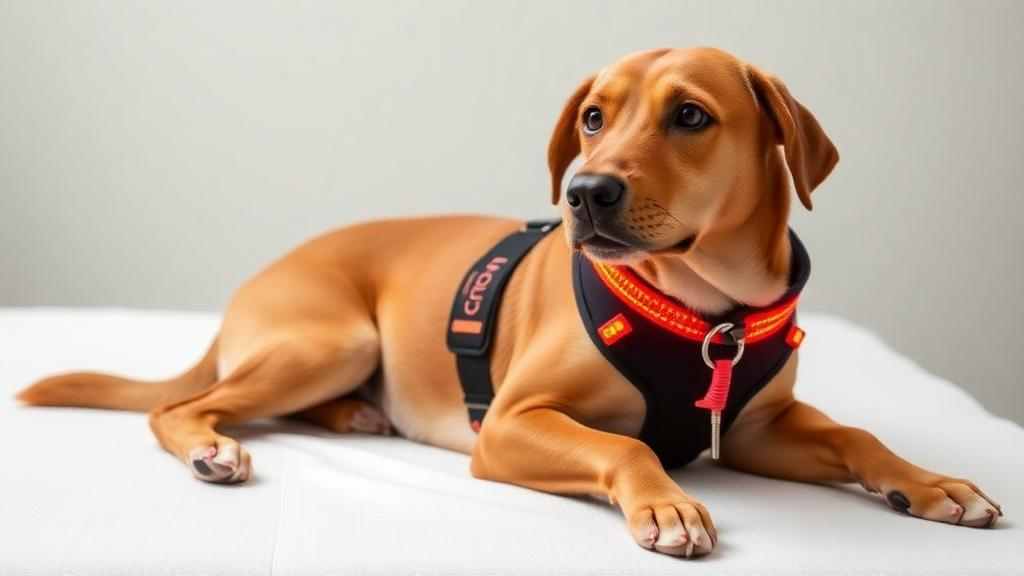
Hypothermia is one of the most common complications of general anesthesia in dogs, and catching it early depends entirely on how reliably a veterinary team can measure body temperature during a procedure. A new pilot study published in PLOS One suggests that a small wearable device originally designed for human athletes may offer a practical alternative to the rectal thermometers that have long been the standard of care in operating rooms and dental suites. The device, known as CORE and manufactured by greenTEG AG in Rümlang, Switzerland, is a wireless, non-invasive sensor that estimates core body temperature from the skin surface by measuring heat flow out of the body rather than relying on a direct internal reading.
The research team, led by Chloe R. Dupleix with colleagues Jacob P. Rastas, Qianqian Zhao, Robert Young, and Rebecca A. Johnson, set out to answer a deceptively simple question: can a sensor stuck to the skin over a major blood vessel track the core temperature of an anesthetized dog as accurately as a rectal probe? The answer, according to their preliminary data, is a qualified yes, with performance depending on both the sedative drug used before anesthesia and whether the fur at the sensor site has been clipped away.
Core body temperature monitoring is a vital part of physiological evaluation during anesthesia. Depending on the type of procedure and the position in which the patient is placed, obtaining consistent core temperature measurements can be surprisingly difficult. Long surgical drapes, limited access to the patient, and the practical challenges of keeping a rectal probe in place all complicate continuous monitoring. Anesthetized animals cannot regulate their own body temperature effectively, and sedative drugs themselves interfere with the body’s thermoregulatory mechanisms, making accurate and frequent measurement essential for patient safety.
The study enrolled three healthy beagle dogs in a pilot design. Before anesthesia was induced, each dog received a premedication of either dexmedetomidine, a potent alpha-2 adrenergic agonist known to cause significant drops in body temperature, or acepromazine, a commonly used phenothiazine tranquilizer. Anesthesia was then induced with intravenous propofol and maintained with isoflurane, a typical inhalant anesthetic regimen in veterinary practice. Throughout the procedures, the dogs were monitored every five minutes with pulse oximetry, non-invasive blood pressure measurement, electrocardiography, and capnometry, providing a full picture of their anesthetic status.
Temperature data were collected every three minutes for up to 120 minutes following induction. The researchers compared three measurement approaches: conventional rectal thermometry, the CORE sensor placed on clipped skin over the jugular veins, and the same sensor placed on unclipped skin at the same location. Testing the sensor both with and without fur removal was a key design choice, because clipping is time-consuming and may not always be desirable in clinical cases, particularly in patients presenting for non-surgical procedures where an owner may object to shaving a patch of fur.
The CORE sensor works on a heat flux principle. Instead of assuming that skin temperature reflects core temperature, which it often does not, the device measures the actual flow of heat through the skin and uses that measurement to calculate a deeper body temperature estimate. This approach has gained attention in human sports and health monitoring, where athletes and researchers use the sensor to track core temperature during exercise without invasive probes. Applying the same physics to a furry, four-legged patient is far from trivial, because fur adds a variable insulating layer that alters heat flux in unpredictable ways.
To evaluate agreement between the wearable and the rectal reference, the team used two complementary statistical tools. The correlation coefficient for repeated measures, denoted r_rm, captures the strength of the association between two measurement methods when multiple readings are taken from the same subjects over time. The Shrout-Fleiss intraclass correlation coefficient, or ICC, goes further by assessing not just whether two methods move together, but whether they agree closely enough to be used interchangeably in practice. Values approaching 1.0 indicate excellent reliability, while values below roughly 0.5 suggest that agreement is too weak for confident clinical use.
In dogs premedicated with acepromazine, the results were encouraging across the board. There was good, statistically significant correlation and reliability between rectal temperatures and CORE readings on clipped skin, with r_rm equal to 0.81 and a P value below 0.0001, paired with an ICC of 0.78. Performance on unclipped skin was equally strong, showing r_rm of 0.79 with P below 0.0001 and an ICC of 0.85. These findings indicate that when acepromazine is the premedication, the sensor can track rectal temperature closely whether or not the fur is clipped, which is a meaningful practical advantage in a busy clinic.
The picture changed under dexmedetomidine. Although the clipped-skin CORE readings were still statistically correlated with rectal measurements, with r_rm of 0.30 and P below 0.0001, the reliability was poor, at an ICC of only 0.28. Dexmedetomidine produces pronounced peripheral vasoconstriction and alters heat distribution in the body, which likely changes the heat flux signal the sensor depends on. Notably, reliability improved substantially when the sensor was placed on unclipped skin in these same dogs, with r_rm rising to 0.48 and the ICC climbing to 0.88, suggesting that the insulating effect of intact fur may in some circumstances stabilize the heat flux measurement rather than disrupt it.
Beyond the correlation statistics, the researchers also assessed clinical agreement using Bland-Altman analysis, which plots the difference between two methods against their average to reveal systematic bias and limits of agreement. Clinically acceptable Bland-Altman agreement was found between the rectal method and the unclipped CORE method, meaning the wearable’s readings fell within a range veterinarians would consider acceptable for guiding patient care. Taken together, these preliminary results suggest that the CORE sensor may provide a viable alternative method for assessing core body temperature in unclipped, anesthetized dogs. As a pilot study involving three animals, the work cannot yet support universal clinical recommendations, and the authors’ findings will need validation in larger and more diverse patient populations. But the prospect of continuous, wireless, non-invasive core temperature monitoring that does not require shaving or a rectal probe represents an appealing step forward for veterinary anesthesia, where every practical improvement in monitoring translates directly into safer procedures for patients.
Subject of Research: Validation of a wearable heat flux body temperature sensor against rectal thermometry in anesthetized dogs
Article Title: Evaluation of a novel body temperature sensor (CORE) in dogs under general anesthesia following premedication with dexmedetomidine or acepromazine: A pilot study
Article References: Dupleix, C. R., Rastas, J. P., Zhao, Q., Young, R., & Johnson, R. A. (2026). Evaluation of a novel body temperature sensor (CORE) in dogs under general anesthesia following premedication with dexmedetomidine or acepromazine: A pilot study. PLOS One, 21(10), e0360808. https://doi.org/10.1371/journal.pone.0360808
Image Credits: AI Generated
DOI: 10.1371/journal.pone.0360808
Keywords: veterinary anesthesia, dogs, core body temperature, wearable sensor, heat flux thermometry, dexmedetomidine, acepromazine, hypothermia, rectal thermometry, Bland-Altman analysis, intraclass correlation, PLOS One
Cite Scienmag News
William Thompson. (October 19, 2026). Wearable Sensor Tracks Core Body Temperature in Anesthetized Dogs Without Rectal Probes. Scienmag. https://scienmag.com/wearable-sensor-tracks-core-body-temperature-in-anesthetized-dogs-without-rectal-probes/
William Thompson. "Wearable Sensor Tracks Core Body Temperature in Anesthetized Dogs Without Rectal Probes." Scienmag, 19 October 2026, https://scienmag.com/wearable-sensor-tracks-core-body-temperature-in-anesthetized-dogs-without-rectal-probes/. Accessed 19 October 2026.
William Thompson. "Wearable Sensor Tracks Core Body Temperature in Anesthetized Dogs Without Rectal Probes." Scienmag. October 19, 2026. https://scienmag.com/wearable-sensor-tracks-core-body-temperature-in-anesthetized-dogs-without-rectal-probes/


