

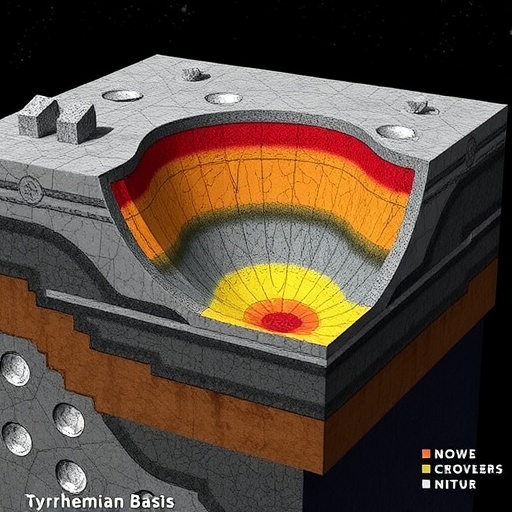
In a groundbreaking study published in Nature Communications, researchers have unveiled a fascinating dynamic beneath the Tyrrhenian basin, where a remarkably weak mantle wedge facilitates mantle exhumation intertwined with discrete fragments of oceanic crust. This discovery not only sheds light on the complex geological processes shaping the Mediterranean region but also challenges prevailing paradigms about subduction zones and mantle dynamics worldwide.
The Tyrrhenian basin, lying beneath the Mediterranean Sea between the western coast of Italy and the islands of Sardinia and Corsica, has long intrigued geologists due to its unique tectonic setting. It is an area where the African plate is being subducted beneath the Eurasian plate, resulting in intense volcanic and seismic activity. However, traditional models have struggled to fully explain the intricate interplay between mantle flow, crustal deformation, and magmatic evolution in this region. The recent findings by Su, Leng, Liao, and their colleagues open a new chapter in understanding these processes by focusing on the role played by the mantle wedge—a region of partially molten and potentially mechanically weakened material located above the subducting slab.
Central to this research is the identification of a “weak mantle wedge” beneath the Tyrrhenian Sea, which has profound implications for how mantle material can be exhumed, or brought closer to the Earth’s surface. In classical subduction models, the mantle wedge is typically envisioned as a relatively robust zone that facilitates the melting of the subducted slab and leads to volcanic arc formation. However, the new evidence suggests that this mantle wedge is not uniformly strong and, in fact, exhibits zones of significant mechanical weakness. This weakness allows portions of the mantle below to ascend or be exhumed in episodic, discrete events, rather than as a steady or continuous process.
The exhumation process described by the researchers is punctuated by fragments of oceanic crust that have been detached, transported, and embedded within the mantle wedge structure. This punctuated exhumation results in a geological mosaic where mantle material and oceanic crustal components coexist in complex assemblages. The presence of these crustal fragments within the exhumed mantle domain is critical because it influences not only the physical properties of the mantle wedge but also its chemical and thermal characteristics, thereby affecting subsequent melting and volcanic outputs.
The study employs an array of advanced geophysical and geochemical techniques, including seismic tomography, petrological analysis of mantle xenoliths, and geodynamic modeling, to characterize the strength and deformation behavior of the mantle wedge. Seismic imaging reveals low-velocity zones consistent with partial melting and elevated temperatures, which correlate spatially with areas of mantle exhumation. Petrological analysis of mantle samples recovered from volcanic products shows signatures indicative of recycled oceanic crustal materials and metasomatic processes influenced by subduction fluids.
Furthermore, geodynamic simulations carried out by the research team illustrate how the interplay between slab rollback, mantle wedge viscosity reduction, and extensional forces within the Tyrrhenian basin combine to generate conditions favorable for discrete mantle exhumation events. These models highlight the feedback mechanisms whereby mechanical weakening of the mantle wedge promotes its partial delamination from the overlying crust, leading to localized mantle upwelling and transport of oceanic crust fragments along flow channels.
This behavior stands in stark contrast with more continuous, uniform mantle flow observed in many other subduction settings around the world, where mantle wedges maintain a relatively stable, supportive role for arc volcanism rather than actively contributing to crust-mantle mixing. The Tyrrhenian basin thus emerges as an exemplar of a continental back-arc basin where mantle wedge strength variations can drastically modify lithosphere dynamics.
One of the broader implications of these findings is their relevance to seismic hazard assessment and volcanism forecasting in the Mediterranean region. The episodic, discrete nature of mantle exhumation events could correspond to intermittent magmatic surges or altered stress distributions within the overriding plate, both factors that may modulate earthquake occurrences and volcanic eruptions. Understanding the physical state and evolution of the mantle wedge enhances predictive models of these natural hazards.
Moreover, the embedded oceanic crust fragments discovered within the mantle wedge provide a novel mechanism for the geochemical recycling of oceanic lithosphere materials back into the upper mantle, potentially influencing mantle heterogeneity on regional and global scales. This process complicates the geochemical signatures used to trace mantle source compositions, given the mixture of mantle and crustal components involved.
From a tectonic perspective, the findings emphasize the significance of mantle wedge rheology and its feedback with slab dynamics in shaping back-arc basin evolution. The Tyrrhenian basin’s rapid extension and subsidence can now be better understood as consequences of mantle wedge weakening, facilitating both crustal thinning and mantle exhumation that together sculpt basin architecture.
The research also raises intriguing questions about how widespread such weak mantle wedges are globally and whether other back-arc or subduction-related basins exhibit similar punctuated mantle exhumation phenomena. If confirmed, this could necessitate a reevaluation of subduction zone models to incorporate variable mantle wedge strengths and episodic crust-mantle mixing in explaining volcanic and tectonic processes.
Technologically, this study exemplifies the power of integrating multidisciplinary datasets—ranging from deep Earth imaging and sample geochemistry to sophisticated numerical simulations—to unravel complex geological systems. These approaches are increasingly vital as researchers aim to decode the subtle interplay between Earth’s lithosphere and deeper mantle environments, driving the planet’s surface dynamics.
In summary, the discovery of a weak mantle wedge causing mantle exhumation punctuated by discrete oceanic crustal fragments in the Tyrrhenian basin represents a transformative leap in understanding subduction zone processes. By illuminating the complexities underpinning lithosphere-asthenosphere interactions, the study by Su, Leng, Liao, and colleagues provides a new lens through which to interpret mantle dynamics, crustal evolution, and geohazard potential in one of the world’s most tectonically active regions. This work not only enriches geoscience theories but also paves the way for enhanced monitoring and mitigation strategies in Mediterranean tectonic and volcanic environments.
Subject of Research:
Mantle dynamics and exhumation processes in the Tyrrhenian basin related to mantle wedge weakening and subduction zone tectonics.
Article Title:
Weak mantle wedge causes mantle exhumation punctuated with discrete oceanic crust in the Tyrrhenian basin
Article References:
Su, H., Leng, W., Liao, J. et al. Weak mantle wedge causes mantle exhumation punctuated with discrete oceanic crust in the Tyrrhenian basin. Nat Commun (2026). https://doi.org/10.1038/s41467-025-68052-1
Image Credits:
AI Generated


