


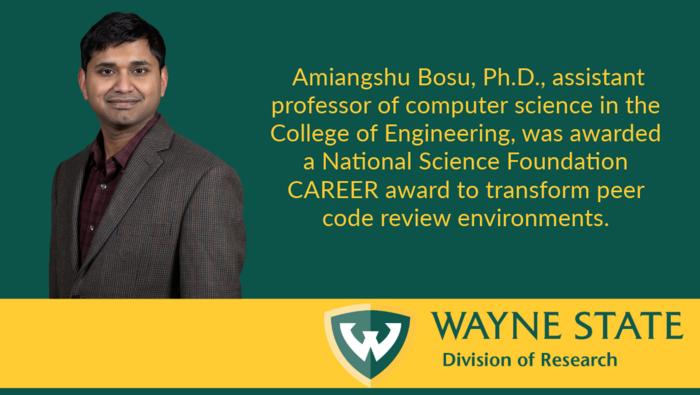
DETROIT — Amiangshu Bosu, Ph.D., assistant professor of computer science in the College of Engineering at Wayne State University, received a CAREER award from the National Science Foundation (NSF) to formulate better practices involving peer code review.

Credit: Wayne State University
DETROIT — Amiangshu Bosu, Ph.D., assistant professor of computer science in the College of Engineering at Wayne State University, received a CAREER award from the National Science Foundation (NSF) to formulate better practices involving peer code review.
Peer code review is a mandatory software verification practice among most open source and commercial software development organizations. In this practice, one or more peers inspect and approve a code change before integrating it into a project’s repository. As developers spend significant effort daily on code review tasks, improving code review effectiveness is a high priority for these organizations.
“Challenges limiting code review effectiveness include code learning difficulties with limited time and code context, misunderstandings among the participants over confusing suggestions, and interpersonal conflicts due to disrespectful feedback,” Bosu explained. “In the short term, these challenges increase required efforts, delay the outcomes, increase the likelihood of rejections and frustrate the participants. In the long term, these challenges degrade software quality, cause conflicts among the participants, demotivate an inappropriately written review’s target, pose barriers to newcomers’ onboarding, disproportionately impact minorities and even cause long-term developers to leave permanently. Despite several studies confirming these short and long-term consequences, practical solutions to these challenges remain nonexistent.”
The five-year, $596,760 grant from the NSF’s Division of Computing and Communication Foundations will benefit Bosu’s study, “Transforming Peer Code Review Environments for Code Learning and High-Quality Feedback.”
The overarching goal of this project is to transform code review tools and workflows to address participants’ challenges in understanding the code under review and communicate that understanding with others in unambiguous and constructive languages.
“The project will work to improve code reviews using empirical methods, machine learning and natural language techniques to produce tools to be used in code reviews,” said Bosu. “The new knowledge and tools will be used as an educational platform that will support students and new programmers. The project will integrate the research into education by using the tools in classes and curriculum development, using the classroom setting to gain understanding of how to support developers in professional code-review ecosystems.”
Bosu added that with the emergence of AI-based assistants such as ChatGPT and Github Copilot, developers are increasingly using AI to generate code. However, he says AI-generated code often includes errors, is of low quality and can have security defects. For that reason, manual verification techniques such as code review are becoming even more critical among software development pipelines.
“CAREER awards from the National Science Foundation are a very prestigious award for early-career faculty,” said Ezemenari M. Obasi, Ph.D., vice president for research at Wayne State University. “Dr. Bosu is most deserving of this award for his research that aims to cultivate Wayne State’s prosperity agenda by developing best practices and fueling innovation that may impact areas from education, business, emerging technologies and beyond.”
The grant number for this National Science Foundation award is 2340389.
# # #
Wayne State University is one of the nation’s pre-eminent public research institutions in an urban setting. Through its multidisciplinary approach to research and education, and its ongoing collaboration with government, industry and other institutions, the university seeks to enhance economic growth and improve the quality of life in the city of Detroit, the state of Michigan and throughout the world. For more information about research at Wayne State University, visit research.wayne.edu.
Cite Scienmag News
Denise Maddox. (April 19, 2024). Wayne State researcher aims to improve coding peer review practices. Scienmag. https://scienmag.com/wayne-state-researcher-aims-to-improve-coding-peer-review-practices/
Denise Maddox. "Wayne State researcher aims to improve coding peer review practices." Scienmag, 19 April 2024, https://scienmag.com/wayne-state-researcher-aims-to-improve-coding-peer-review-practices/. Accessed 4 September 2026.
Denise Maddox. "Wayne State researcher aims to improve coding peer review practices." Scienmag. April 19, 2024. https://scienmag.com/wayne-state-researcher-aims-to-improve-coding-peer-review-practices/

