


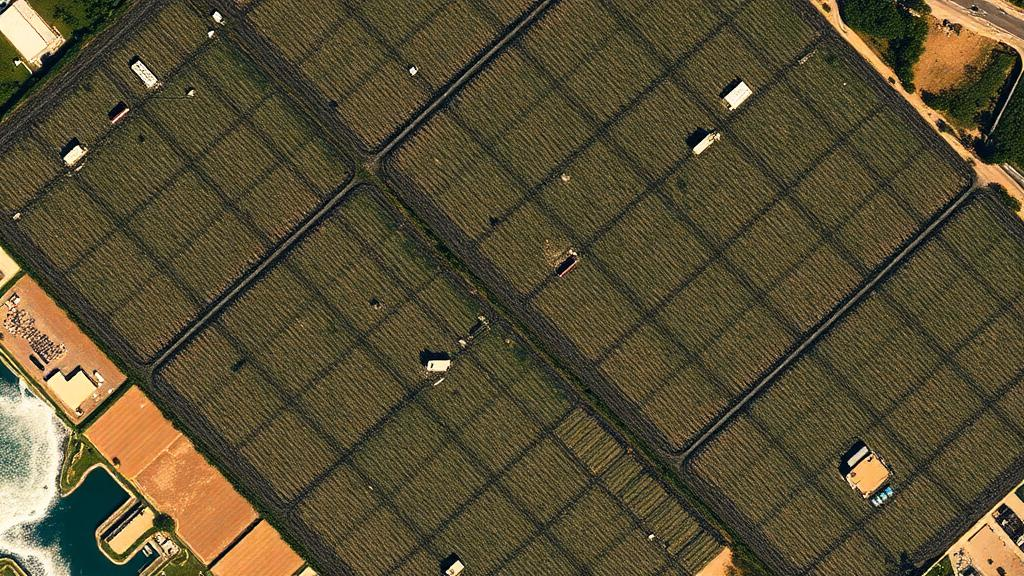
Satellite images tell a story of a planet in constant motion: forests fall, cities sprawl, floodwaters creep across farmland, and glaciers retreat one season at a time. The task of automatically spotting what has changed between two images of the same place, taken at different moments, is known in the remote-sensing world as change detection, and it has become one of the most consequential problems in applied artificial intelligence. Now a team of researchers at Southwest University in Chongqing, working with a colleague at the Chongqing Institute of Geology and Mineral Resources, has unveiled a deep learning framework that claims to solve one of the field’s most stubborn dilemmas: how to be simultaneously smart about what changed and razor-sharp about exactly where it changed. Their system, described in the journal Applied Intelligence, is built on an unexpected mathematical foundation—the humble wavelet transform, a signal-processing tool that dates back decades but is finding fresh life inside modern neural networks.
The core problem the team set out to address is a tension that has haunted change detection since deep learning took over the field. Convolutional and transformer-based networks are excellent at building rich semantic representations: they learn what a building looks like, what a road is, what a healthy canopy of trees resembles. But the very machinery that gives them this big-picture understanding—repeated downsampling, large receptive fields, aggressive feature aggregation—tends to blur away the fine textures and crisp edges that define the actual boundary of a change. The result is a familiar frustration for practitioners: a model that correctly announces that a new building appeared, but draws its footprint as a smeared blob that bleeds into neighboring roads and shadows, or one that misses a narrow strip of deforestation entirely because the thin feature was washed out by layers of abstraction.
The new framework, which the authors call WG-DSANet, attacks this tension by refusing to treat all image information as equal. Instead of processing features only in the spatial domain, the network performs a hierarchical frequency-domain decomposition on the paired features extracted from the two images being compared. Drawing on the classical wavelet theory formalized by Stéphane Mallat and Ingrid Daubechies, the architecture splits each feature map into low-frequency and high-frequency components. The low-frequency band carries the coarse structure and semantic context—the general layout of the scene—while the high-frequency band carries the fine detail: edges, textures, and the subtle local differences that often mark the boundary between changed and unchanged land.
The heart of the method is a module the authors call wavelet-guided feature fusion. When the features from the before and after images meet, they are decomposed into their frequency components, and an adaptive gating mechanism then decides, on a per-channel basis, which differences to keep and which to suppress. The gating is what makes the approach more than a mechanical filter bank bolted onto a neural network: the network learns, during training, to selectively preserve texture differences that are informative about real change while damping the high-frequency noise that plagues satellite imagery—sensor artifacts, illumination shifts between acquisition dates, and the shimmer of atmospheric interference. In effect, the model learns a policy for what deserves attention in each frequency band, rather than applying a fixed rule.
This decomposition then pays a second dividend, and it is here that the architecture shows its most distinctive engineering. Because the features are already separated into frequency bands, the network can deploy what the authors term a dual-sieve attention mechanism. In the shallow layers of the network, where small targets such as isolated new structures or narrow roads still retain their spatial extent, the attention module focuses on these small objects, which would otherwise be drowned out by larger surrounding patterns. At the same time, the sieve suppresses noise that masquerades as change. The name is apt: like a pair of sieves with different mesh sizes, the mechanism lets through the signals that matter at each scale while catching the debris.
Even with frequency-aware fusion and dual-sieve attention, the authors found that boundaries needed one more push to become truly crisp. Their solution is deliberately lightweight: residual edge cues are injected directly into the network via small convolutional operations, restoring sharp boundaries without the computational burden of a full edge-detection subnetwork. The choice reflects a broader trend in the field toward lightweight architectures, a theme the authors situate alongside prior work on efficient attention and compact models. The result is a pipeline that coordinates frequency-domain reasoning and spatial-domain precision rather than treating them as rivals—a design philosophy the paper’s title captures as coordinated frequency and spatial cues.
To validate the approach, the team ran extensive quantitative experiments against established benchmarks, comparing their framework with a landscape of prior methods that includes densely connected siamese networks, transformer-based siamese architectures, gate-attention U-Net variants, and recent wavelet-integrated frequency networks. Beyond raw accuracy numbers, the authors performed targeted feature-visualization analyses, inspecting what the network’s internal representations actually respond to. These visualizations, they report, confirm that the frequency–spatial cooperation materially sharpens change localization and suppresses spurious detections—the false alarms that arise when seasonal lighting differences or registration errors trick a model into seeing change where none exists. The code has been made publicly available on GitHub, allowing other researchers to scrutinize and build upon the implementation.
The practical stakes of this kind of work are considerable. Change detection underpins near-real-time deforestation monitoring, flood inundation mapping from multi-source satellite imagery, agricultural land abandonment tracking, and post-disaster damage assessment. In each of these applications, the difference between a smeared boundary and a precise one translates directly into operational value: hectares of forest miscounted, flood extents overestimated, or compensation claims for destroyed buildings contested because the automated map drew the wrong footprint. A framework that preserves fine textures while retaining semantic understanding could therefore matter not just to computer-vision researchers but to the agencies and NGOs that rely on automated maps to make decisions with real-world consequences.
The paper also situates itself within a fascinating intellectual arc. Wavelets were developed in the 1980s as a theory of multiresolution signal decomposition, offering a way to analyze a signal at multiple scales simultaneously—something Fourier analysis alone could not do well for localized features. For years they lived in the classical signal-processing world of denoising and compression. The past few years have seen them migrate into deep learning, with wavelet-based fusion networks appearing in remote-sensing segmentation, character recognition, and now change detection. The Chongqing team’s contribution is to show that the wavelet decomposition is not merely a preprocessing trick but a structural principle that can organize an entire attention and fusion strategy—decomposing features, enabling scale-aware attention, and naturally exposing the edge information that spatial convolutions can then refine.
Challenges remain, as they always do in this fast-moving field. The framework’s performance, like that of all supervised change detectors, depends on the quality and diversity of its training annotations, and the authors’ experiments, while extensive, cover the benchmark scenes typical of the literature rather than the full chaos of operational global imagery. Multimodal scenarios—comparing optical with radar imagery, for instance—pose additional difficulties that the frequency-spatial framework will need to prove itself against. Still, the publication, received in April 2026 and published in September in Applied Intelligence’s volume 56, marks a credible step toward change detection systems that no longer force practitioners to choose between understanding the scene and seeing its edges. As satellites multiply and the cadence of Earth observation accelerates, the demand for maps that are both semantically intelligent and pixel-precise will only grow—and the tools meeting that demand are increasingly likely to be built on mathematics that predates the neural networks now wielding them.
Subject of Research: Deep learning-based remote sensing change detection using wavelet frequency decomposition and attention mechanisms
Article Title: Detail-aware change detection with coordinated frequency and spatial cues
Article References: Yuan, J., Zhou, J., Chen, S., Zhao, L., & Wang, Z. (2026). Detail-aware change detection with coordinated frequency and spatial cues. Applied Intelligence, 56(15), Article 427. https://doi.org/10.1007/s10489-026-07477-7
Image Credits: AI Generated
DOI: 10.1007/s10489-026-07477-7
Keywords: change detection, remote sensing, wavelet transform, deep learning, attention mechanism, computer vision, satellite imagery, edge detection, feature fusion, neural networks, image processing, Applied Intelligence
Cite Scienmag News
Blake Davidson. (October 5, 2026). Wavelets Meet Attention: New AI Spots Tiny Changes in Satellite Images With Unusual Precision. Scienmag. https://scienmag.com/wavelets-meet-attention-new-ai-spots-tiny-changes-in-satellite-images-with-unusual-precision/
Blake Davidson. "Wavelets Meet Attention: New AI Spots Tiny Changes in Satellite Images With Unusual Precision." Scienmag, 5 October 2026, https://scienmag.com/wavelets-meet-attention-new-ai-spots-tiny-changes-in-satellite-images-with-unusual-precision/. Accessed 5 October 2026.
Blake Davidson. "Wavelets Meet Attention: New AI Spots Tiny Changes in Satellite Images With Unusual Precision." Scienmag. October 5, 2026. https://scienmag.com/wavelets-meet-attention-new-ai-spots-tiny-changes-in-satellite-images-with-unusual-precision/


