

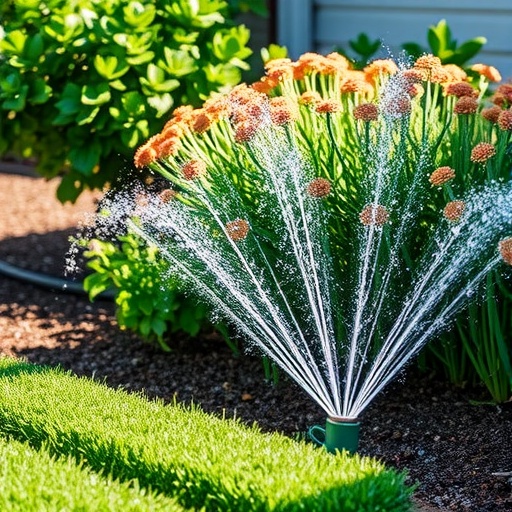
In an era where climate change poses an imminent threat to agricultural sustainability, a groundbreaking study by Zhang, Ge, Thiery, and colleagues has surfaced, focusing on the critical intersection of irrigation practices and their cooling effects in agricultural environments. The researchers tackle a pressing issue: while water-saving practices are often lauded for their efficiency, the implications of such methods on local climate and cooling effects merit deeper consideration. This research offers vital insights into how modern farming techniques can inadvertently alter microclimates, ultimately impacting crop yields and ecological balance.
The study, aptly titled “Irrigation cooling effect reduced by water-saving practices,” highlights a stark contradiction in agricultural water management: the conservation of water resources may inadvertently compromise the natural temperature moderation that conventional irrigation provides. Through comprehensive field studies, the researchers quantified the cooling effects of various irrigation methods, delineating the complex relationships between water application, soil moisture, air temperature, and overall plant health.
As drought conditions become more commonplace across the globe, agricultural practices are increasingly scrutinized for their environmental impact. Water-saving irrigation techniques, like drip irrigation and regulated deficit irrigation, are designed to optimize water use efficiency. These methods minimize water loss and are heralded for their ability to conserve limited resources. However, this new research sparks a critical dialogue regarding the ecological costs associated with them, primarily focusing on their reduced ability to cool surrounding areas.
The team employed a combination of field measurements and climate modeling to assess the microclimatic effects of different irrigation practices. Their findings reveal that conventional irrigation techniques maintain cooler temperatures around crops due to increased evaporation rates and soil moisture retention. In contrast, water-saving practices often lead to reduced moisture levels, which significantly diminishes the cooling effect that traditional methods have historically provided.
Additionally, the researchers utilized quantitative analysis to understand how changes in temperature and humidity affect plant physiology and yield. With many crops being sensitive to temperature fluctuations, the study suggests that the shift towards more water-efficient practices could inadvertently create hotter local climates. These shifts have far-reaching implications, particularly in an agricultural landscape already impacted by climate change, where even slight temperature increases can exacerbate stress on crops.
Through sophisticated statistical models, the authors also analyzed regional climate data to understand potential long-term effects. They expressed concern that without careful management and strategic adaptation, the agricultural sector may face declining productivity over time. This perspective is particularly timely, as farmers grapple with the twin challenges of water scarcity and the unrelenting pressures of climate change.
Zhang and colleagues acknowledged that while water-saving innovations are necessary to address immediate water shortages, there needs to be a paradigm shift in how irrigation is approached. They advocate for an integrated management framework, which considers both water conservation and the local climatic impacts of irrigation practices. Such a framework would involve collaborative efforts among scientists, agronomists, and policymakers to develop irrigation strategies that harmonize efficiency with environmental sustainability.
Importantly, the research also points to the potential role of technology in this integrative approach. Advancements in soil moisture sensors, climate forecasting, and irrigation management systems could help farmers maintain the delicate balance between conservation and cooling. By enabling data-driven decisions, technology could guide farmers to optimize irrigation schedules based on real-time weather patterns, thereby mitigating the adverse effects highlighted in the study.
The implications of the study extend beyond mere academic interest. Agriculture is a cornerstone of the global economy, supporting billions of livelihoods. Therefore, the findings must resonate within public policy and agricultural funding strategies. Governments and institutions need to prioritize research funding that explores innovative irrigation methodologies that not only conserve water but also enhance environmental resilience.
Furthermore, the research dovetails with a rising tide of public awareness regarding sustainable agricultural practices. As consumers increasingly demand transparency and eco-friendliness in food production, farmers adopting more sustainable irrigation techniques could find a burgeoning market that values both reduced water use and the maintenance of healthy ecosystems.
In conclusion, while water-saving practices are essential in today’s context of escalating water scarcity, the research by Zhang et al. serves as a clarion call for a more nuanced understanding of irrigation’s role in agricultural ecosystems. By recognizing the dual impacts of irrigation—both its role in conserving water and its essential function in moderating local climates—stakeholders can forge a path forward that ensures sustainability while safeguarding food security in a warming world.
The delicate balance between conserving water and maintaining agricultural viability necessitates a proactive approach that is grounded in scientific inquiry. As we heed the findings of this pivotal research, the agricultural community is tasked with advancing practices that not only address immediate resource constraints but also uphold the environmental integrity that fuels the very crops we depend on.
Subject of Research: The cooling effects of irrigation methods on local climates and crop yields in the context of water-saving practices.
Article Title: Irrigation cooling effect reduced by water-saving practices.
Article References:
Zhang, C., Ge, Q., Thiery, W. et al. Irrigation cooling effect reduced by water-saving practices.
Commun Earth Environ (2025). https://doi.org/10.1038/s43247-025-03030-5
Image Credits: AI Generated
DOI: 10.1038/s43247-025-03030-5
Keywords: irrigation, water-saving practices, cooling effect, agricultural sustainability, climate change, microclimate, crop yield, soil moisture, evaporative cooling, technology in agriculture.


