


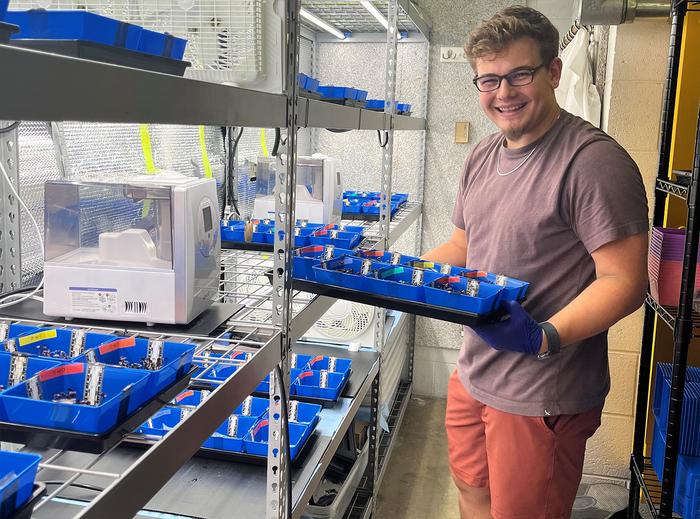
URBANA, Ill. – Urban agriculture has the potential to improve food security through local, efficient, and sustainable food production. Examples of urban food systems include hydroponics, where plants grow in a nutrient solution without soil, and aquaponics, which combines hydroponics with raising fish in tanks.

Credit: College of ACES
URBANA, Ill. – Urban agriculture has the potential to improve food security through local, efficient, and sustainable food production. Examples of urban food systems include hydroponics, where plants grow in a nutrient solution without soil, and aquaponics, which combines hydroponics with raising fish in tanks.
A new study from the University of Illinois Urbana-Champaign examines the use of aquaponics wastewater as a growth medium for lettuce in a hydroponic system. This practice can potentially create a circular ecosystem for organic waste recycling and food production.
The researchers tested effluent from two aquaponic systems in combination with liquid residual from hydrothermal liquefaction (HTL), an emerging technology that converts wet biomass to biocrude oil through a high-temperature, high-pressure process. HTL yields a wastewater called hydrothermal liquefaction aqueous phase (HTL-AP), which is rich in nutrients and can potentially be used as fertilizer.
“We wanted to see if the naturally occurring microbes from fish waste in aquaponic systems could help convert the nutrients in HTL-AP into forms that plants can absorb. We focused on using wastewater for lettuce seed germination. Eventually, we’ll observe different stages of crop growth, including full-grown lettuce and other crops,” said lead author Liam Reynolds, a doctoral student in the Department of Agricultural and Biological Engineering (ABE), part of the College of Agricultural, Consumer and Environmental Sciences and The Grainger College of Engineering at Illinois.
Reynolds conducted the research as an undergraduate student in ABE. He won second place for the paper in the K.K. Barnes Student Paper Award Competition at the 2023 American Society for Agricultural and Biological Engineers Annual International Meeting in Omaha, NE.
For the study, Reynolds placed Buttercrunch lettuce seeds in Ziploc plastic bags on paper towels saturated with the wastewater treatments for 10 days, measuring seed germination rate and growth.
He tested 32 trial solutions combining different percentages of HTL-AP with wastewater from aquaponic systems at the U. of I.’s Bevier Café and the Chicago High School for Agricultural Sciences. The trials also included standard hydroponic fertilizer and deionized water as control solutions.
“We’ve previously shown that it’s possible to grow lettuce hydroponically using treated wastewater; however, it doesn’t grow as quickly and effectively as it could. There are likely to be some toxic compounds inhibiting plant growth, and there are also not enough nutrients in a plant-available form,” said co-author Paul Davidson, an associate professor in ABE.
In earlier studies, Davidson’s research team used 2.5% HTL-AP; however, Reynolds tested solutions ranging from 1% to 10%.
“We found that solutions containing up to 8% HTL-AP are still viable for plant growth, at least in the germination phase. This is a higher percentage of HTL-AP than anybody has demonstrated before,” Davidson stated. “This makes it possible to recycle a waste stream that would otherwise go to a wastewater treatment plant, which takes up resources, or it would be discharged into the environment causing pollution.”
While the researchers did not find evidence the fish waste microbes benefited the lettuce at the seed germination stage, they expect to see effects as the lettuce grows. For now, they concluded that a combination of HTL-AP and aquaponic wastewaters does not inhibit the germination of lettuce seeds.
Aquaponic effluents could eventually supplement or even replace standard liquid fertilizers, although more work is needed to ensure the right combination of wastewater to provide adequate nutrition for hydroponic crop production. Davidson’s team will also address food safety issues, as some sources of wastewater may contain heavy metals that are toxic to humans.
The researchers conclude it is crucial to identify alternative nutrient sources to increase the circularity of global food-production systems as well as decrease the reliance on chemical fertilizers derived from fossil fuels.
The paper, “Investigating the Impacts of Wastewaters on Lettuce (Lactuca sativa) Seed Germination and Growth,” is published in Agriculture [DOI: 10.3390/agriculture14040608]. Authors include Liam Reynolds, Vitória Leme, and Paul Davidson. This work was partially funded by the USDA National Institute of Food and Agriculture, Hatch project 1021253.
Journal
Agriculture
Method of Research
Experimental study
Article Title
Investigating the Impacts of Wastewaters on Lettuce (Lactuca sativa) Seed Germination and Growth
Article Publication Date
12-Apr-2024
Cite Scienmag News
Alan Morgan. (July 3, 2024). Wastewater is a viable medium for growing lettuce in hydroponic systems, study shows. Scienmag. https://scienmag.com/wastewater-is-a-viable-medium-for-growing-lettuce-in-hydroponic-systems-study-shows/
Alan Morgan. "Wastewater is a viable medium for growing lettuce in hydroponic systems, study shows." Scienmag, 3 July 2024, https://scienmag.com/wastewater-is-a-viable-medium-for-growing-lettuce-in-hydroponic-systems-study-shows/. Accessed 4 September 2026.
Alan Morgan. "Wastewater is a viable medium for growing lettuce in hydroponic systems, study shows." Scienmag. July 3, 2024. https://scienmag.com/wastewater-is-a-viable-medium-for-growing-lettuce-in-hydroponic-systems-study-shows/

