


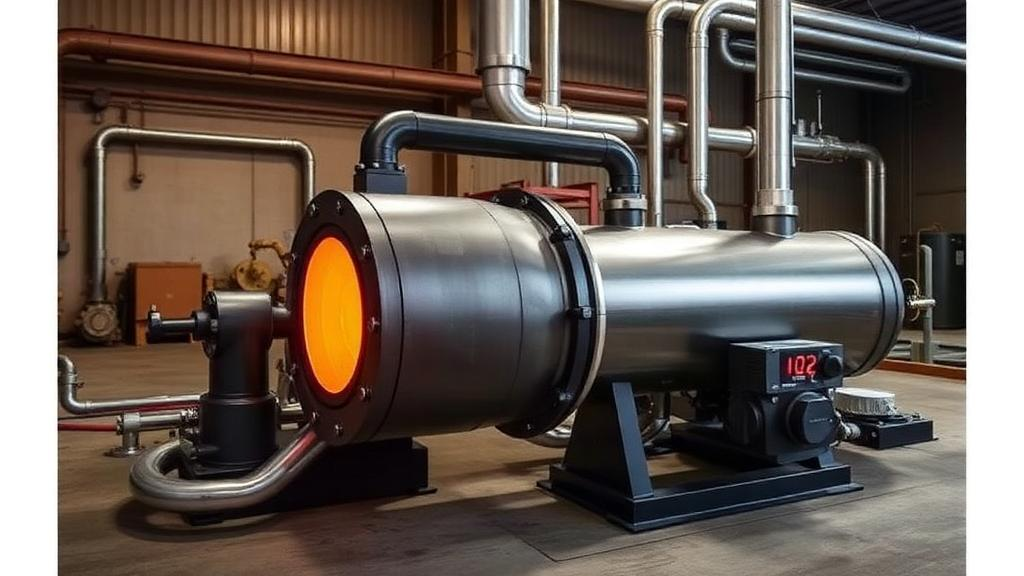
In the sprawling refinery complexes where crude oil begins its transformation into fuel, an enormous amount of energy literally goes up in smoke. Furnace exhaust gases leave the stacks at temperatures that would make most engineers wince, carrying with them heat that was purchased with fuel and then simply released to the atmosphere. A new study published in Results in Engineering has tackled this problem head-on at Iran’s Marun oilfield facilities, showing how a carefully optimized shell-and-tube heat exchanger can capture that escaping thermal energy and put it to work preheating crude oil before it enters the desalting unit. The research, led by Mohammad Ghodrati and colleagues, demonstrates that the difference between a mediocre heat-recovery system and an excellent one lies in the fine details of geometry.
The concept behind the study is elegantly practical. Crude oil arriving at a desalting unit is typically cold and viscous, and its water-oil emulsion is stubbornly stable, which makes salt removal difficult. Heating the crude before desalting reduces viscosity, destabilizes the emulsion, and improves separation. Meanwhile, the furnace exhaust leaves at approximately 973 kelvin, about 700 degrees Celsius, brimming with recoverable sensible heat. Rather than routing that heat through an intermediate conversion step, the researchers proposed transferring it directly to the crude stream through a shell-and-tube heat exchanger, avoiding the losses and complexity associated with boilers, organic Rankine cycles, or thermoelectric devices. Direct reuse, they argue, is the most attractive route when a compatible heat demand exists within the same plant.
Deciding which fluid goes where inside the exchanger was itself a consequential engineering choice. Following the guidance of industry specifications API 660 and IOGP S-614, the team assigned the crude oil to the tube side and the exhaust gas to the shell side. The rationale is rooted in mechanics and maintenance: the higher-pressure, fouling-prone crude benefits from the tube side, where mechanical cleaning and hydroblasting are straightforward, while the high-volume, pressure-drop-sensitive gas stream performs better on the shell side, where baffles can enhance heat transfer without excessive hydraulic penalty. This allocation reduces required shell thickness, controls fabrication cost, and keeps the dirtiest fluid in the easiest-to-clean passage.
What sets this work apart from earlier heat-exchanger studies is the sheer breadth of the design exploration. The researchers constructed a discrete design space of 192 configurations by combining four tube diameters ranging from 19.05 to 38 millimeters, four tube lengths from 1 to 3 meters, three segmental baffle types, and four tube arrangements including triangular and square patterns. Each configuration was simulated using three-dimensional, steady-state computational fluid dynamics with the RNG k-epsilon turbulence model, chosen for its established reliability in flows with curvature, recirculation, and strong strain rates. The simulations ran on the Simorgh supercomputer at Amirkabir University of Technology, with a final mesh of roughly 14 million cells verified through a Grid Convergence Index analysis showing discretization uncertainties below 0.6 percent.
The team deliberately avoided the classic trap of optimizing for a single metric. Instead, they evaluated four normalized indicators for every design: shell-side heat-transfer performance, total pressure drop, capital cost, and entropy generation, the last serving as a second-law measure of thermodynamic irreversibility. Entropy generation in a heat exchanger arises from two competing mechanisms, heat transfer across finite temperature differences and viscous friction, and minimizing it forces a design to respect both thermal and hydraulic realities simultaneously. Cost was estimated through established power-law correlations linking heat-transfer area and pumping power to equipment expense, providing a comparative economic yardstick across the 192 candidates.
The parametric results revealed a landscape of stubborn trade-offs. Increasing tube length reliably improved heat transfer by enlarging the exchange area and extending fluid residence time, but it simultaneously raised pressure drop and capital cost, and its effect on entropy generation was sometimes non-monotonic as thermal and frictional irreversibilities shifted in relative importance. Larger tube diameters eased hydraulic constraints but did not guarantee better overall performance; at the largest diameter tested, cost penalties mounted sharply. Baffle type emerged as a key lever on entropy generation, while tube arrangement played a comparatively minor role. Sensitivity analysis confirmed that tube diameter dominated the cost indicator, tube length governed thermal performance, and baffle configuration most strongly shaped thermodynamic losses.
To navigate this crowded trade-off space, the researchers applied Pareto analysis, identifying 141 non-dominated designs out of the 192 candidates, a large set that reflects how richly the objectives conflict in a discrete design space. They then ranked the Pareto solutions by their Euclidean distance to an ideal point representing perfect performance on all four normalized criteria, a transparent method that avoids the subjective weighting that can bias multi-objective decisions. The winning configuration, designated D2L4P4B1, pairs a 25.4-millimeter tube diameter with a 3-meter length, a 45-degree rotated square tube arrangement, and single-segmental baffles. It scored 0.903 on normalized heat transfer, 0.954 on entropy-generation performance, and a respectable 0.76 on pressure drop, with the shortest distance to the ideal point at 0.4433.
The CFD visualizations of the optimal design bring the physics to life. Temperature contours show a searing hot zone near the exhaust-gas inlet where the largest temperature gradients, and therefore the most intense heat transfer, occur, followed by a gradual cooling of the gas as it flows across the tube bundle. On the tube side, the crude oil warms steadily along its path, confirming effective absorption of the recovered heat, a rise that directly translates into lower viscosity and easier emulsion breaking downstream. Pressure contours reveal a smooth, gradual decline from inlet to outlet with no abnormal jumps, indicating that the optimized geometry keeps hydraulic losses within acceptable bounds for the viscous crude service.
The validation of the numerical framework lends credibility to the findings. Comparisons against published CFD data from Li and He showed maximum deviations of just 2.34 percent for the shell-side heat-transfer coefficient and 9.8 percent for pressure drop, good agreement for a system as geometrically complex as a baffled shell-and-tube exchanger. The authors are candid about the limits of their approach: the study relies on steady-state simulations with discrete design variables, excludes fouling evolution and transient operation, and validates against numerical rather than experimental data. They also note that a plant-specific design would need to impose the desalter’s required inlet-temperature range as an explicit constraint.
Even with those caveats, the study offers a compelling template for refineries seeking to squeeze value from their stacks. It demonstrates that the best heat-recovery design is never the one that maximizes heat transfer alone, nor the cheapest, nor the thermodynamically cleanest, but the one that balances all three against hydraulic reality. By coupling a rigorous CFD campaign with Pareto-based multi-objective selection and entropy-generation analysis, the researchers have shown that furnace exhaust at Marun can be converted from an environmental liability into a process asset, preheating crude oil, easing the burden on the desalting unit, and cutting the fuel that would otherwise be burned to do the same job. For energy-intensive industries worldwide, the message is that the geometry of a heat exchanger, down to the millimeter of a tube diameter and the angle of a baffle, can decide whether waste heat is truly recovered or merely relocated.
Subject of Research: Multi-objective CFD optimization of a shell-and-tube heat exchanger for recovering refinery furnace exhaust heat to preheat crude oil before desalting
Article Title: Multi-objective design and optimization of a shell-and-tube heat exchanger for recovering Marun furnace exhaust heat and preheating crude oil entering a desalting unit
Article References: Ghodrati, M., Deymi‑Dashtebayaz, M., Khoshnevis, A. B., & Yazdani, M. (2026). Multi-objective design and optimization of a shell-and-tube heat exchanger for recovering Marun furnace exhaust heat and preheating crude oil entering a desalting unit. Results in Engineering, 32, Article 113398. https://doi.org/10.1016/j.rineng.2026.113398
Image Credits: AI Generated
DOI: Not provided
Keywords: waste heat recovery, shell-and-tube heat exchanger, CFD simulation, multi-objective optimization, entropy generation, Pareto front, crude oil preheating, refinery furnace, furnace exhaust gas, pressure drop, baffle design, energy efficiency
Cite Scienmag News
Denise Maddox. (October 14, 2026). Waste Furnace Heat Turned Into Crude Oil Preheating by Optimized Heat Exchanger Design. Scienmag. https://scienmag.com/waste-furnace-heat-turned-into-crude-oil-preheating-by-optimized-heat-exchanger-design/
Denise Maddox. "Waste Furnace Heat Turned Into Crude Oil Preheating by Optimized Heat Exchanger Design." Scienmag, 14 October 2026, https://scienmag.com/waste-furnace-heat-turned-into-crude-oil-preheating-by-optimized-heat-exchanger-design/. Accessed 14 October 2026.
Denise Maddox. "Waste Furnace Heat Turned Into Crude Oil Preheating by Optimized Heat Exchanger Design." Scienmag. October 14, 2026. https://scienmag.com/waste-furnace-heat-turned-into-crude-oil-preheating-by-optimized-heat-exchanger-design/


