


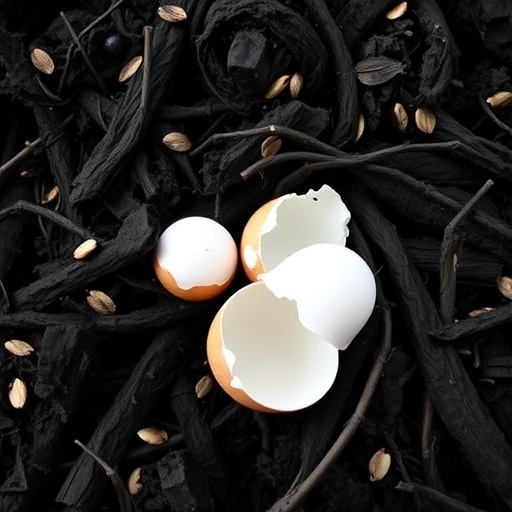
A groundbreaking advance in wastewater treatment has emerged from the intersection of waste valorization and innovative material science. Researchers have developed a novel biochar adsorbent derived from agricultural and food waste, capable of efficiently removing tetracycline—one of the most pervasive antibiotic pollutants—from contaminated water. This new material leverages the synergistic properties of cotton stalk biochar, calcium extracted from discarded eggshells, and β-cyclodextrin, a starch-based cyclic molecule, to create an effective and sustainable adsorbent.
The hybrid material, known as Ca@CBC/β-CD, is synthesized through a microwave-assisted crosslinking process, integrating calcium-rich sites into a porous carbon matrix while embedding β-cyclodextrin molecules that offer specialized cavity structures. This multi-faceted design produces numerous interaction pathways enabling the robust capture of tetracycline molecules, which is crucial given the compound’s environmental persistence and ecological risks.
Optimal performance was observed under conditions mimicking natural aquatic environments, specifically near pH 6, where the adsorbent’s capacity peaked at an impressive 161.91 mg per gram at 45°C. This temperature-dependent adsorption highlights the thermally enhanced interaction dynamics. Remarkably, the material maintains roughly 84-86% of its efficiency after five regeneration cycles, underscoring its potential for reuse and operational sustainability in real-world applications.
Delving deeper into the adsorbent’s mechanism, advanced spectroscopic analysis combined with density functional theory simulations unveiled a complex adsorption mechanism. Tetracycline molecules are immobilized through calcium-mediated inner-sphere complexation and surface bridging, host–guest inclusion within the β-cyclodextrin’s hydrophobic cavities, and multiple hydrogen bonds. This intricate network of forces underlies the material’s exceptional adsorption capacity and specificity.
To predict and optimize adsorption efficiency across various environmental parameters, the team employed machine learning techniques. Among six models tested, the gradient boosting decision tree emerged as the most accurate, producing a compelling R² score of 0.9914 on test data. This approach pinpointed initial tetracycline concentration, adsorbent dosage, and contact time as pivotal factors influencing adsorption, allowing for rapid performance estimation and experiment optimization without exhaustive laboratory work.
From an environmental impact perspective, life cycle assessment illuminated crucial insights. The adsorbent’s production involves an emission footprint of approximately 5.44 kg CO₂-equivalent per kilogram, primarily attributed to electricity consumption during microwave synthesis. This analysis not only contextualizes the material’s sustainability but also signals pathways for reducing energy use in its manufacture.
While these findings represent a significant proof of concept, the researchers emphasize that further work is needed to optimize formulation ratios, processing conditions, and continuous-flow system testing to fully harness the material’s potential in practical wastewater treatment frameworks. This study exemplifies a compelling waste-to-resource strategy, advancing the development of next-generation biochar adsorbents to tackle the persistent challenge of antibiotic contamination in aquatic environments.
Keywords
Biochar, Antibiotic pollution, Tetracycline removal, Calcium-rich adsorbent, β-cyclodextrin, Waste valorization, Microwave synthesis, Machine learning, Environmental remediation
Cite Scienmag News
Bethany Barker. (July 9, 2026). Waste Cotton Stalks and Eggshells Turned into Biochar for Antibiotic Cleanup. Scienmag. https://scienmag.com/waste-cotton-stalks-and-eggshells-turned-into-biochar-for-antibiotic-cleanup/
Bethany Barker. "Waste Cotton Stalks and Eggshells Turned into Biochar for Antibiotic Cleanup." Scienmag, 9 July 2026, https://scienmag.com/waste-cotton-stalks-and-eggshells-turned-into-biochar-for-antibiotic-cleanup/. Accessed 4 September 2026.
Bethany Barker. "Waste Cotton Stalks and Eggshells Turned into Biochar for Antibiotic Cleanup." Scienmag. July 9, 2026. https://scienmag.com/waste-cotton-stalks-and-eggshells-turned-into-biochar-for-antibiotic-cleanup/


