


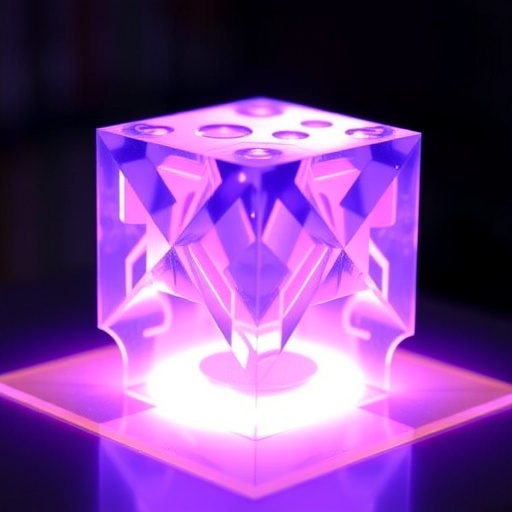
Researchers at the University of Utah and The University of Texas at Austin have demonstrated a new form of 3D printing that can create intricate, hollow structures in a single exposure of laser light. Unlike conventional additive manufacturing, which builds objects gradually by stacking one layer on top of another, the technique solidifies an entire three-dimensional shape at once. The approach uses a custom photopolymer resin and an inverse-designed nanoscale phase mask that transforms a laser beam into a carefully calculated holographic pattern. In demonstrations, the system produced complex structures in as little as 7.5 seconds, potentially opening a faster route to manufacturing microscopic devices, biomedical scaffolds and optical components.
The work addresses one of the central limitations of current high-resolution 3D printing. Layer-based methods can produce sophisticated shapes, but every interface between successive layers may introduce weak points, roughness or microscopic seams. Some laser-based techniques avoid visible seams by curing material continuously, yet they often require the printing beam to scan through the object point by point. That process can take minutes or hours when the desired structure is large or geometrically complicated. The Utah and Texas researchers instead sought to encode the full volume of a part into a single optical exposure. Their results, published in Science Advances, show that holographic control of light can produce true three-dimensional objects rather than structures that are essentially two-dimensional patterns extended along one direction.
The printer begins with a specially formulated resin containing long polymer molecules. Before exposure, the resin remains liquid or otherwise unstructured. When illuminated with the correct laser intensity, a photochemical reaction generates reactive species that link the polymer chains together, a process known as crosslinking. The exposed regions become a solid network, while the unexposed material remains removable by washing. The final object is therefore defined not by a mechanical nozzle or a sequence of deposited layers, but by the three-dimensional distribution of light inside the resin. This distinction is crucial: the laser must create enough energy throughout the intended volume to cure the material, while keeping neighboring regions below the threshold required for crosslinking.
Generating such a pattern is difficult because light does not travel through the resin as if it were moving through empty space. Even a transparent-looking material absorbs and scatters some of the incoming light, and variations in its optical properties can cause diffraction. As the beam propagates, its waves interfere with one another, shifting energy away from the target locations and blurring the projected shape. A conventional two-dimensional mask can block light in unwanted areas at a surface, but it cannot directly control how the beam evolves deep inside a volume. The researchers’ solution was to place a nanopatterned phase mask in front of the light source. Rather than simply blocking light, the mask changes the phase of different portions of the beam, directing energy through the resin in a pattern calculated to compensate for diffraction.
The mask is designed using computational optics, an approach that works backward from the desired object. The researchers first define the three-dimensional shape they want to print, including regions that must remain solid and voids that must remain empty. An inverse-design algorithm then calculates the optical phase pattern required at the mask so that, after the laser propagates through the resin, the energy distribution matches the target geometry. In principle, this is similar to designing a hologram, but with a critical difference: the hologram is optimized for light traveling through a reactive material and for producing a volumetric chemical response. The resulting phase mask is nanoscale because its features must manipulate the laser wavefront with a precision comparable to the wavelength of light.
The team’s earlier experiments demonstrated the ability to print arrays of microtubes with individual diameters as small as 6 micrometers. Those structures had very high aspect ratios, reaching approximately 120 to 1, and contained hollow spaces along their length and width. However, the researchers described those initial objects as “extended 2D” structures because the method could not yet create independent voids running through the print’s vertical dimension. In practical terms, the printer could form long, thin hollow tubes, but it could not freely sculpt empty spaces along all three axes. That restriction separated the earlier demonstrations from fully volumetric 3D printing.
The latest study overcomes this limitation by combining a redesigned resin with a more precise understanding of the chemistry and timing of the curing process. Light exposure occurs extremely rapidly, while the chemical reactions that ultimately harden the resin unfold over a much longer timescale. This difference gives the researchers a narrow but important window in which optical intensity can be shaped with great precision. The phase mask is engineered so that regions intended to become voids receive insufficient exposure to trigger significant crosslinking, even when they are surrounded by curing material. At the same time, the bright regions receive enough energy to form a stable solid network. “We engineer the way light flows through the resin such that there are bright regions where we want curing to happen—the solid regions of the print—and darker regions where we don’t,” said Rajesh Menon, a professor of electrical and computer engineering at the University of Utah.
The researchers demonstrated the concept by producing objects that included a hollow cylinder and a hollow cube, with voids oriented along multiple axes. These shapes may appear simple compared with the intricate components used in advanced engineering, but they represent a major proof of principle because their internal spaces cannot be generated by merely extending a flat pattern. The ability to control solid and empty regions throughout a volume could eventually support the fabrication of microfluidic channels, lightweight lattice structures, miniature heat exchangers and medical implants with carefully tuned porosity. At microscopic scales, the same capability may be useful for optical devices and lab-on-a-chip systems, where internal geometry directly determines how fluids, light or cells move through a component.
The speed of the process is another potential advantage. A complete shape can be cured in a single exposure lasting only seconds, rather than assembled through thousands of separate layers or scanned points. That does not mean the method is immediately ready to replace every existing 3D printer. The size of the printable volume, the resolution of the phase mask, the optical properties of the resin and the need to wash away uncured material all place limits on the technology. Scaling the method to larger objects will require controlling laser uniformity, resin stability and heat generation while preserving the precision of the holographic pattern. Even so, the demonstration shows that manufacturing speed and geometric complexity do not necessarily have to be traded against one another. By treating light as a programmable three-dimensional tool, the researchers have moved closer to a new category of additive manufacturing in which an entire object can emerge from a single flash.
The study was led by Menon and Dajun Lin at the University of Utah, in collaboration with Michael Cullinan and Zachariah A. Page of The University of Texas at Austin and members of their laboratories. Chih-Hao Chang and additional researchers also contributed to the work. Funding came from the U.S. National Science Foundation Future Manufacturing program, with partial support from the Robert A. Welch Foundation. The paper, “Single-exposure holographic 3D printing via inverse-designed phase masks,” suggests that future printers may rely less on mechanical motion and more on algorithmically engineered light. If the approach can be expanded beyond its current microscopic demonstrations, a single exposure could one day create objects whose internal architecture would be difficult, slow or impossible to manufacture with conventional layer-by-layer methods.
News Publication Date: 12-Aug-2026
Web References: https://www.price.utah.edu/2026/07/06/price-engineerings-new-holographic-printer-makes-3d-shapes-in-one-shot
References: Lin et al., Science Advances, DOI: 10.1126/sciadv.aec3536
Keywords
Holographic 3D printing, additive manufacturing, inverse-designed phase masks, photopolymer resin, photolithography, optical lithography, microstructures, materials science, applied optics, nanophotonics, volumetric printing, microfabrication
Cite Scienmag News
Denise Maddox. (August 20, 2026). Holographic printer creates 3D shapes, including voids, in one shot. Scienmag. https://scienmag.com/holographic-printer-creates-3d-shapes-including-voids-in-one-shot/
Denise Maddox. "Holographic printer creates 3D shapes, including voids, in one shot." Scienmag, 20 August 2026, https://scienmag.com/holographic-printer-creates-3d-shapes-including-voids-in-one-shot/. Accessed 4 September 2026.
Denise Maddox. "Holographic printer creates 3D shapes, including voids, in one shot." Scienmag. August 20, 2026. https://scienmag.com/holographic-printer-creates-3d-shapes-including-voids-in-one-shot/


