


Starting venom immunotherapy for wasp allergy does something strikingly specific to the immune cells that trigger anaphylaxis: within a month, the basophils of treated patients become far less responsive to wasp venom itself, while their reactions to other triggers stay essentially unchanged. That is the central finding of a prospective study from University Hospital Würzburg in Germany, published in the journal Allergy, Asthma & Clinical Immunology, which tracked circulating basophils in twenty-four patients during the first twenty-eight days of Vespula venom immunotherapy, or VIT.
Yet the mechanisms behind its clinical success have never been fully mapped. The Würzburg team, led by Janik Fleissner, Johanna Stoevesandt, Matthias Goebeler, Axel Trautmann and Andreas Kerstan, set out to examine what happens to basophil function and surface receptor expression during the earliest phase of treatment, before long-term tolerance has had time to consolidate.
Basophils are rare players in the blood, making up less than one percent of peripheral leukocytes, but they punch far above their weight in allergic disease. They carry the high-affinity IgE receptor FcεRI on their surface, with allergen-specific IgE molecules docked onto it, and when venom cross-links enough of those receptors, the cells degranulate and release histamine. They also secrete interleukin-4, helping to steer the immune system toward the type 2 polarization that characterizes allergic responses. In short, they are both effectors of anaphylaxis and architects of the allergic immune state.
The study enrolled twenty-four patients with a clear history of Vespula sting-induced anaphylaxis, all eligible for VIT under current guideline criteria. Sensitization was confirmed by intradermal testing and venom-specific IgE measurements. Most patients had experienced grade II or grade III reactions according to the Ring and Messmer classification, and three had concomitant atopy. Blood was drawn before treatment, after three days, and after one month of therapy, with the induction protocol using a standardized aqueous mixture of closely related Vespula venoms.
In the laboratory, the researchers primed whole-blood basophils with interleukin-3 and challenged them with three different stimuli: Vespula venom itself, an agonistic anti-IgE antibody that bypasses allergen specificity by directly cross-linking IgE, and the bacterial peptide fMLP, which activates basophils through an entirely IgE-independent pathway. Basophil activation was quantified by flow cytometric measurement of CD63, a marker of degranulation. At baseline, venom produced a clear dose-dependent response, with higher CD63 expression at 1000 nanograms per milliliter than at 100 nanograms per milliliter.
After one month of VIT, the venom-driven response had fallen significantly at both concentrations, dropping to 64.9 percent CD63 positivity at the higher dose and 23.7 percent at the lower dose, with the reduction more pronounced at the lower concentration. In sharp contrast, activation by anti-IgE remained unchanged throughout the observation period, and fMLP-induced activation stayed largely stable as well, apart from a statistically non-significant dip at day twenty-eight. This dissociation is the study’s most telling observation: whatever the treatment was doing to basophils, it was acting selectively on the allergen-specific arm of the response, not on the cells’ general capacity to degranulate.
Parallel measurements of surface receptors revealed a surprising counter-current. Rather than declining, the number of FcεRI receptors per basophil rose from about 6,500 at baseline to roughly 25,500 by day twenty-eight, and the inhibitory receptor FcγRIIb climbed from about 4,500 to more than 8,300 per cell, with increases already visible at day three. The frequency of IgE-positive basophils in the blood dipped transiently at day three before returning to baseline, while the amount of IgE bound per basophil, measured as mean fluorescence intensity, did not change significantly. The paradox of more IgE receptors coexisting with less allergen-specific activation suggests that receptor abundance alone does not determine basophil responsiveness; the composition of the IgE and IgG bound to those receptors matters more.
The serological data point to what that composition might be. Over the first month, total IgE rose modestly, from about 164 to 195 kilounits per liter, and venom-specific IgE rose more steeply, from 13.1 to 23.6 kilounits per liter, a roughly four-fold increase. But the most dramatic change was in venom-specific IgG4, which jumped from 1.9 to 8.0 milligrams per liter, a mean 12.8-fold induction that significantly outpaced the rise in venom-specific IgE. Consistent with this, the venom-specific IgG4 to IgE ratio increased significantly over the month, shifting the humoral balance toward the antibody class most associated with immune tolerance.
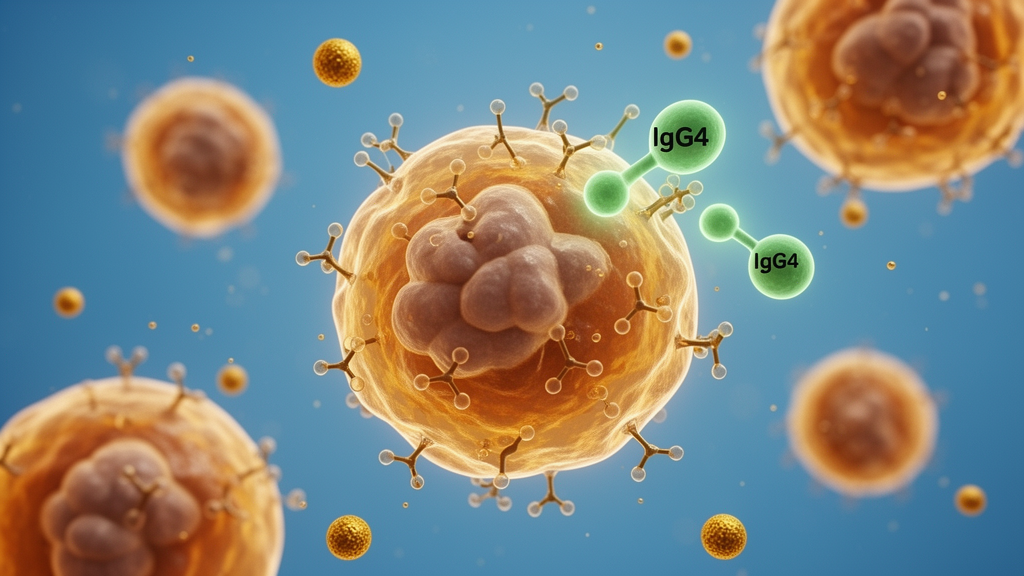
The authors propose a mechanistic model that ties these threads together. IgG4 can act as a blocking antibody, competing with IgE for allergen binding, but it may also form allergen-containing immune complexes that simultaneously engage FcγRIIb and FcεRI-bound IgE on the basophil surface. This co-aggregation of the inhibitory and activating receptors suppresses downstream signaling from FcεRI, preventing degranulation. Because the inhibition depends on allergen-specific immune complexes rather than on receptor cross-linking in general, it explains why anti-IgE and fMLP responses were spared. The concurrent upregulation of FcγRIIb may further lower the threshold for this inhibitory signaling, amplifying the effect of the newly induced IgG4. The researchers caution that they did not directly measure FcγRIIb occupancy or IgG4-mediated co-aggregation, and that the relative contributions of receptor-mediated inhibition versus direct IgE blocking by IgG4 may differ between allergens, so serum transfer assays and direct occupancy measurements will be needed to confirm the model.
The study’s authors are careful about scope. The cohort was small, making subgroup analyses by anaphylaxis severity or clinical protection after re-sting infeasible, and the observation window closed at one month, so the findings speak to early immune modulation rather than long-term tolerance. The patients studied were also a homogeneous single-center series, all treated with the same venom product under the same protocol. Even so, the work offers a concrete, measurable signature of the immune system pivoting toward tolerance: venom-specific basophil excitability falling, FcγRIIb rising, and venom-specific IgG4 surging. The authors suggest that this combined profile of basophil activation, receptor expression and serum IgG4 could eventually serve as a biomarker of immune modulation during VIT, and they argue that the initial protection built during the up-dosing phase, driven by rapid desensitization of mast cells and basophils, is later reinforced by a second layer of IgG4- and FcγRIIb-mediated suppression that consolidates into durable tolerance.
Subject of Research: Early immune modulation of basophil activation and Fc receptor expression during Vespula venom immunotherapy
Article Title: Vespula spp. venom immunotherapy: basophil excitability and FcεRI/FcγRIIb expression
Article References: Fleissner, J., Stoevesandt, J., Goebeler, M., Trautmann, A., & Kerstan, A. (2026). Vespula spp. venom immunotherapy: basophil excitability and FcεRI/FcγRIIb expression. Allergy, Asthma & Clinical Immunology, 22(1), Article 54. https://doi.org/10.1186/s13223-026-01062-w
Image Credits: AI Generated
DOI: 10.1186/s13223-026-01062-w
Keywords: venom immunotherapy, Vespula venom, basophils, anaphylaxis, FcεRI, FcγRIIb, IgG4, IgE, allergen-specific immunotherapy, basophil activation test, immune tolerance, CD63
Cite Scienmag News
Nathaniel Bowman. (October 29, 2026). Wasp venom immunotherapy quiets basophils by reshaping IgG4 and Fc receptors. Scienmag. https://scienmag.com/wasp-venom-immunotherapy-quiets-basophils-by-reshaping-igg4-and-fc-receptors/
Nathaniel Bowman. "Wasp venom immunotherapy quiets basophils by reshaping IgG4 and Fc receptors." Scienmag, 29 October 2026, https://scienmag.com/wasp-venom-immunotherapy-quiets-basophils-by-reshaping-igg4-and-fc-receptors/. Accessed 4 November 2026.
Nathaniel Bowman. "Wasp venom immunotherapy quiets basophils by reshaping IgG4 and Fc receptors." Scienmag. October 29, 2026. https://scienmag.com/wasp-venom-immunotherapy-quiets-basophils-by-reshaping-igg4-and-fc-receptors/




