


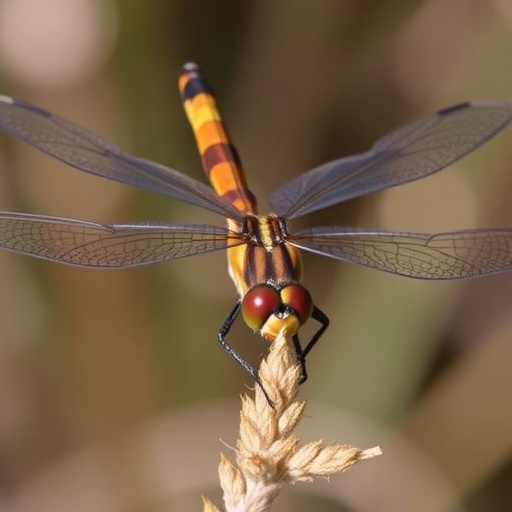
In the escalating global climate crisis, the narrative often centers on the direct lethality of rising temperatures to various species. However, recent groundbreaking research reveals that the subtle disruption of reproductive behaviors may be a silent yet critical driver of species declines, particularly in charismatic insects like dragonflies. A comprehensive study led by Nalley and Moore, published in Nature Climate Change, brings into sharp focus how conspicuous sexual traits—notably wing ornamentation used in mating displays—could be pivotal in determining a species’ vulnerability to warming climates and increasing wildfire events.
This research draws from an expansive dataset, encompassing over 1,600 local extinction records of 60 distinct dragonfly species. Such a vast compilation of field data presents a robust framework for teasing apart the complex interactions between climate stressors and biological traits. The crux of their findings underscores a stark pattern: dragonfly species exhibiting elaborate mating-related wing ornaments consistently faced higher extinction rates and suffered greater habitat loss compared to their non-ornamented counterparts. This suggests that sexual selection traits, long appreciated in evolutionary biology for their role in mate attraction and competition, might paradoxically predispose species to greater climate vulnerability.
Critically, this pattern emerged even when accounting for traditionally considered ecological factors such as thermal tolerance, habitat specialization, or body size—traits that usually dominate vulnerability assessments. Contrary to expectations, these ecological characteristics did not significantly influence extinction sensitivity, placing a new lens on how biologists assess species’ resilience. It appears that the reproductive apparatus of these dragonflies, rather than their fundamental ecological limits, may be the Achilles’ heel in the face of warming and fire disturbances.
The implications of these findings stretch beyond dragonflies themselves, hinting at a broader biological principle: traits linked to mating and reproduction may be disproportionately sensitive to environmental stressors, with cascading effects on population survival. Wing ornamentation in dragonflies, manifesting as colorful and conspicuous extensions used during aerial courtship displays, demands significant energy investment and precise physiological regulation. Rising temperatures can interfere with these processes by disrupting phenology, mobility, or signaling efficacy, thereby diminishing reproductive success even before survival thresholds are breached.
Moreover, wildfire, which is intensifying in frequency and scale due to climate change, compounds these threats. The study highlights how burn events exacerbate habitat loss for ornamented species more acutely than for those without such traits, suggesting a synergistic stress. Habitat alterations caused by wildfire may reduce suitable sites for mating and oviposition, further hindering population persistence. This intertwined vulnerability bridge between thermal stress and habitat destruction underscores the multifaceted nature of climate challenges.
From an evolutionary ecology standpoint, the results invite a reevaluation of sexual selection’s role under rapid environmental change. Traditionally viewed as a driver of diversity and adaptation, sexual ornamentation might simultaneously impose constraints under stressful conditions, exposing species to heightened extinction risk. This paradox challenges conservationists and evolutionary biologists to reconcile the short-term adaptive advantages of showy traits with their potential long-term costs in a warming world.
Technically, the study applies rigorous statistical models to control for confounding variables, reinforcing the causal link between ornamentation and extinction likelihood. The data integration spans geographic gradients and temporal scales, capturing the nuanced responses of multiple species to fluctuating climatic pressures. Such methodological sophistication ensures that the observed associations are not artefacts but likely reflect underlying biological mechanisms.
Expanding beyond dragonflies, these insights could illuminate patterns across other taxa where sexual display traits are prominent. Birds with elaborate plumage, amphibians with complex calls, and fish with vivid colors might all face analogous threats as climate-imposed stressors undermine reproductive efficiency. This realization emphasizes the critical need to integrate behavioral and reproductive ecology into climate vulnerability assessments.
Conservation strategies might need reorientation in response to these findings. Rather than focusing solely on thermal niches or habitat adequacy, preserving genetic and phenotypic diversity in mating traits could be crucial. Protecting populations with reduced ornament expression or facilitating microhabitats that buffer thermal extremes during mating seasons could mitigate extinction risks. Additionally, fire management plans must consider the differential habitat sensitivity of ornamented versus non-ornamented species to optimize conservation outcomes.
In the context of accelerating climate change scenarios, the study serves as a poignant reminder that extinction drivers are multifactorial and often insidious. The loss of species with elaborate mating displays erosion not just biodiversity but also the intricate evolutionary narratives that have shaped natural communities. Dragonflies, often admired for their dazzling aerial acrobatics and vibrant colors, become emblematic of the silent crisis afflicting sexually selected traits amid environmental upheaval.
This research thereby challenges policymakers, ecologists, and the public to broaden their conception of climate impacts. It is not enough to measure survival; understanding the nuances of reproduction and mate attraction underpins the persistence of ecosystems. A failure to incorporate these dimensions risks underestimating extinction trajectories and impeding effective conservation interventions.
Future research directions highlighted by Nalley and Moore’s work include detailed physiological studies examining how elevated temperatures specifically impair wing ornament development and functionality. Additionally, exploring genetic variability in ornament expression and its heritability could provide insights into potential adaptive responses or evolutionary constraints. Longitudinal monitoring will be essential to track population dynamics in real-time and refine predictive models.
In conclusion, the story of showy dragonflies being driven extinct by climate warming and wildfires offers a compelling and sobering window into the complex interplay between sexual selection and climate vulnerability. It underscores a critical shift from focusing solely on baseline survival to appreciating the fragility of reproductive systems under environmental stress. As the planet warms and fire regimes change, the fate of these winged jewels may signal broader patterns of biological resilience or collapse, challenging humanity to rethink how we safeguard life’s intricate tapestry.
Cite Scienmag News
Sloane Callahan. (September 10, 2025). Warming, Wildfires Threaten Showy Dragonflies’ Survival. Scienmag. https://scienmag.com/warming-wildfires-threaten-showy-dragonflies-survival/
Sloane Callahan. "Warming, Wildfires Threaten Showy Dragonflies’ Survival." Scienmag, 10 September 2025, https://scienmag.com/warming-wildfires-threaten-showy-dragonflies-survival/. Accessed 7 September 2026.
Sloane Callahan. "Warming, Wildfires Threaten Showy Dragonflies’ Survival." Scienmag. September 10, 2025. https://scienmag.com/warming-wildfires-threaten-showy-dragonflies-survival/


