


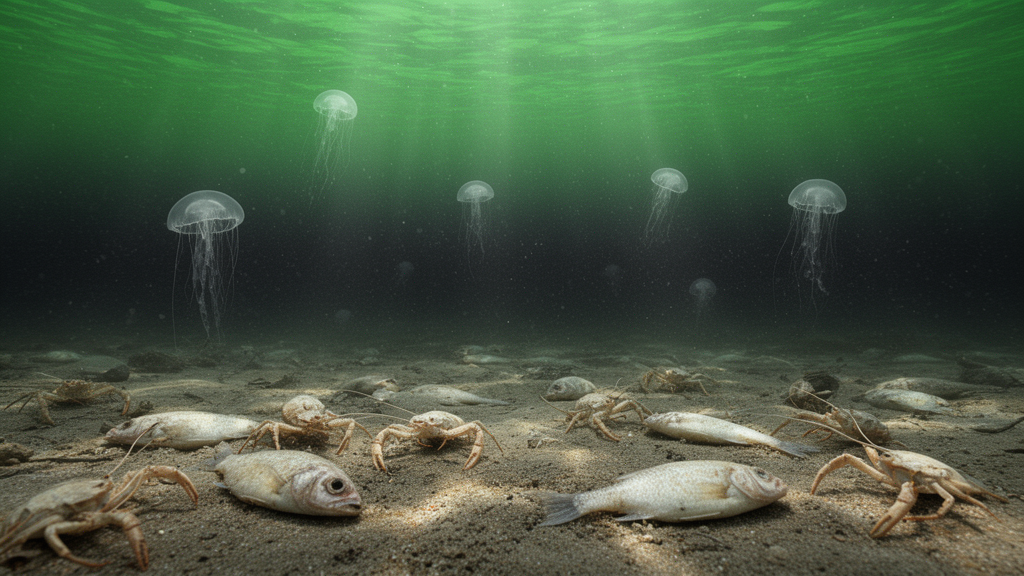
When summer rains hammer the coast of western Japan, the Ariake Sea often pays a hidden price. Freshwater surging from rivers spreads across the denser seawater below, sealing the bay like a lid and cutting off the oxygen that bottom-dwelling creatures need to survive. Within days, fish and shellfish begin to suffocate in what scientists call coastal hypoxia, one of the most damaging and least visible consequences of nutrient pollution and climate change. A new study published in Communications Earth & Environment now shows just how much worse this phenomenon is likely to become in a warmer world, and the numbers are striking: under a climate scenario four degrees Celsius warmer than the historical baseline, the average duration of hypoxic events triggered by extreme river discharge increases by roughly a third.
The research, led by Lin Hao of Kyushu University together with colleagues from Kyushu University, The University of Osaka, Nippon Koei, and Hitachi, addresses a stubborn gap in coastal oceanography. Scientists have long known that oxygen depletion in coastal waters arises when the physical supply of oxygen, through mixing and air-sea exchange, fails to keep pace with the biological demand created by decaying organic matter. Stratification, nutrient enrichment, and warming all intensify this imbalance. Yet the specific contribution of extreme hydrological events, the floods and deluges that flush enormous pulses of freshwater and nutrients into the sea, has remained poorly constrained under future warming, largely because climate models have lacked the resolution to capture both the storms and the delicate physics of a shallow estuary at the same time.
To close that gap, the team built a three-dimensional hydrodynamic-biogeochemical model of the Ariake Sea and drove it with high-resolution regional climate simulations drawn from the d4PDF database, a large ensemble of climate projections produced on the Earth Simulator under programs funded by Japan’s Ministry of Education, Culture, Sports, Science and Technology. The choice of study site matters. The Ariake Sea is a large, shallow, semi-enclosed embayment on the island of Kyushu, famous for its tidal flats and its fisheries, including nori seaweed and bivalves. Its restricted circulation and strong river influence make it a natural laboratory for studying how flood events translate into oxygen crises, and its economic importance makes the findings directly relevant to coastal managers.
The modeling framework allowed the researchers to run controlled experiments that would be impossible in the real ocean. By comparing simulations of historical conditions with simulations in which the climate is two and four degrees Celsius warmer, they could isolate how warming changes both the magnitude of extreme river discharge and the ocean’s biological and physical response to it. The results on the hydrology side are unambiguous. Extreme discharge events grow more intense as the climate warms: the study finds that under the four-kelvin scenario, the magnitudes of floods with 50-year and 100-year return periods increase by 6.9 percent and 10.0 percent respectively, relative to the historical baseline. In other words, the once-in-a-century floods of today’s climate become measurably larger in a warmed world.
Those modest increases in flood size produce a dramatically larger response in the ocean. For discharge events falling within the 50-to-100-year return period range, the mean duration of hypoxia in the Ariake Sea increases by 33.2 percent under the warmest scenario, with a 95 percent confidence interval spanning 11.7 to 55.3 percent and a statistical significance of p less than 0.01. The asymmetry is the key insight: a roughly ten percent boost in flood magnitude translates into a threefold larger percentage increase in the time that coastal waters spend starved of oxygen. The mechanism is physical rather than mysterious. Larger freshwater pulses strengthen the density stratification of the water column, deepening and reinforcing the lid that separates oxygen-rich surface water from the oxygen-consuming bottom layer. Once that barrier is established, respiration in the lower layer consumes oxygen faster than turbulent mixing can replenish it, and the hypoxic zone persists.
Equally revealing is what the study found when it compared the two-degree and four-degree scenarios. The additional increase in hypoxia duration from moving from plus two kelvin to plus four kelvin of warming is limited, suggesting a nonlinear but partially saturating relationship between warming and hypoxia response. The largest jump in oxygen stress occurs between the historical baseline and the first increment of warming, implying that even moderate climate change may lock in much of the projected intensification of coastal dead zones. For coastal communities, that is both a warning and a sliver of hope: the trajectory of the next few decades of warming will disproportionately shape the hypoxia burden of the second half of the century.
The spatial fingerprint of the intensified hypoxia is also distinctive. The model shows intensified hypoxic conditions concentrated near the estuaries, where the freshwater plumes enter and stratification is strongest, while persistent low oxygen extends offshore into the open areas of the bay. This two-part pattern, acute oxygen stress at the river mouths and chronic oxygen depletion farther out, has implications for how the damage unfolds biologically. Estuarine zones are typically nursery habitats for fish and shellfish, so intensified hypoxia near river mouths strikes at the most vulnerable life stages, while persistent offshore low oxygen compresses the habitable area of the entire bay and can force mobile species into shrinking refuges.
Behind the statistics lies a well-understood biogeochemical engine. Rivers deliver not just freshwater but nutrients, nitrogen and phosphorus that fertilize coastal phytoplankton. When blooms die and sink, bacteria decompose the organic rain, consuming dissolved oxygen in the process. In a well-mixed water column, the ocean replenishes that oxygen almost as fast as it is consumed. But when stratification seals the bottom layer, the oxygen budget tips into deficit, and the longer the lid stays on, the deeper the deficit grows. Warming compounds the problem in a second way, because warmer water holds less dissolved oxygen and accelerates metabolic rates, raising biological demand precisely when supply is constrained. The new study demonstrates that climate-driven intensification of extreme discharge acts as an amplifier on this entire chain, strengthening stratification and prolonging the hypoxic season.
The authors argue that their findings carry a clear message for climate adaptation: extreme events, not just gradual mean warming, must be built into coastal planning. Many adaptation strategies for estuaries, from nutrient reduction targets to dredging and circulation engineering, are designed around historical flood statistics and average conditions. If 50- and 100-year floods become larger and their hypoxic consequences grow by a third or more, those design assumptions quietly expire. The study underscores the need to integrate extreme hydrological events into coastal climate adaptation frameworks, ensuring that oxygen management, fishery protection, and land-use planning account for a future in which the worst floods are worse and their ecological aftershocks last longer.
The research also showcases the methodological power of combining large-ensemble climate datasets with coupled physical-biogeochemical modeling at estuary scale. By sampling many realizations of historical and warmed climates, the d4PDF approach allows robust statistics on rare events that no single simulation could deliver, and the confidence intervals reported in the study reflect that rigor. As similar modeling frameworks spread to other semi-enclosed seas and river-influenced coasts around the world, from the Gulf of Mexico to the Baltic, the Ariake Sea results offer a template for quantifying how the dead zones of tomorrow will differ from those of today. For the fishing communities that depend on these waters, the forecast is sobering: in a warming climate, the floods will be bigger, the lids on the sea will close tighter, and the suffocating summers will last longer.
Subject of Research: Climate warming amplification of coastal hypoxia driven by extreme river discharge in the Ariake Sea, Japan
Article Title: Climate warming amplifies coastal hypoxia response to extreme river discharge
Article References: Hao, L., Sun, Z., Sanada, A., Wada, A., Cui, Y., Takeda, M., Maruya, Y., Watanabe, S., Irie, M., & Yano, S. (2026). Climate warming amplifies coastal hypoxia response to extreme river discharge. Communications Earth & Environment. https://doi.org/10.1038/s43247-026-04106-6
Image Credits: AI Generated
DOI: 10.1038/s43247-026-04106-6
Keywords: coastal hypoxia, climate warming, extreme river discharge, Ariake Sea, stratification, dissolved oxygen, hydrodynamic-biogeochemical model, d4PDF, estuary, flood return period, nutrient enrichment, climate adaptation
Cite Scienmag News
Violet Maxwell. (October 9, 2026). Warming Supercharges Deadly Low-Oxygen Zones in Coastal Seas, Study Finds. Scienmag. https://scienmag.com/warming-supercharges-deadly-low-oxygen-zones-in-coastal-seas-study-finds/
Violet Maxwell. "Warming Supercharges Deadly Low-Oxygen Zones in Coastal Seas, Study Finds." Scienmag, 9 October 2026, https://scienmag.com/warming-supercharges-deadly-low-oxygen-zones-in-coastal-seas-study-finds/. Accessed 9 October 2026.
Violet Maxwell. "Warming Supercharges Deadly Low-Oxygen Zones in Coastal Seas, Study Finds." Scienmag. October 9, 2026. https://scienmag.com/warming-supercharges-deadly-low-oxygen-zones-in-coastal-seas-study-finds/


